
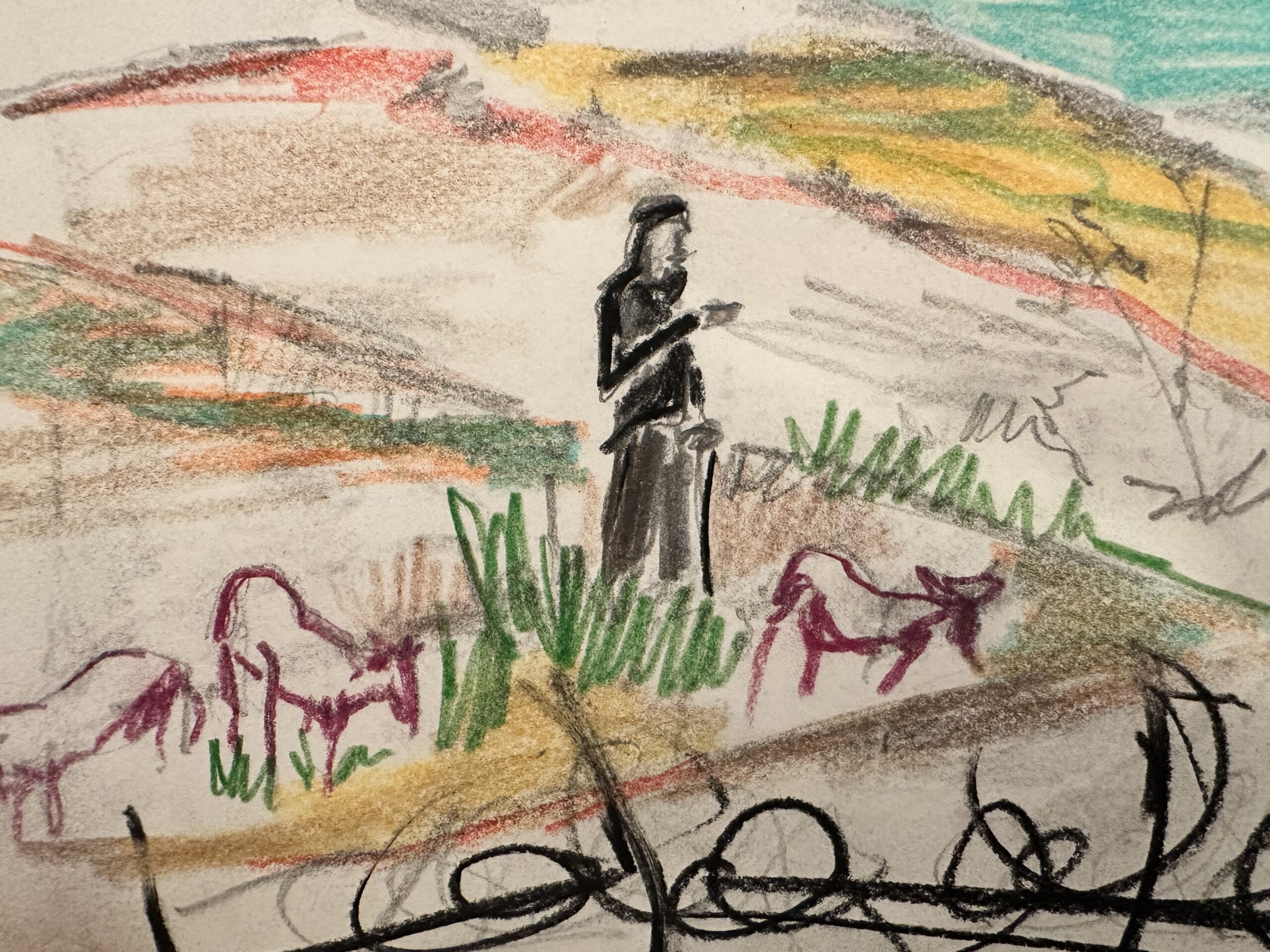
Settler grazes herd just outside the fence of a family’s home
This past Sunday we drove into the Palestinian village of Taybeh, the last majority Christian village in the West Bank, two cars full of us, in the late morning. We relieved the activists who had just finished their night shift. I was in a car with two Germans, a journalist and a photographer, who were at work on a profile of Arik Ascherman, one of the founders of the Protective Presence movement. Arik, who had recently had his driver’s license revoked by the Israeli police department, with which he has been locked in a decades long battle, had gone in ahead of us in a car driven by another activist volunteer. When we arrived we all trooped out of our respective cars and were greeted by a man I knew slightly, a Brit named Paul who has been living in his car in the West Bank these past weeks in order to maximize his usefulness in the field by being available at all hours should the settlers arrive unexpectedly, as we can expect they will.
Herding flocks through Palestinian grounds and homes is a settler terrorists’ bread and butter. It is the most basic low-effort pastime guaranteed to trap Palestinians inside their homes, shaking with fear for their family’s safety and worrying for their fields and groves which the settlers’ goats rapaciously devour. We can never be sure when the terrorists will descend with the intention to attack – this happens sporadically and without warning — but every single day, and several times a day, settler terrorists will engage in a standard set of low-effort harassments. They, in their sweatshirts and prayershawls, swinging long sticks and loping through lands that don’t belong to them, intend to make daily life for Palestinians living on the outskirts of villages unlivable, so that they leave. Just today a settler proudly posted a video of himself affixing a mezuzah to the home of a Palestinian family he had just assisted in ethnically cleansing.
It is still true that having activists on site beside Palestinian victims tempers the settler’s sense of entitlement. Even though they are a good deal more brazen than even the last time I was here to do this work, just a year ago, they are still less emboldened if we are there. They will not attack, or not as violently, if they can see us. And much stronger than our capacity to dampen their bloodlust is our capacity to fortify the Palestinians who beg us to stand by. I do not know whether the comfort we afford is warranted, but it is certainly real.
We activists are fascinated by the settlers. They are, overwhelmingly, children. The ones I met on this first day could not have been older than fourteen years old. “Why aren’t you in school? Where is your mother? Where does she think you are? Doesn’t she want more for her child than this?” I had occasion to ask them all these questions a few hours after our arrival. When we got out of the car Paul told us that the flock that had just passed through was by now out of sight. We leaned over the wall that lined the edge of this small plateau where we were standing and craned our necks looking for the flock. This is the activists’ bread and butter: keeping a lookout for flocks, guessing at the home toward which they are being led, to which home we must hasten. We were standing at the top of a small hill and below in the valley Arik pointed out a Palestinian compound below us in the valley, in which, he said, only women and children were living. If the settlers moved their herd there we would have to brave the steep climb down the rocks in order to stand near the family and alleviate their fears.
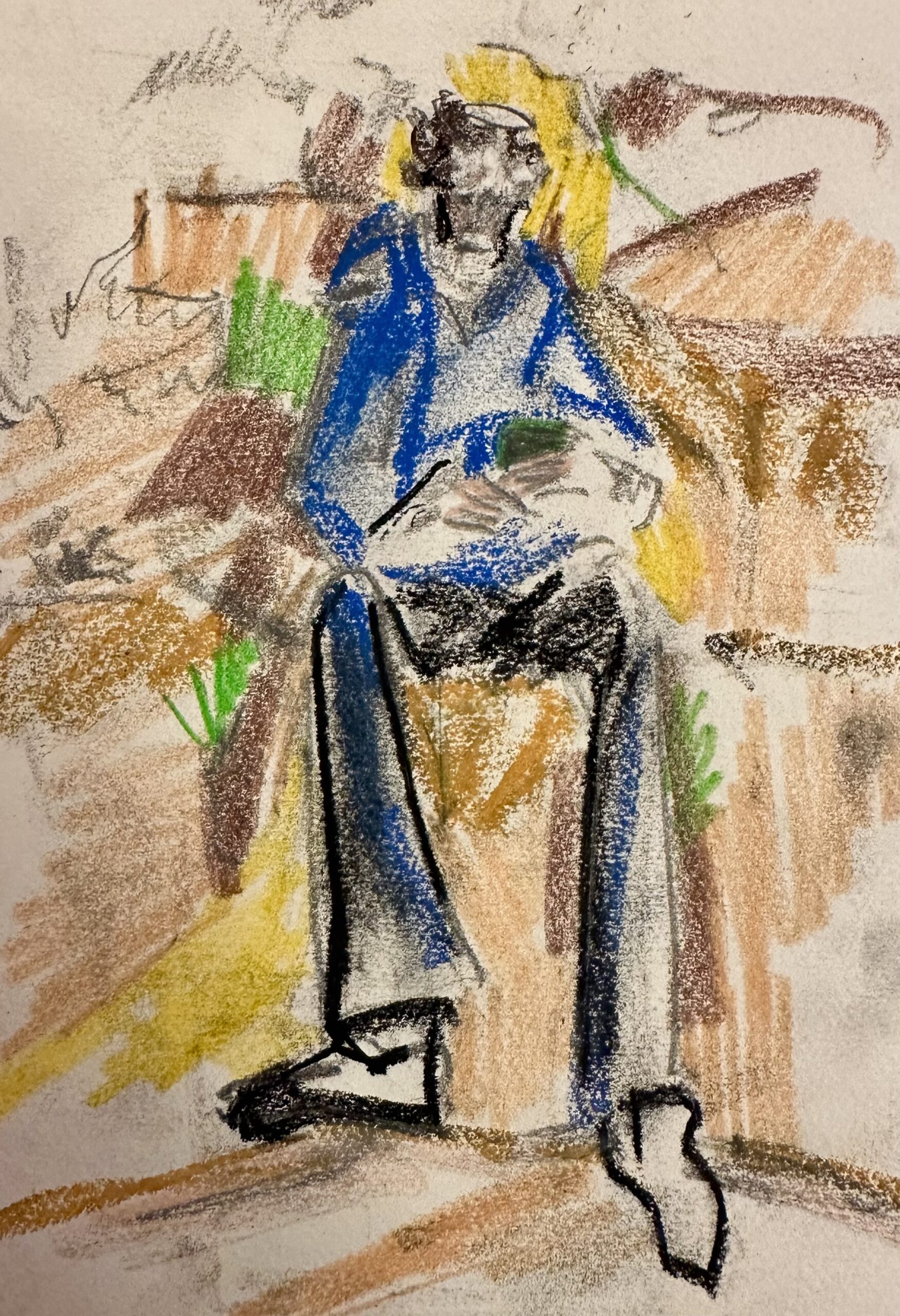 Rabbi Arik Ascherman coordinates with other activists from a rock in Taybeh
Much of Arik’s job, as our field manager and our leader, is to determine which Palestinians are in most risk and so most in need of our protection. There are never enough activists to circulate in all of the places in which our presence could offer some relief. Arik has to decide who goes where and who is left alone. On this particular morning, there were two herds roaming in the valley over which we stood. Paul and two other activists stayed at the top of the hill in case the settler came back, but we had spotted a new herd, accompanied by two settlers, in the valley below, and Arik determined that we’d better move a bit closer just in case this pair began encroaching on the family compound.
“Okay. We have to move down into the valley. Whoever is afraid of a violent interaction should stay put,” Arik said before navigating the jagged, steep rocks tessellating to the valley floor. The Germans and I followed close behind him. The family compound is encircled by a metal gate which had been installed to keep the settlers from breaking in. It is astonishing what a difference this gate and others of its kind have made. True, the family lives in a sort of prison, but the prison keeps enemies out as well as the innocents inside.
The settlers were inching closer and Arik called out to the eldest son of the family in Arabic asking if he wanted us to make a break for the gate so he could unlock it and let us inside. This risked settler intrusion but offered greater security if we made it through. The teenage Palestinian assented to the scheme, jiggled the key in the lock and we ran down the rest of the slope into the compound before he slammed the gate shut on our backs.
The settlers moved closer and closer. A chilly rain restored us all to the elemental mercy of nature and we scurried beneath the overhang of the Palestinian home. The settlers had no such respite. Resourceful, they climbed a few feet up to the shack in which the Palestinians typically bake their bread. What were they up to in there? “Fire,” Arik muttered, and he was right. The pair was collecting tinder and flickering a lighter on and off. “If they start a fire in that shack I have to go up.” We all agreed to follow him. At first we stood just outside the shack but when it was clear that they had kindled a small flame on the floor we moved closer and then inside. The settlers were both young. One was feisty, the other solemn. The feisty one pushed and shoved us, pushed his chest up against me and said “I’m not your boyfriend! Stop touching me!” Arik instructed over and over again, “Record everything, all of you! Get every interaction from all angles!” The idea was to film enough to make it clear that we had not provoked any attack and that we had been wholly passive every time he pushed us. “We’re recording everything! We will show it to the police!” Arik told them and they laughed. They know as well as we do that the police would never punish them.
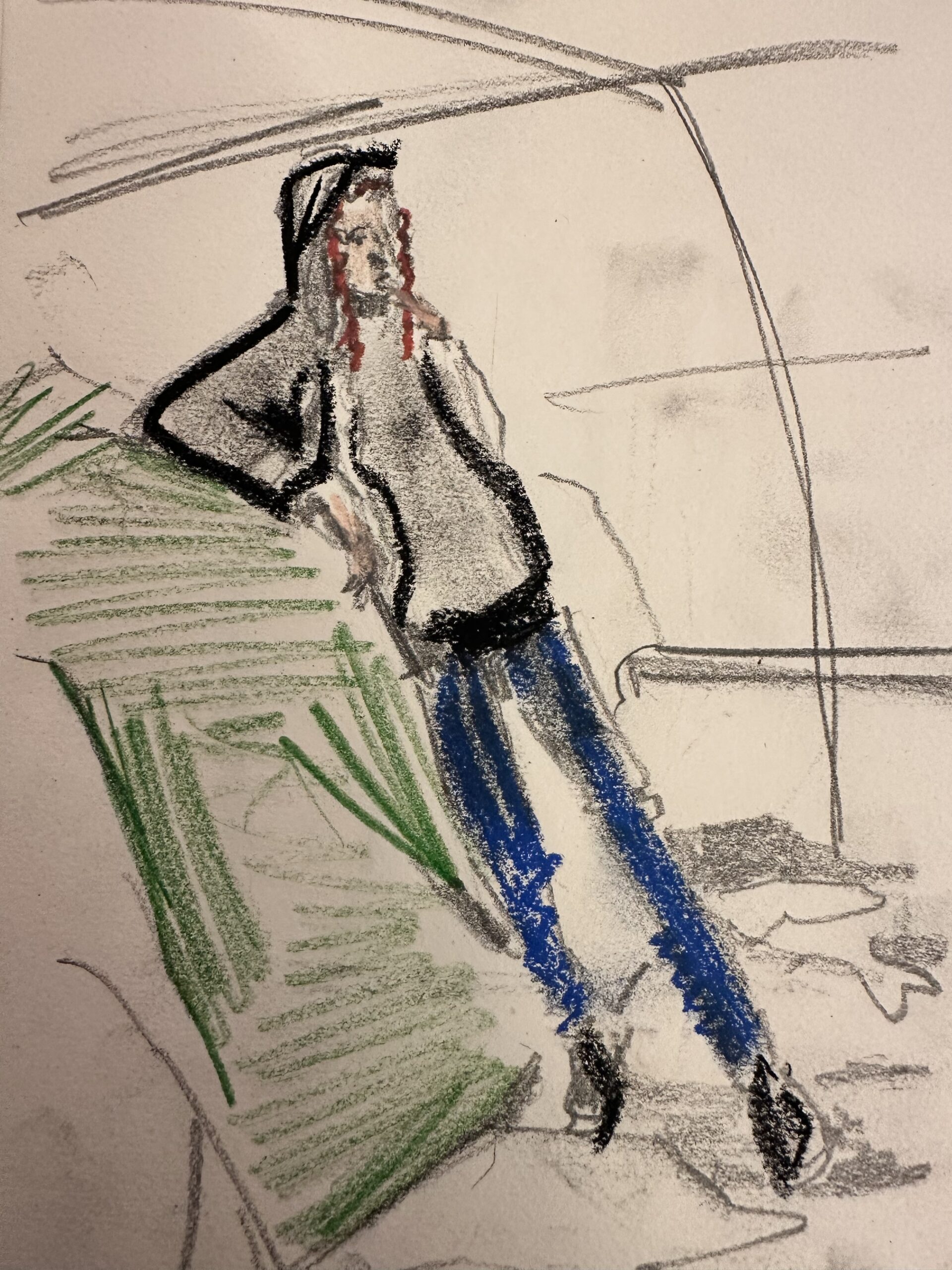
Settler licks his fingers after lunch in a Palestinian building
This ominous dance went on for hours. Finally, the herd got restless and moved on, and the settlers followed their flock. And not a moment too soon – we were needed in two other places.
As I was writing this dispatch from the safety of Tel Aviv, the settler terrorists posted an accounting in their group chat (which some activists have infiltrated):
A monthly summary of the struggle with the Arab enemy in the holy land for the month of Cheshvan:
- The list of villages that were attacked and the number of attacks at each village:
- Yatta (6), Abu Faleh (4), Turmusaya (4), Burqa Ramallah (4), Beta (3), Beit Umar (2), Deir Jarir (2), Mukhmous, Samua, Rujib, Kisan, Barham, Luban a-Sharqiya, Sa’ir, Al Mu’ayr, Ain Ayyub, Sinjil, Ain Safa, Susiya, Jama’in, a-Dik, Majdal Bani Fandal, Beit Fajr, a-Samua, Malik, Duma, Farha
- Number of cars burned: 53
- Number of structures set on fire: 22
- Number of mosques set on fire: 1
- Number of Arabs wounded: 74
- Number of price tags [i.e. revenge killings]: 10
- In addition tens of windshields were smashed, tens of olive trees were cut down, and tens of tires were slashed.
The report concludes with two emojis of burning flames