
How many great women painters have been honored by history? In 1948, the writer Edward James claimed there were just seven female masters: Artemisia Gentileschi, Rosalba Carriera, Elisabeth Vigée le Brun, Angelica Kaufmann, Rosa Bonheur, Mary Cassatt, and Berthe Morisot. It was a relatively new phenomenon to have a successful woman artist, he wrote, thanks in part to the “modern emancipation of women.” His was a reductive list indeed, symptomatic of the fact that women artists have been overshadowed by male counterparts for as long as they have been producing art.
The occasion for James’ belletristic exaggeration was a gallery opening for the Surrealist painter Leonora Carrington at the Pierre Matisse Gallery in March of that year, a woman artist who was finally the subject of a major gallery exhibition. “She has been through the valley of the shadow of death, and she has come out more alive than ever she was before,” James wrote of Carrington in his text. “Disaster and grief and horror only destroy the unresilient . . . her brain, her soul and her talent flowered, sprouted, flourished after the deluge of pain, bewilderment, despair.” He wasn’t purely mythologizing; just a few years prior, during the war, Carrington had been institutionalized following the imprisonment of her lover and sometimes collaborator Max Ernst by the Nazis. The sanitorium was a kind of abyss, her six months spent there flecked by sparks of consciousness between druggings and dreamstates. Much of her work after that period bears the tincture of that somnambulistic state. In the aptly titled Down Below, painted shortly after her release, chimerical forms lay across a grassy knoll, under a blue sky that gives way to green like an aurora borealis. A transparent horse, an animal which figures in many of her works, parades in the background as a bird-woman with long white hair flowing from her feathery head looks on. A medieval castle is in the distance, perhaps representing the sanatorium in which she was imprisoned. This is no reverie, but a nightmarish underworld.
A new retrospective at the Musée Luxembourg in Paris, Leonora Carrington, aims to chronicle her early life and Surrealist leanings. As Surrealism reached its centenary in 2024, there’s been a renewed interest both in the movement and its participants. This, mixed with an indefatiguable desire to right the wrongs of history by spotlighting women artists, is why Carrington is enjoying a posthumous renaissance. Last year, NYRB Classics published Carrington’s novella The Stone Door, having previously published The Hearing Trumpet, and the Met Museum included Carrington’s work in their blockbuster exhibition Surrealism Beyond Borders.
But Carrington wasn’t one of the founding fathers of the movement. In fact, Carrington came to Surrealism late. Born in 1917, the artist was just seven years old when André Breton published the Surrealist Manifesto, and she wouldn’t officially join the group until the mid-1930s, when the movement was more than a decade old. But she was predestined to work in the vernacular of fantasy. Her childhood home in Crookhey Hall, a Gothic Revival manor in Lancaster is the stuff of fairytales, with pointed arches, secret doors, and a glasshouse covered in creeping vines. It was the perfect setting to stimulate her imagination, and it was there she began experimenting with drawing and painting. Great expectations weren’t foisted upon her by her parents, who reserved that focus for their male children, and as such, Carrington was able to continue to cultivate her creativity independently — largely unnoticed, save for a nun at her convent school who upbraided her for wearing mismatched shoes: “Leonora Carrington,” the nun loudly announced. “Desperate to be different.”

It didn’t take Carrington long to find her tribe. In fact, they came to her: in the summer of 1936, André Breton, Paul Éluard, Georges Hugnet, and Man Ray set up an international exhibition of Surrealism in London, banding together with British, European, and Scandinavian committees to select the works. The art historian Herbert Reade wrote a corresponding catalogue which Carrington’s mother gifted her spontaneously. Flipping through it, she landed on an image: Max Ernst’s Two Children Are Threatened by a Nightingale.
In the picture, a bird swoops down through the gradient blue sky, as a woman or girl runs towards the viewer, her hair streaming in waves behind her. A faceless man has grabbed a small child, who rests in his arms as he runs across the roof of a shed. Every human figure is grey and indistinct, but their fear, even through the facelessness, is palpable. The mixed-media piece’s miniature wooden gate and shed lift off of the canvas in its physical form, but even flattened into an image in a book, Carrington immediately felt a sense of familiarity: “A kind of world which would move between worlds,” as she later described the painting’s representation to her. “The world of our dreaming and imagination.” She fell irrevocably in love with Ernst as she held the book in her hands.
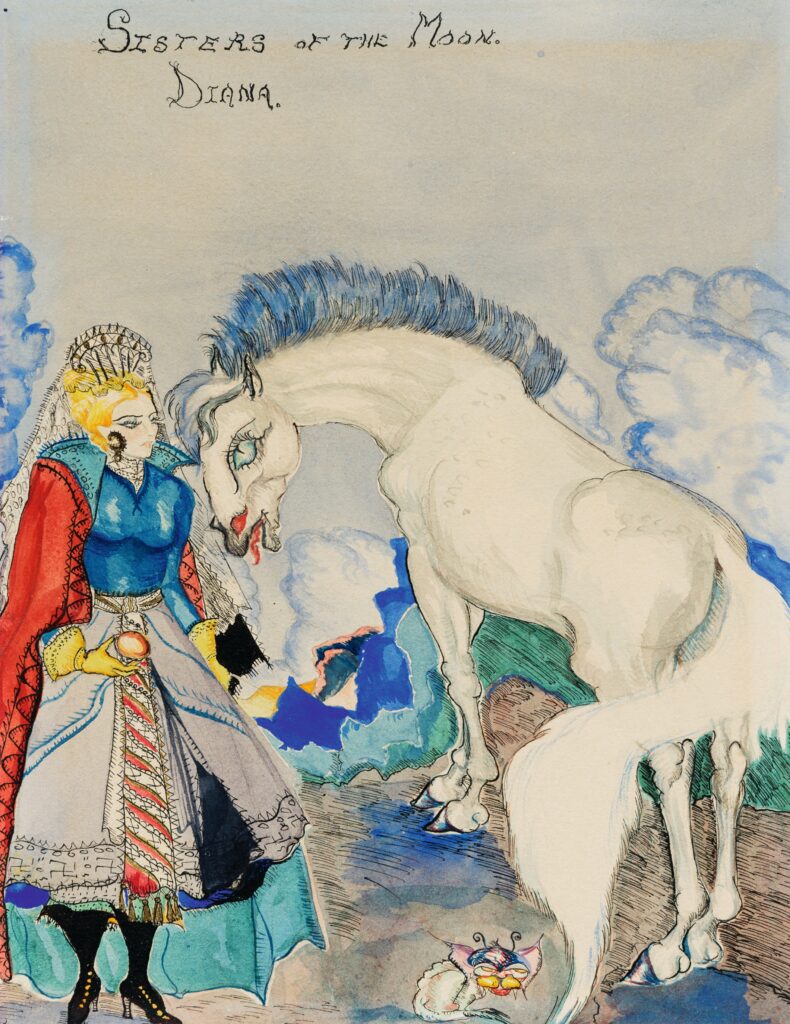
Sisters of the Moon
At that point, Carrington had recently begun homing in on her distinctive style, evident in Sisters of the Moon, a series of watercolors drenched in pure blue that she made between 1932–1933. Like the arcana of tarot, each shows a unique figure, individually named. They look like sorceresses with powers of divination, surrounded by fantastical figures or environments. In one, Juliette, little fairies with spider-web wings fly around a woman with a shock of orange hair who smiles knowingly as if she is commanding them. Her dress is unlike anything from the fashions of the time, a bolt of royal blue around her torso, with wisps of gauzy blue fabric comprising the train floating around her legs. Other pictures in the series depict blue-haired horses, a woman wearing a blue-plumed hat, or a blue dragon head, mid-snarl, hanging from a ceiling. Tonally and stylistically, these pictures represent a style from which she would deviate, but thematically, Sisters of the Moon prefigures her later work, particularly in the coexistence of animals (real or fantastical) and humans as well as the almost-mythical power of women.
Despite having already produced a self contained series of paintings, Carrington had no formal training. Ernst’s work provoked her to pursue art studies. She convinced her parents to enroll her in an art school where she was taught by the Cubist painter Amédée Ozenfant. In that classroom Carrington and her peers were instructed to draw an apple over and over for six months straight until the fruit began to morph and its form broke down into an abstraction.
A year passed between the fateful day Carrington encountered Ernst’s work in the book her mother gave her, and the day they met in person, a year in which her enamour fully crystallized. It didn’t matter that he had a wife; it didn’t matter that Carrington was 19 and he 46. She was his “bride of the wind,” as he began lovingly referring to her, and through him, Carrington sublimated into the world of the Surrealists. She left her native England for France and moved into Ernst’s small flat on Rue Jacob in Paris’ 6th arrondissement two blocks from the heart of artistic and intellectual courts, the dueling Café de Flore and Les Deux Magots.
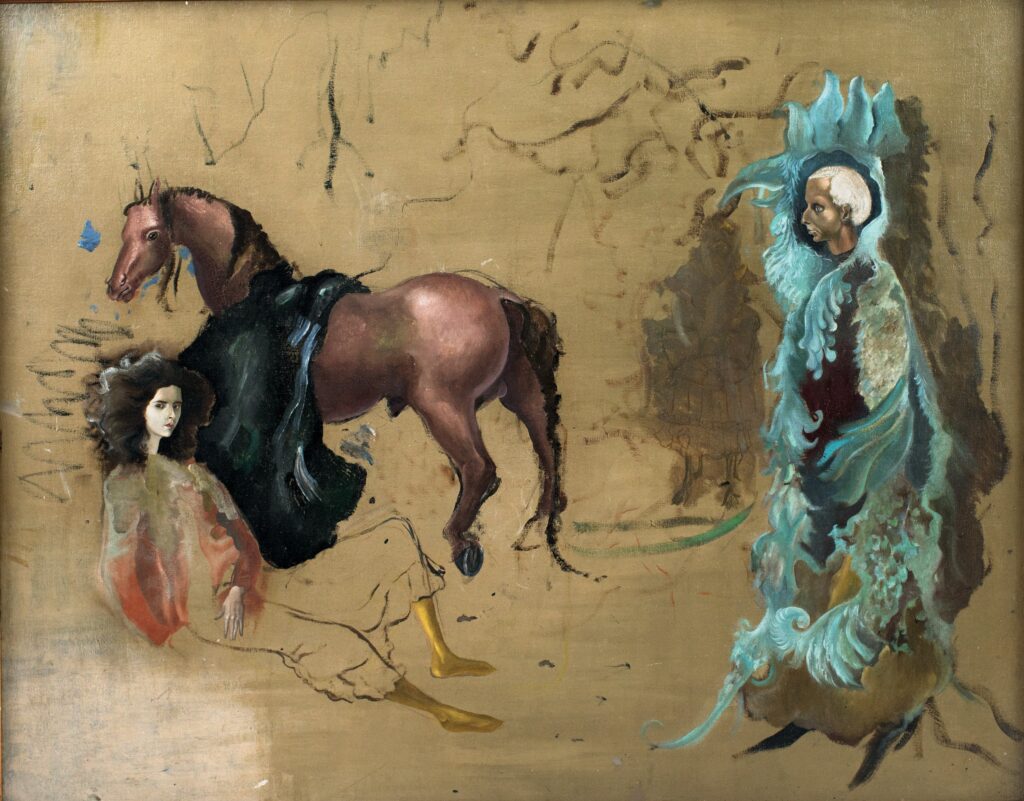
Double Self Portrait (Portrait with Max Ernst)
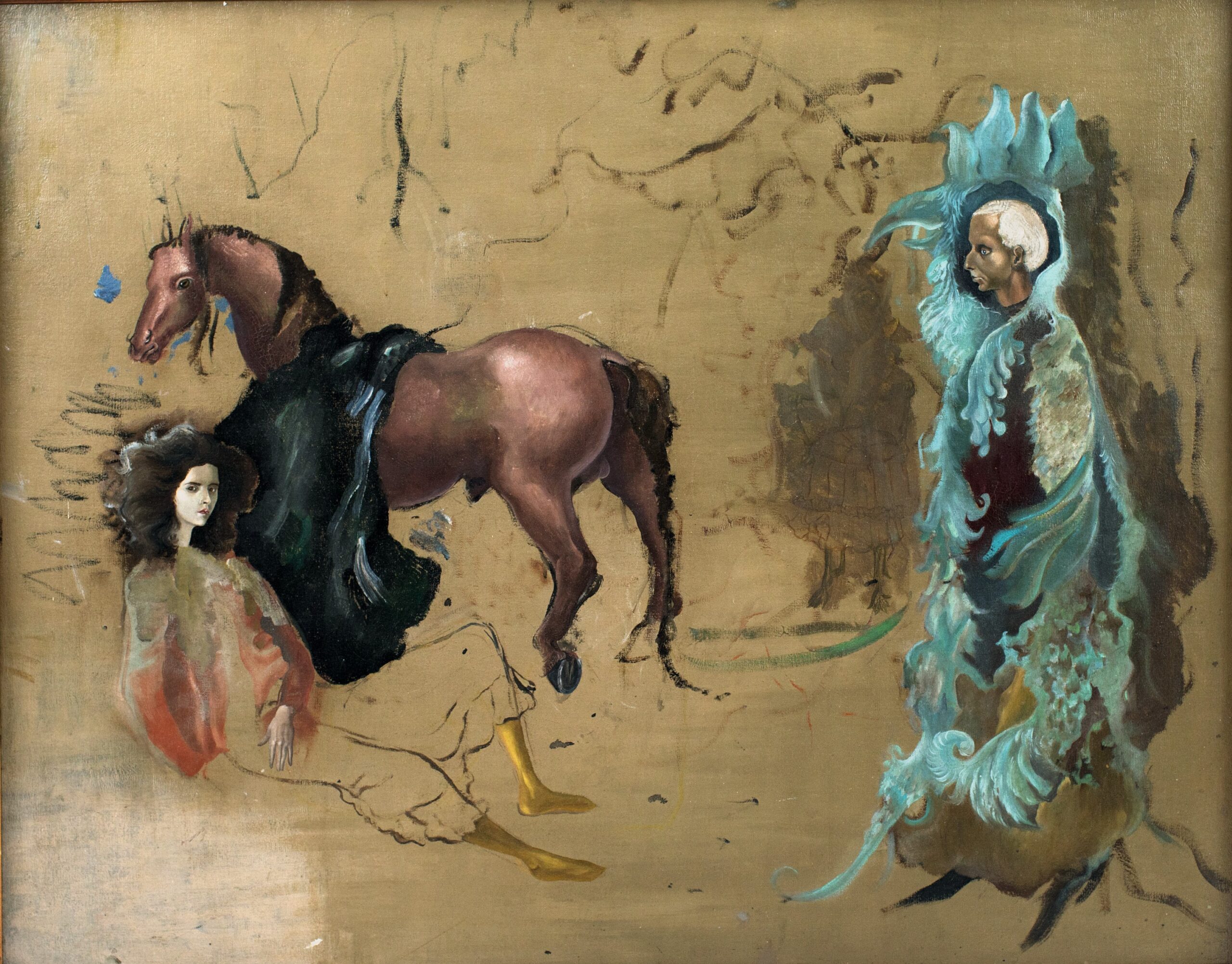
With Ernst as a muse, Carrington begins to develop her own style which is rendered forcefully in a portrait of the couple, her Double Portrait completed in 1938. The canvas is a beige tableau that at first glance looks like an unfinished study. Carrington and Ernst are at opposite sides: she is looking at the viewer, he is looking at her. His head and body are encased in a bird-like costume, with ice-blue plumes tumbling down his sides. She lies on the ground, flanked by a horse who takes a protective stance. Here is Carrington in chrysalis; around the corner, she fully emerges.
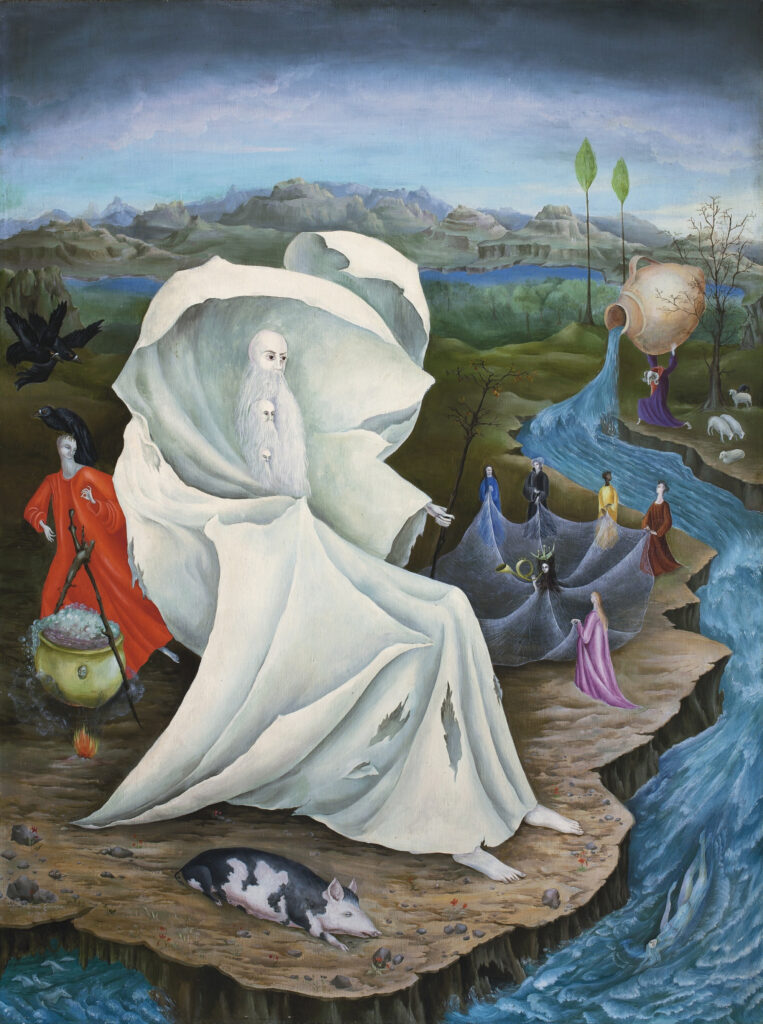
The Temptation of Saint Anthony
The centerpiece of the Luxembourg exhibition was also the centerpiece of the Matisse gallery show: The Temptation of Saint Anthony, painted in 1945. Saint Anthony is cloaked in a white fabric which billows up and around him forming the protective shape of an egg shell. He is surrounded by demons in the forms of small women and men, one ritualistically heating a cauldron while a woman in a spider-web dress plays a trumpet. The ground on which he is situated is cut jaggedly and is surrounded by a rush of water in which another eldritch figure blends into the waves. This canvas is her most Boschian, and although scholars often compare it to that Flemish master’s own iteration of Saint Anthony, her Temptation evokes the latter’s Garden of Earthy Delights more than any other of his works. Despite the scene’s fantastical nature it is a depiction of a natural world, with rolling hills, trees, and blue skies, the same greens and blues that Bosch uses in his imaginary garden.
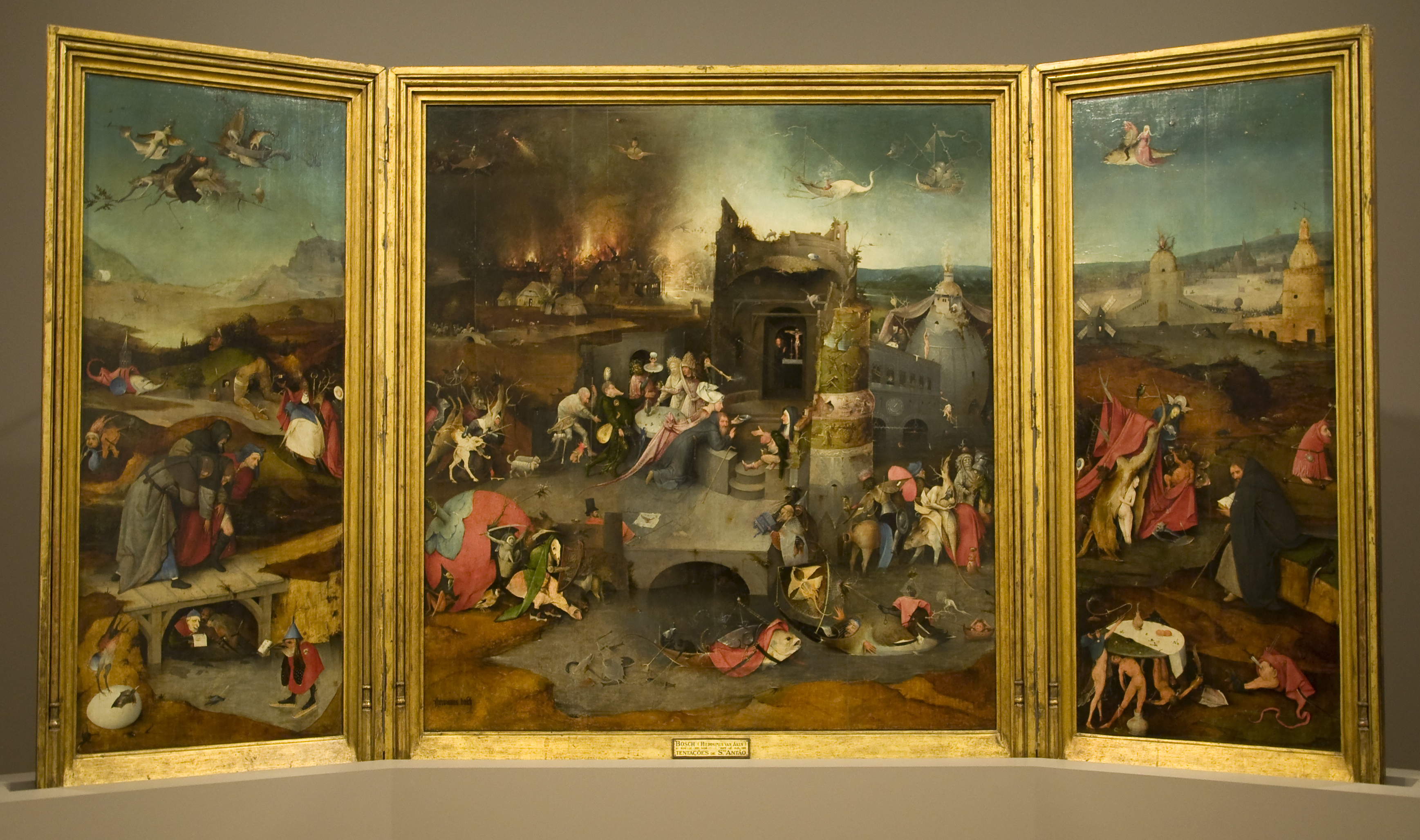
It’s a unique work in her oeuvre, and one that was prompted by an unusual assignment: an art competition in which eleven painters (including Max Ernst and Salvador Dali) submitted their versions of the scene for a chance to be featured in Albert Lewin’s movie The Private Affairs of Bel Ami, which was released in 1947 with a glittery cast starring George Sanders, Angela Lansbury, and Ann Dvorak. The winning painting would be shown in a flash of technicolor during the otherwise black-and-white film. For Carrington, who had long been inspired by the Renaissance artists, having spent hours upon hours at the Uffizi as a teenager, here was her chance to explore scenes painted by the masters. Ernst won the competition, but his cartoonish depiction lacks the verisimilitude of the world that Carrington painted around the saint, which was similar to the landscape painted by Michelangelo in his own Temptation.
And what of Ernst? His imprisonment in jail, and hers in the sanatorium, cleaved the relationship swiftly. Though they briefly reunited in Lisbon in 1941 following both of their releases, each had a singular focus: to get out of Europe, he with the help of the art collector Peggy Guggenheim, she with the help of Mexican poet Renato Leduc. Love was a luxury neither of them could afford. Guggenheim, witnessing the dynamic between the two, snidely referred to them as looking “like Nell and her grandfather in The Old Curiosity Shop.”
After a few brief stints in New York, including that Matisse gallery show, Carrington settled in Mexico. “Houses are really bodies,” she wrote in The Hearing Trumpet, a novel she published in the 1970s. “We connect ourselves with walls, roofs, and objects just as we hang on to our livers, skeletons, flesh and blood stream.” Mexico was more than a place of momentary refuge for her: there she found new inspirations, and a true sense of home. New shades began to suffuse her palette. Orplied is an astonishing work of burnt umber, fiery oranges and reds, and white heightening that creates an almost iridescent quality. Much like the Eduard Mörike poem the title references, the tableau shows an Avalon-like land ensconced in red light. The painting glows.
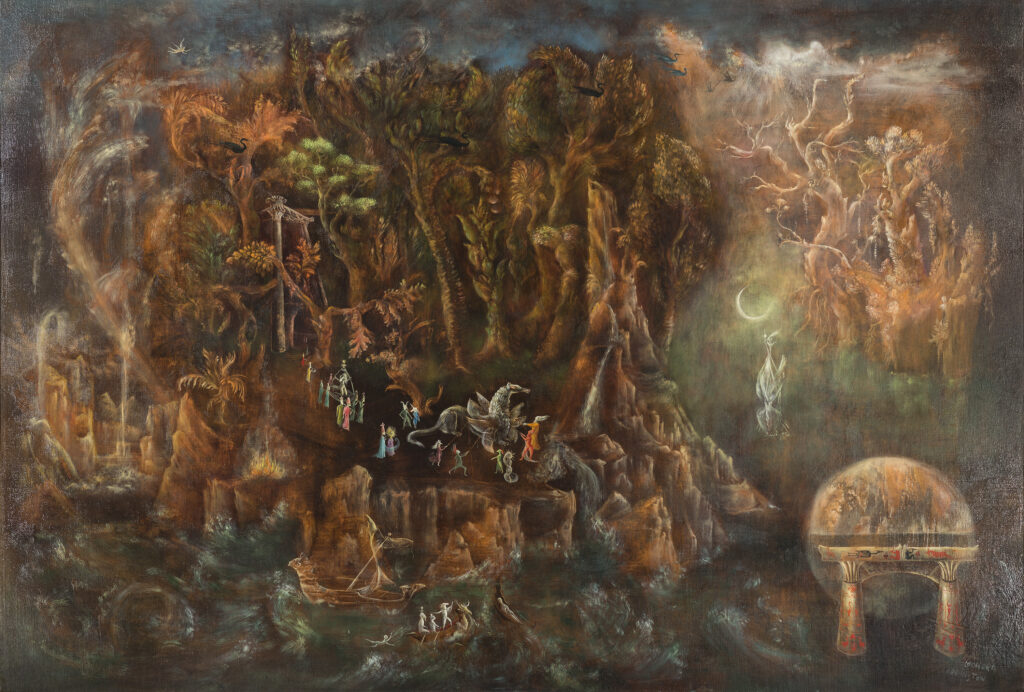
Orplied
Carrington’s style is wholly her own. Though her paintings possess that dreamlike quality of the Surrealists, their Freudian obsessions, her work is grounded in a different plane. Unlike the slippery worlds of Dalí, where clocks melt and faces slide, or the pure desolation of Yves Tanguy’s landscapes, Carrington’s world is anchored in her visions. As described by her son, she “adorned everything with her imagination, allowing the fantastical to triumph over reality.” Numerous comparisons have also been made to Dorothea Tanning, whom Ernst later married, but like Dalí, Tanning’s figures and landscapes are constantly undulating. Carrington’s pictures are fixed in time: they are a memory, not a dream.
In the latter half of her life, Carrington experimented with writing. André Breton prodded her to recount her experiences in the asylum, which led to an essay in his publication VVV in 1944. The diaristic account was later republished in book form in 1987. It is brutal. Carrington describes waking up unsure if she is in a hospital or concentration camp. Her hands and feet are bound; she is repeatedly injected with drugs that conjure convulsions. She fades in and out. Details scatter. “I am afraid I am going to drift into fiction,” she writes, “truthful but incomplete, for lack of some details which I cannot conjure up today and which might have enlightened us.”
Carrington published two novels, The Hearing Trumpet and The Stone Door almost back-to-back in 1976 and 1977. Both books are imbued with the autobiographical: “The light of a vision or a dream is united to any given luminous body outside,” she writes in The Stone Door. “No longer alone in my own body. Thoughts and dreams but not a particle of dust to prove their reality. Meanwhile I am wasting each day living in captivity.” But, of course, the books cannot convey the alchemical impact of standing in front of her paintings, the tactile quality of each painting, and that feeling of her touch along the canvas.
Though she received recognition by her peers, she struggled financially. She made some sales — Peggy Guggenheim purchased one of her works, as did Helena Rubenstein — but even when she managed to sell them her paintings only earned her a few hundred dollars a piece (a few thousand in today’s dollars) whereas her peers were making tenfold that amount. After what must have felt like an eternity living in Ernst’s shadow, slowly, towards the end of her life, the museum world began to embrace her. In 2008, the Dallas Museum of Art hosted an exhibition titled Leonora Carrington: What She Might Be. In an interview for the corresponding exhibition catalogue, Carrington mulled on the title of “Surrealist” that has been sempiternally attached to her. “Although I liked the ideas of the Surrealists, André Breton and the men of the group were very machistas. They only wanted us to entertain them as muses, mad or sensuous. Besides,” she added, “My clock did not stop at that moment.”
Her artistic sensibilities were manifold and evolved throughout her life. As she aged, Carrington traded the cerebral for the mystical. In a 2002 painting, Q Symphony, a group of spirits play harps, trumpets, and piano illuminated by the constellations of stars surrounding them in the inky blue-black sky. Death was on the mind. In the same interview, she described being in “the process of learning to die.”
Now, fifteen years after her passing in May 2011, it seems she is finally receiving the artistic accords and triumphs her peers enjoyed in life: museum retrospectives and record sales at auctions. Thankfully, the Luxembourg museum has not fallen prey to that tempting trope of marketing, the undiscovered artist, or the woman artist. She has not, thank goodness, been branded as the lover of Max Ernst, or assigned the title “Surrealist.” Instead, on the metro station advertisements, catalogues, and museum walls, there is just her name: Leonora Carrington.