
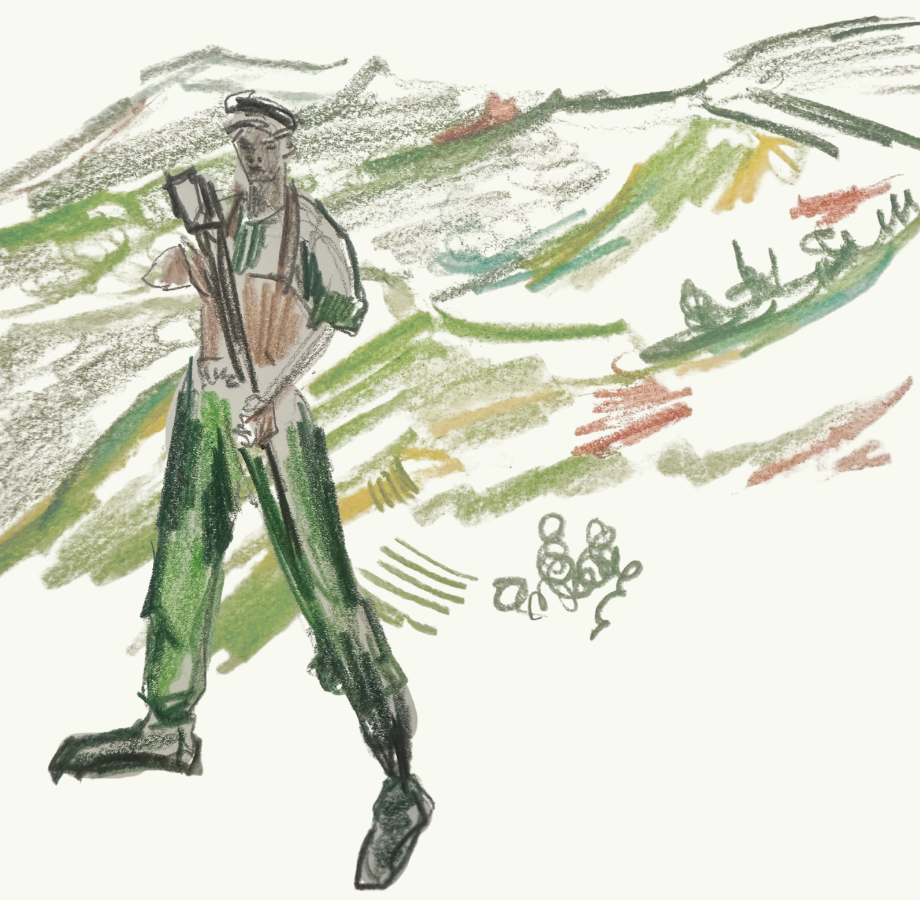
The dogs barked as I approached the safehouse, but Kite soon called them off and welcomed me into the small space he shared with other members of the resistance. As he did so, I noticed his prosthetic leg. There was some chatter as I got in; a handful of people lived there. A lanky man handed me a cup of instant coffee, and Kite invited me to sit in the living room while the others retreated to the kitchen. He told me to call him by his alias — “like the bird” — as this was the name he adopted upon joining Myanmar’s revolutionary forces. In his early 30s, he was a circuit engineer before becoming a fighter.
The fading building was bare and dimly lit. There were a few tired sofas and a long table against the wall with computers and other hardware I couldn’t identify. Kite explained that he now contributed to the revolution by providing logistical support; something about ensuring the money reached those who needed it. He spoke in short, crisp sentences. There was something rigid about his speech, about his demeanor. You could see the soldier in him.
Kite joined the resistance in the aftermath of the military coup that overthrew Myanmar’s democratically elected government and ignited a civil war. How did he feel upon hearing the army had taken over? “I suddenly… I suddenly suffered,” he said, struggling to find the words. It wasn’t fully unexpected, he added. The tensions between the army and the civilians in government were widely known. Still, it came as a shock. Protests erupted across the country. Demonstrations were initially peaceful, but the time for nonviolent resistance passed once the army started shooting down protesters. For Kite it was a no-brainer: he wanted to fight. The next steps were straightforward. “We had to connect with the EAOs, the ethnic armed organizations,” he said. There are about twenty-five well-established EAOs in Myanmar, and hundreds of smaller entities; the country is a patchwork of alliances and rivalries. While certain groups back the junta, most of the major EAOs control their own territories, run their own governments, and, most importantly, command powerful armies that have been battle-tested against the military. Some agreed to train civilians.
In April 2021, Kite traveled to northern Myanmar for basic military training with the Kachin Independence Army. Becoming an insurgent combatant was a brutal process. “The experience was very awful,” he recounted, wiping sweat pearling on his temples. Over the course of two and a half months, he was initiated into the rigors of military life and taught to handle weapons such as AK-47s and RPGs. I asked if he was afraid. “Yes yes yes,” he murmured swiftly without looking at me. He made a point of adding that he never questioned his commitment to the cause. “Every comrade wants to sacrifice their life defeating the dictatorship,” he said. He pronounced these words like a mantra.
His fellow recruits came from across the country and had different profiles. “Some are in engineering, some are medical students, some are artists, poets. So many artists, some actors and singers,” he told me. I could sense that he was impressed by the fact that celebrities too had joined the fight. Being in the trenches alongside Myanmar’s equivalent of Zendaya must have felt peculiar.
Educated civilians were an asset for armed groups. Engineers could produce firearms and drones, and volunteers with a medical background were mobilized to staff jungle hospitals. Kite’s leg was amputated in one of them. He told me that he was injured on a scouting mission. “I stepped on a landmine on my way to the enemy camp. Suddenly I call out I’ve been hit, I’ve been hit, I’ve been hit. I make a call with the walkie-talkie to my superiors: Sir, my name is comrade Kite, I’ve been hit.” They told him to stay low because they were under fire.
“After fifteen minutes, the medic team arrived and gave me medicine. Morphine and blood clotting medicine. After that they carried me to the jungle hospital.” It’s there, in a facility hardly more sophisticated than a tool shed, that they cut off his leg. Shortly after, he was smuggled into Thailand so that he could obtain adequate medical treatment. “Sometimes I dream about the tragedy that happened,” he told me. “When I step on the landmine, there’s a high pitch tone that always happens in my ears.”

For most of its history, Myanmar was a ruthless military dictatorship. War was waged against ethnic groups, and citizens protesting for democracy risked being imprisoned or murdered. Things changed after 2008, when the junta enacted a new constitution establishing a semi-democracy. The government would be predominantly run by civilians, but the military would keep key ministries and a presence in parliament. It was an astute way to liberalize the country without relinquishing all control; to bring about the change Myanmar craved without risking a Reign of Terror.
The first cohort of civilian leaders was hand-picked by the army. Democracy wouldn’t be rushed. The chosen few were former generals, but against all odds they took their mandate seriously: peace deals were made with certain rebel groups and foreign investment started flowing in. Myanmar was on an upward trajectory. In 2015, the former generals were voted out in favor of Aung San Suu Kyi’s NLD, the National League for Democracy. Following the NLD’s victory, the army escalated its military operations against ethnic minorities, effectively sabotaging the peace process that Aung San Suu Kyi had identified as her priority. It’s also during that period that the Rohingya crisis worsened. Aung San Suu Kyi’s handling of the issue made her complicit in the eyes of the world and shattered her international standing, but it did not undermine her popularity across Myanmar. When the NLD was re-elected by a landslide in 2020, the military decided it had had enough. In February 2021, it staged a coup and arrested Aung San Suu Kyi and others. Myanmar’s people mounted a resistance, and the Spring Revolution was born.
The country has been at war since. Clashes keep multiplying, millions have been displaced by the conflict, and countless villages have been incinerated. The military tortures, rapes, and kills. I met Myanmar’s resistants in Thailand as the uprising was still young; many of them operated from across the Thai-Myanmar border as it afforded them more latitude. Years later, the revolution has stalled. Victory has thus far remained a mirage, too vivid to dispel but too distant to reach. I can’t say that I’m surprised, there were signs. A blend of mistrust, generational divides, and ethnic tensions rendered cohabitation within the resistance uneasy. Despite having a common enemy, from the start every faction led a different struggle. Every person spoke of a different revolution.
Torrential rain poured over Mae Sot, a city near the border, as I ran through its narrow streets toward the upscale café where I was due to meet Ko and Stan, two students in their early 20s. They belonged to Gen Z, and by all accounts this was their uprising. That generation had brought a start-up mentality to the struggle; whatever the challenge, their posture was let’s get it done. They were also digital natives, which expanded the domain of resistance.
The coffee shop was uncluttered. Everything inside was either white or ultramarine. Anodyne covers of Disney-movie songs looped in the background, clashing with the peculiar aesthetics of the place. Ko and Stan arrived thirty minutes late, greeting me as if we were old friends. Unlike me they had waited for the rain to pass. They looked quite young — especially Stan, who had braces. They both belonged to minority groups; Ko was Muslim and Stan was born in Shan State. They were joking around, having fun. The seriousness of their work was not lost on them, but still they were in some ways like ordinary undergrads.
I asked if they had fought with guerilla forces before crossing into Thailand. Ko said he hadn’t, “I’m very fat, it’s not my role for the revolution!” They contributed to the uprising through Burma Academy, a platform that provided courses. It was doing well so far. So well that they had been flagged as undesirable by military supporters. “This guy, he’s posting about anti-military things, like you should arrest him. He exposes people. And our Burma Academy was exposed here!” Stan said excitedly, showing me the posts on his phone. “But they don’t know who we are, they just got Burma Academy!” They were delighted to appear on this sort of most wanted list.
Ko and Stan had been involved in the Spring Revolution since its inception, initiating a student boycott that had swept the country. “I’ll give two, three years of my life just to finish the revolution, I’ll think of the rest later. This is the mindset of almost everyone, every youth in Myanmar,” Stan said. Uneasy at the idea of preventing access to education, albeit for a worthy cause, they launched Burma Academy. “We might not be able to give them a degree, but we can ensure them some quality education that might be useful in life,” explained Stan. They walked me through the classes they offered. When a course about the United Nations appeared on the screen, Ko didn’t miss a beat. “Very shitty organization!” he quipped. They both laughed.
How would the Spring Revolution end? They both rejected a deal with the military, which they repeatedly labeled as fascist. “Several politicians and organizations always shout out dialogue, dialogue, dialogue, but people on the ground, and the students, and the workers, and the farmers. . . . Most people who are pro-democracy don’t want to dialogue with the military,” Ko explained. Stan agreed. “Thousands of people were killed. We can’t just forget it like nothing happened.”
They were adamant about their aspirations. “We want federal democracy, this is why we fight,” said Ko. The revolution had brought a shift in perspectives. Many had realized that the military’s anti-federalism propaganda was just a way to cement the dominance of the main ethnic group, the Bamar. No longer demonized, federalism came to be seen as the way forward to empower minorities. They both had voted for Aung San Suu Kyi, but their allegiance was not to a figure or a party. “The military arrested her and some other leaders, but their role is not important in our revolution,” Ko explained. “Many people will fight because of her, but overall we are not fighting for her. We are fighting for a lot more.”
Myanmar’s recent history is intertwined with that of Aung San Suu Kyi. The story differs from person to person. For some, she was a hero, a member of the same pantheon as Nelson Mandela. She had sacrificed everything for Myanmar and deserved unshakable faith. For others, she was an ardent Bamar ethno-nationalist with blood-soaked hands. Despite promising ethnic communities a new approach, her rise to power had translated into less autonomy and more violence. They felt betrayed. It was clear to me immediately upon meeting one human rights activist, a 37-year-old named Thet Swe Win, that he was in this latter group. Of the many tattoos covering his forearms, one stood out: thick Gothic letters formed the sentence Et tu, Brute?
Thet Swe Win was an idealist, but he operated like an entrepreneur. We met in a tea shop he had opened to employ fellow activists. Stepping inside felt like entering a hive — the place was effectively an informal headquarters. Thet Swe Win kept busy. He spearheaded many revolutionary initiatives, ran safehouses sheltering roughly seventy resistants in exile, and had helped about 150 people cross into Thailand. I asked how he financed it all. They had donations, he explained, but he also contributed himself, adding that his family had a company in Myanmar, a beauty spa. “Like this tea shop. I sold two of my cars to start it up” he said flatly.
He hated being an illegal migrant. “I cross the border and I’m illegal. That’s bullshit. Are we not all the same?” As we spoke about the international community’s reaction, disappointment exuded from him. “They are supporting Ukraine, but why not Burma?” he asked without waiting for a reply. “Are we not the same human beings?” He kept alluding to everyone’s common humanity, as if everything that was happening violated this sacred truth.
“All of my work is about understanding each other,” he said. In practice, this meant providing a counterweight to Bamar nationalism, which is tied to the Bamar’s Buddhist identity. He was Bamar himself, “but I have no religion” he hastened to add. Thet Swe Win was among the first to raise the alarm on the Rohingya crisis. “Even among the activists, no one talked about the Rohingyas. Only a few people dared to talk about it,” he said. This was in 2012. Islamophobic tropes were being spread by the media and the government. “All of the Muslim people will come and take over our land. We’ll lose our land, we have to defend it and kill all the Muslims. That kind of thing. Very nationalistic,” he said, the words leaving a bitter taste in his mouth.
He despised the Bamar-centric NLD. “I have more enemies there than many others, because NLD people also hate me” he said with a chuckle. Unlike many, Thet Swe Win had been overtly critical of them while they were in office. “I also criticized Aung San Suu Kyi for the genocide, for keeping silent and taking sides,” he added. Her status entailed certain responsibilities. “She had the obligation to lead, to change the morality of the people,” he said firmly. “She failed to do it.”
Thet Swe Win initially hesitated to join the revolution. He had boycotted the 2020 election because of the NLD’s treatment of ethnic minorities. “When the military staged the coup I was quite confused. Ok, this is just a fight between the NLD and the military,” he said, summarizing his thoughts at the time. “Like, you know, the evil and the lesser evil fighting. But they both are evil. What should I do?” He joined the struggle shortly after, concluding that the military takeover was “insulting to the people’s will.”
We discussed the National Unity Government, the most visible revolutionary institution. “It has to be the forefront of the revolution, the tip-top of the bullet of the revolution,” he said. As things stood, it had some issues. “It needs to reform. It needs more involvement of the ethnic peoples, especially in the military affairs,” he claimed. “They need to change their position from pretending to be a real government, to being, you know, a more realistic revolutionary government.”
Within the resistance, the National Unity Government is simply the NUG. Formed after the coup, it became the official face of the Spring Revolution. As the military arrested Aung San Suu Kyi and her party’s top brass, politicians that were lower in the pecking order managed to escape. Most of them had been elected under the NLD banner. Even if they were anonymous backbenchers with little experience, they possessed something that the military didn’t have. They had been chosen by the people.
These politicians were brought together by a group of young policymakers, several of whom had studied abroad before returning to a transforming Myanmar. One of them, whom I’ll call Nwe Oo Naing, explained to me that during the NLD years, he and a small band of like-minded friends started to meet regularly to coordinate and develop projects that aligned with their ideals. “We all had an official job. But as leaders of the country, we want to make a difference, right?” Nwe Oo Naing told me. They acted as a little unit around the state apparatus, working evenings and weekends to promote a progressive agenda and build bridges between the government, civil society, and ethnic minorities. Three days after the coup, they met in secret. “What do we do?” was the only question on their minds; they felt compelled to act. If not them, who?
Leveraging their networks, they gathered politicians who had avoided arrest, advised them, and crafted the blueprint of a revolutionary government. Their key move was to connect the politicians to ethnic groups, and to nudge them into building a united front that would break with the country’s history of ethnic strife. The idea was simple. The politicians would commit to decentralization, and the ethnic armies would commit to the Spring Revolution. With such forces on board, the military would be swiftly overthrown. Following the success of the revolution, a new Myanmar would be built, one in which federalism, democracy, and human rights would be more than buzzwords.
Even if the NUG and other revolutionary institutions retained a strong NLD presence, the advisors in the shadows were hopeful that the newly minted ministers would stick to the plan. Things started off well, but within months, the relationship between the ethnic armies and the NUG had deteriorated. The uncomfortable truth is that the initial stages of the revolution were too successful. As victories lined up on the battlefield, politicians with little authority or capacity of their own were propelled to stardom overnight — largely due to the ethnic armies’ military prowess. These politicians were seen, and most importantly saw themselves, as heroes. Several NUG officials also used their newfound status to find refuge abroad, which made them increasingly disconnected from the reality on the ground. Sharing power and credit with EAOs was deprioritized, and the revolutionary leadership rolled back its commitments to decentralization and pluralism. The ethnic groups felt betrayed, and the broad formal coalition against the junta that was initially envisioned never materialized, leaving the resistance in the hands of shifting alliances.
Despite numerous setbacks, the young policymakers kept pushing for their initial vision. The NUG was Myanmar’s only legitimate government, and some in it were doing extraordinary work. They couldn’t afford to abandon it. “If we lose our hope, this revolution will not succeed,” another advisor told me with a strained smile. Attempting change from the inside was nevertheless a difficult predicament. “Mostly we have to seal our mouths,” she said. “We swallow, swallow, swallow, swallow.”
Myanmar’s ethnic armed organizations are not a monolith. Some run exemplary democracies through a robust state apparatus. Others are closer to cartels which dedicate their time and effort to the drug trade and to enforcing authoritarian policies. EAOs also differ in strength. The smallest are ragtag forces, whereas the larger ones have professionalized armies comprising tens of thousands of fighters — approximately the size of the Dutch or Swedish army. Despite their differences, however, they share a common denominator: a mistrust of the Bamar.
Different people insisted that I speak to Khuensai Jaiyen, an ethnic Shan in his 70s involved in peace negotiations; only then would I understand the dynamic between the EAOs and the broader revolution. Khuensai Jaiyen, who was a rebel fighter for nearly three decades, assumed the role of elder-statesman for the political wing of the Shan State Army – South. An online search reveals that, up until the mid-’90s, he worked for Khun Sa, a Shan nationalist, warlord, and drug trafficker nicknamed the Opium King and the Prince of Death. Not a choirboy, then.
I met him at his office in Chiang Mai. An aide led me through a long corridor to a pale conference room and instructed me to wait. Khuensai Jaiyen arrived minutes later. He was well groomed; his combed silver hair and large glasses gave him a grandfatherly look. A short-sleeved shirt exposed small, elegant tattoos on his arms, and I discerned hints of a larger one on his chest through his collar. He spoke in a gentle voice, often taking long pauses halfway through a sentence and making eye contact as if to ensure that he had the full attention of his audience.
“It’s normal to blame other people for what’s happening to you of course,” he told me after I asked about the relationship between the Shan and the Bamar. “But we are to blame ourselves too for trusting people too much. That’s our problem.” For him, any dealings with the Bamar happened against a backdrop of oppression. Yet, Myanmar’s many peoples had to find a way to live together. “If we cannot do that now, it will never happen in the future,” he explained. He viewed this crisis as a historical opportunity.
Several EAOs remained on the fence. They didn’t have an alliance with the NUG or the military. The leader of the junta, Min Aung Hlaing, had tried to win them over by promising multiparty democracy and federalism. “I’m sure he means that,” Khuensai Jaiyen told me. He lingered for a moment. “In his own fashion,” he added with a mischievous laugh. “There is a Chinese proverb,” he said. “Make happy those who are near, and those who are far will come.” Both the NUG and the junta had close relationships with a few ethnic armies; how these partners were treated would likely dictate the approach of those still weighing their options.
“I would like them to win,” he said of the NUG. “I would like to help them to win. However, if you really want to win, you will need to know how to win.” During our conversation, Khuensai Jaiyen often conjured historical figures. He typically shared what he found inspiring about them before linking it to Myanmar’s situation. After telling me about Mao, Nehru, Gandhi, and Shimon Peres, he mentioned a name that clashed with the rest. “It’s like the example given by Dale Carnegie,” he said. Really? I thought. The How to Win Friends and Influence People guy? I listened closely. “He said: I like strawberries very much. But when I went fishing, I found out that somehow the fish don’t like strawberries, so I have to use earthworms.” He took a long pause, looked at me straight in the eyes, and grinned. “The NUG needs to do the same. To feed earthworms to us.”
It seemed to be received wisdom that the NUG’s problems would dissipate if it established distance from the NLD. Yet, Aung San Suu Kyi’s party remained popular and held a long track record of fighting for democracy; there was no realistic path forward that excluded it.
Kyaw Wunna was a thin, energetic man working for the NLD. There was an intensity about him, one I had seen before in skilled litigators. I spotted him as I reached a bustling cafeteria at the limit of an open-air market where exiles gathered to drink milk tea. As we sat at a small table with plastic chairs by the parking lot, another customer saluted him. After a brief exchange, Kyaw Wunna turned to me with a large smile. This was his good friend, he explained. They had been in prison together.
Kyaw Wunna was first jailed in 1990, when he was an engineering student. He got three years for supporting the then-newly created NLD. In 1998, he was arrested again for publishing a book about student movements. The second time around he was sentenced to seven years, but was released after five thanks to an intervention by the United Nations. By his early 30s, he had spent eight years in jail. Eight years sacrificed on the altar of democracy. And even outside, being a former political prisoner entailed a certain isolation. “Even our relatives didn’t want to let us into their houses,” he recounted. This wasn’t because these people repudiated their relatives’ political activity, but because people who associated with former political prisoners were invariably questioned by intelligence officers. Everyone feared being singled out by a regime that had no issues jailing adults and children alike on the basis of trivial justifications.
Following his release, Kyaw Wunna and other ex-inmates founded the Former Political Prisoners’ Association. As it turned out, Aung San Suu Kyi valued their sacrifice. Soon after her own release in 2010, she sought contact with the association’s members and convinced them to join the NLD. In the party, they found an organization that shared their ideals. In them, Aung San Suu Kyi recognized people whose loyalty had been proven. Kyaw Wunna climbed the party ranks and was eventually made responsible for the research that was used to determine policies. He also joined the brain trust that managed electoral campaigns. Kyaw Wunna worked with Aung San Suu Kyi daily and was involved in major political decisions.
Even if I expected him to toe the party line, I wanted to hear him about the criticism directed towards the NLD. He was a sharp insider; if someone could offer a principled defense of Aung San Suu Kyi’s government, it was him. I asked about the Rohingya crisis. As expected, he categorically refused to blame Aung San Suu Kyi. “According to the 2008 Constitution, the government has no right to intervene in military affairs,” he intoned. He also referred to her appearance at the International Court of Justice in 2019, where she defended Myanmar against allegations of genocide. “Some complained that she protected the army,” he said with irritation and disbelief. For him, she had only fulfilled her duty as head of state. “As a father, you have to protect your family. As a leader, you have to defend your country. So she never defended the army,” he told me, implying that defending the army and defending the country were different things. He also suggested that not condemning the military was a strategic calculus. “She kept quiet about this issue because there would have been more complications,” he said. Shaming the military before the world would have had dire consequences domestically.
He argued that the NLD wanted to do more for ethnic peoples, but that the constitution limited its capacity. It’s true that the constitution was flawed, but this answer was not fully satisfying, especially since the NLD had previously taken some liberties with it. For example, Aung San Suu Kyi was constitutionally prohibited from becoming President; the military had inserted a clause preventing anyone with relatives of another citizenship from occupying the presidency. This directly targeted Aung San Suu Kyi, whose sons are British. Unable to amend the constitution, the NLD created a new office out of thin air. Specifically designed for Aung San Suu Kyi, the position of State Counsellor was effectively above the President.
If morally justifiable, the move was constitutionally dubious; the military decried it as democratic bullying. It seemed to me that the NLD was willing to play fast and loose to further its own priorities, but not those of ethnic communities. I asked Kyaw Wunna how this was consistent. He thought the parallel didn’t hold, claiming that the creation of the State Counsellor position merely exploited a loophole and wasn’t unconstitutional. I remained skeptical; couldn’t they have found loopholes to empower ethnic communities too? For him, the narrative suggesting that they had betrayed ethnic communities was fueled by power-hungry ethnic leaders, several of whom saw democracy as a threat to their rule. If the NLD was so bad for minorities, why had it been elected in so many ethnic regions? “The people in those regions believe the NLD, believe in Aung San Suu Kyi . . . more than in their leaders! This love makes some ethnic leaders jealous of her.”
I asked about Aung San Suu Kyi. How would she react to the current situation? He said she’d call for dialogue and peace. “She feels really sorry about the people killings in Sagaing and Magway regions, and Karen State. She heard the news and felt really depressed,” he added. She feels. He didn’t sound like he was speculating. I asked if they were in touch. “Yeah I’m in contact with her,” he replied. “The lawyer is my very close friend.” Through him, Kyaw Wunna sent her regular updates. She didn’t say much in return. What she did tell him was that she was surprised by the military’s actions. “She told me, through the lawyer, that the army was cutting down their tree,” he said. “You’re living on the tree and you’re cutting it down. That means you destroy yourself.”
All I heard was the wind rushing through the fields as the scooter moved under an uncertain sky. Minutes ago, Salai Yaung had picked me up near a busy crossroad. In his early 20s, he spoke little English; we had limited ourselves to basic courtesies and awkward smiles as he handed me a helmet. I had been struck by his delicate traits, by the shy kindness he exuded. He seemed out of place in the revolutionary underbelly.
Salai Yaung took us off the main road. As we progressed through winding streets, I noticed how the buildings around us, with their metal gates and well-maintained courtyards, were nicer than the humble shelters I had visited elsewhere. We stopped in front of a thick steel barrier blocking a house that was two or three stories high. Upon climbing upstairs, we entered a vast area that appeared to be the main living quarters. Soft light filtered through large windows, giving a pleasant warmth to the space. If welcoming, the room was rather empty, as if someone had just moved in and hadn’t yet managed to unpack. Salai Yaung gestured towards the dining table where a young woman joined us. She asked me to call her Vera, her chosen pseudonym. When I enquired about her excellent English, she replied that she had studied in the United States. She would translate. We talked about Salai Yaung’s upbringing in Rakhine state, about how they only got electricity in 2010, about how his school obtained its first computer, about how it was displayed like a museum object. No one was ever allowed to use it. At 17, he moved to Yangon to study politics, started volunteering for the NLD, and was eventually picked as one of three young people to work with high-ranking party officials and Aung San Suu Kyi herself.
He spoke of her with reverence, praising her discipline and her empathy. When I raised the litany of controversial issues, he defended her. Vera continued with some comments of her own about the Rohingya crisis. “It was all caused by the military,” she said. “For the general public, for international and Western people, they think Oh, they’re trying to cover what the military’s doing. No, the NLD has nothing to do with it.” She saw the NLD’s stance as an attempt at damage control. “They just want to protect Burmese Buddhists, they don’t like anything that’s a different ethnicity,” she said about the army. Cutting ties with them would have amounted to letting them loose. They were just like the white supremacists in the United States, she added.
Vera then said something no one else confessed to me. The coup forced her to do some introspection, she explained, particularly on her stance towards the Rohingyas. “Before that, I was… To be honest, I was very…” She hesitated. “Not very… But I was somehow biased. I think I was protecting the Burmese idea in general. Like we’re not doing anything bad, we have no idea. But now, given the coup, we’re the ones who are running just like the Rohingyas. And I can totally see why they’re scared, because the military has no moral code.” Salai Yaung too seemed uneasy. Having experienced visceral fear and exile, Vera could no longer look the other way. “I learned about that only after the coup,” she added guiltily. Tears welled in her eyes.
The resistants driving the Spring Revolution came of age as the country was connecting to the world. For Vera, this made all the difference. She described that period as a “little spark” that gave them a sense of what life could be. Her voice became more assured. “They’re taking their guns and fighting because they know what it feels like to be free,” she said. “They would rather sacrifice their lives than go on living without a future.”
I pictured these young civilians who took up arms. I thought of their sleepless nights in the jungle, of their buried friends, of the pit in their stomach upon hearing the military’s fighter jets in the distance. I couldn’t help but think that those sacrifices didn’t have to be, that the Spring Revolution could have secured solstice.
After our conversation, Salai Yaung offered to drop me off in town. We put the helmets back on and hopped on his scooter. On the highway, he said something that I didn’t understand because of the noise around us. I shouted that I couldn’t hear. “Are you happy to be here?” he yelled. I didn’t know what to say. I mumbled something about feeling grateful to be meeting with people like him who were willing to share their story. I was there by choice and only for a time. I was also free to leave. Seconds passed. “I’m not happy to be here,” he replied. “I miss my family. I miss home.”