
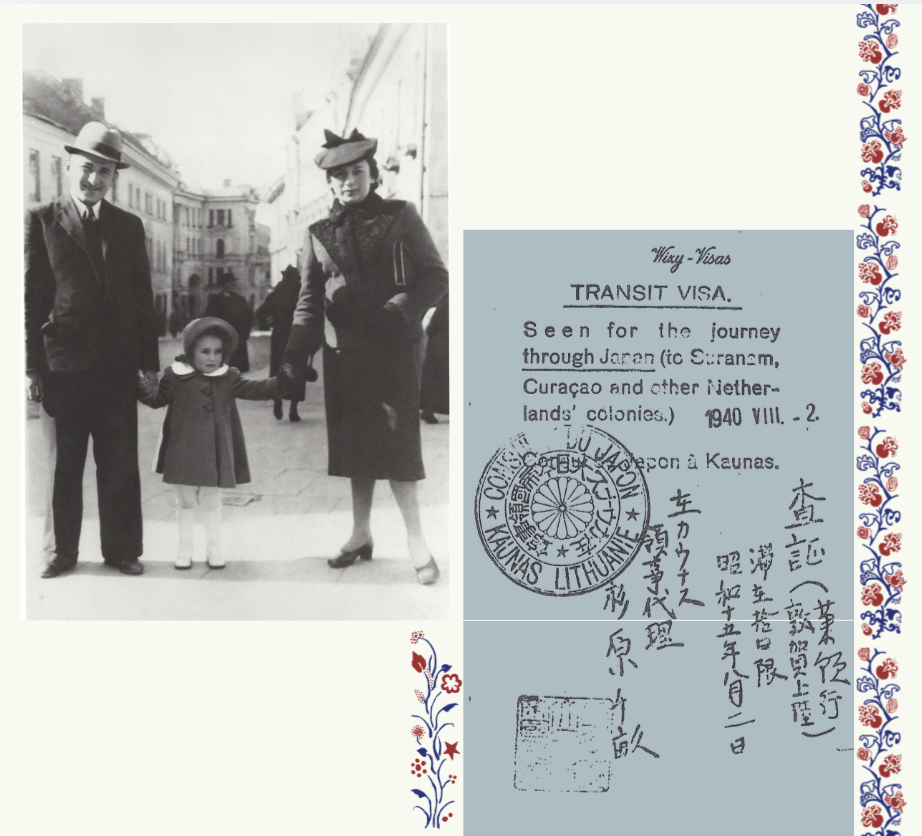
In April 1989, my mother went to the gate at O’Hare to greet Yukiko Sugihara. Yukiko was 75 and my mother turned 80 a few months earlier. Although they had never met before, they recognized each other without hesitation. My mother took Yukiko’s hands and held them throughout the drive into the city. At her apartment overlooking Lake Shore Drive, she prepared a range of traditional Eastern European dishes in Yukiko’s honor. “In the glow of the setting sun on Lake Michigan, we enjoyed the food and reminisced about the past, the memories and the passings of our husbands . . . [and] the hardships both our families had endured,” Yukiko wrote in the prologue to her memoir. Their encounter lent them each a sense of purpose and closure, at an age when the past begins to loom larger than the present. Yukiko called my mother “a truly special friend,” and my mother reciprocated as effusively as her reserved personality allowed.
The two widows came from a generation where women of a certain class did not work and defined themselves in relation to their marriages. Both had reasons to be proud of their husbands. Chiune Sugihara was a Japanese diplomat posted to Lithuania at the beginning of World War II who gave transit visas through Japan to thousands of stranded Polish-Jewish refugees, allowing them to escape war-ravaged Europe. My father had fled to Lithuania from southwest Poland with my mother and their firstborn child, a girl, when the war broke out. The visas Sugihara issued enabled them to travel from Lithuania via the Trans-Siberian Railway to Vladivostok and then by boat to Japan. In May of 1941, they emigrated to the United States. My brother was born in Chicago four months later.
Sugihara lived in relative obscurity after the war. By the time Yad Vashem, Israel’s Holocaust Museum, gave him the Righteous of Nations designation in 1984, he was too ill to attend the award ceremony in Jerusalem. He died in July 1986, still unrecognized by his home country.
Few people had heard of Sugihara when Yukiko and my mother met. This anonymity lifted in the mid-nineties, in the wake of Stephen Spielberg’s movie Schindler’s List and the opening of the Holocaust Memorial Museum in Washington, D.C. The Nihon Keizai Shimbun reported on a delegation of thirty-five Jews who traveled to Japan to pay tribute to the late diplomat in September 1994. The next week, the Economist picked up the story. “Heroes are rare in Japan, where loyalty to groups is generally more prized than loyalty to private conscience,” the article began. “This week, however, the Japanese rediscovered a neglected hero. . . . As good guys go, Sugihara easily matched Oskar Schindler, the German industrialist recently celebrated by Hollywood.” The New York Times followed with a large spread. The first major biography of Sugihara by Hillel Levine came out in 1996. In 1999, the former Japanese Consulate in Kaunas, Lithuania became a museum in Sugihara’s memory. A year later, Chiune Sugihara Memorial Hall opened in Yaotsu, Gifu Province, Japan.
Yukiko was her husband’s loudest cheerleader. She self-published a memoir titled Visas for Life, which her eldest son Hiroki translated into English in 1995. It became the first stop for those wishing to learn about her husband’s activities in Lithuania. In the memoir, she relates how Sugihara cabled the Foreign Ministry in Tokyo three times asking for approval to issue the visas, and how his request was denied. According to her account, Sugihara realized that if he issued the visas, “he would lose all chance of advancement or be dismissed for violating public service regulations of the civil authorities,” but quoted him as saying, “I may have to disobey my government, but if I don’t, I will be disobeying God.” Yukiko tells of how she supported his decision to help the refugees escape the Nazis and massaged his hands at the end of a long day of writing.
The timing of Sugihara’s emergence from obscurity to posthumous recognition came in an era marked by the fall of the Soviet Union and the reunification of Germany. Democracy and free markets had won the Cold War. Antisemitism was considered a barbaric anachronism, supplanted by the End of History. The silence that greeted survivors of concentration camps in the decades after 1945 gave way to an overflow of stories about Nazi brutality and the victims’ bravery in the face of evil.
In the contested space of Jewish memory since World War II, another rescue narrative may seem superfluous. But we have reached another tipping point. History has returned with a vengeance. As refugees and asylum seekers, my father and mother felt enduring gratitude to the United States for taking them in. They celebrated the date of their arrival every year with a toast to their adopted country. I suspect the United States would be unrecognizable to them today. Or perhaps it would look disquietingly familiar, less like the land that offered them refuge than the continent from which they fled, dogged by political strife, impunity, and violence.
Against this background, Sugihara is an enigmatic figure, the unsung hero whose deeds are still misunderstood forty years after his death. He left a blank canvas on which many people have projected self-serving images. Who was he, and what motivated him? And how did my father find the way to his door?

How often have we heard of children discovering shoeboxes hidden at the back of closets, stuffed with clues about their deceased parents’ lives, challenging them to solve mysteries? In my case, it was a portable metal filing cabinet containing the last letters received from relatives in Europe, copies of visas, a few photos, and telegrams from the Red Cross. I am luckier than most because my parents also left me an unpublished memoir, one composed for the family by a history professor at Queens College in New York from interviews conducted in the mid-eighties. The 160-page oral history alternates between my father’s and mother’s voices. They spoke in fluent, if heavily accented, English.
My parents’ story opens on August 24, 1939, when my father boarded an express train to Warsaw. It was one of six Luxtorpedas, or “Torpedo Trains,” ever made, designed to reach speeds of up to seventy miles per hour. It befits my father’s memory to envision him in a bespoke suit and fedora, reading a newspaper and smoking a cigar, on the Polish interwar equivalent of the supersonic Concorde.
Ever the businessman, he worried about risk. My family had lived for generations in Upper Silesia, a multi-ethnic Polish province adjacent to the German border. The possibility that Hitler would seize territories with large German populations in Poland was uppermost in his mind after the Nazi regime annexed Czechoslovakia. To protect his assets, my father sold an apartment building in Katowice, the capital of Upper Silesia, adjacent to Sosnowiec where he lived and worked, “before the Germans would have a chance to take over the city,” he recalled. He was going to Warsaw to “buy some property further east, away from the German border.”
The train stopped at Piotrków near Łódź, midway to Warsaw, where the eastbound and westbound Torpedo Trains met. Hearing the newsboys on the platform shouting “Extra! Extra!,” my father stepped off the train to buy a paper. The banner headline froze him in place. In all caps, it reported that Hitler and Stalin had signed the Molotov-Ribbentrop Treaty, a non-aggression pact whereby they committed to become allies and refrain from aiding an enemy of the other. “I had an instant feeling that this was the beginning of the end, that it meant something was going to happen in the next few days,” he said. Imagining tanks, artillery and trenches running through his living room, his immediate instinct was to get ahead of the invading German troops. He crossed the tracks and returned home.
“We’re leaving,” he told my mother. “I need time to prepare,” she protested. “Can’t I go see my mother and sisters first?” He gave her enough time to make a single phone call. She reached her younger sister Andzia, who still lived with their widowed mother. “We left $20 gold coins, U.S. dollars, and some zlotys hidden behind the tiles in our bathroom, in the event of an emergency,” she told her. “Use them for our families.” My father emptied their safe. They stuffed cash in the lining of their clothes and placed loose diamonds in a shallow cavity in the heel of my sister’s shoe. In the rush to pack, my mother forgot her coat. Two hours later, they were on the train to Kielce, a mid-sized city seventy-five miles to the northeast.
What were they thinking? Maybe my father told himself it was just a temporary move until he had better information about what came next. Later, he would claim that he tried hard to persuade his brothers and sisters to leave with him, but I question whether this is true. There wasn’t time to uproot them. He and my mother both came from prosperous and well-established families. Each had six siblings to whom they were very attached. Four of my mother’s uncles emigrated to New York after World War I, but the rest of the sprawling clan stayed in close geographic proximity. “A mother should have her children near her,” my mother recalled her mother saying when she phoned home from Kielce. “Of all of them, why do you have to leave?”
Hitler invaded Poland one week later, at 4:45 AM on September 1, 1939, sending forces in from four directions and attacking deep into the country’s territory from the air in a Blitzkrieg. “We thought we would be safe away from the German border, but we were wrong,” my father admitted. “The bombing was a terrible experience.” They took cover in the basement of a neighboring building. The makeshift shelter was crowded, claustrophobic, and unlikely to withstand a direct hit. “We felt trapped,” my father said, “and were almost ready to give up.” To assuage mounting anxieties, my mother took a small apron and wrote my sister’s name, birthday, and parents’ names in red ink. It became my sister’s uniform, worn day and night around her tiny waist, to protect her should she become orphaned or lost.
When they emerged from the shelter in the middle of the second night, chaos had enveloped the country. Polish radio played Chopin’s “Military Polonaise” around the clock in lieu of news, to mask the collapse of Polish defenses. My sister was two-and-a-half years old. My father and mother were 34 and 30 respectively. At that moment, the three of them became refugees, never to return home again.
The lightning speed of Germany’s advance dictated that my parents keep heading east. Their route was contingent on improvised travel arrangements. Passenger trains stopped running. They moved under cover of night, because the Germans bombed during daylight hours. My father tripped carrying my sister as they walked through the woods in the dark. Their suitcase fell off the roof of a car driven by a Polish army officer, who took pity on a woman with a small child but refused to stop to retrieve their belongings. They bribed truck drivers and commandeered places on vans intended for government officials.
They finally stopped in the town of Luck (today “Lutsk”), 350 miles east of Sosnowiec. They had traveled the width of Poland in a week with a young child, having barely eaten or slept for days. Luck was close to the Soviet border; any farther would have taken them across into Russia. As it turned out, Russia came to them instead. On September 17, Soviet Foreign Minister Vyacheslav Molotov declared that Poland no longer existed. The next day, Red Army tanks rolled into Luck unopposed. “The whole city came out to watch the death of Poland,” my father said.
The Russians announced that residents of what they renamed “Western Ukraine” were required to give up their Polish passports and become Russian citizens after October 8. As capitalists, my parents were class enemies. “We didn’t want the honor of Russian citizenship,” my father facetiously remarked. “We were afraid of the Russians, afraid they would take our money, leave us to starve, or worse, they might send us to a camp in Siberia.”
Agitated and scared, my parents picked up and left again. Their destination this time was Vilna (Vilnius), 360 miles to the north. For three-and-a-half cold and miserable days, they rode in an open-air cattle car, traversing a distance that should have taken no more than a few hours by automobile had the roads been passable. When they reached Vilna on the afternoon of October 15, it was unseasonably warm and the city looked beautiful. Absent a plan for what to do next, they rented a room from a widow named Sara Cyrelson, who sold fine leather gloves to a dry goods store owner they knew from Sosnowiec, and settled down.
My father chose Vilna because of a rumor circulating among the refugees. Poland had seized Lithuanian territory, including Vilna, in skirmishes after World War I, and integrated it into the Second Polish Republic. The gossip was that the Soviets would restore Vilna to Lithuanian sovereignty in exchange for the right to station troops on Lithuanian soil. It was a Faustian bargain, but one the Lithuanian government accepted.
Jews comprised roughly forty percent of the population of Vilna. Yiddish and Polish were the dominant languages spoken in the streets. Napoleon dubbed Lithuania the “Jerusalem of the North” in 1812 because it was the center of Jewish learning in Europe, with the greatest number of religious academies, or yeshivas. The country represented a Switzerland of sorts, controlled neither by Hitler nor Stalin, albeit in a dangerous neighborhood. An estimated 25,000 Polish-Jewish refugees crossed the Lithuanian border to flee German and Soviet occupation. Those like my parents who arrived before the handover on October 28 departed Poland magically by waiting for Vilna to become Lithuanian again. Others were smuggled illegally over the border during the winter and spring months of 1939–1940.
Their sojourn in Vilna bought my parents eight months of respite before Russian duplicity upended their sense of security again. The Soviets never negotiated with the Lithuanians in good faith. As the world watched Hitler’s troops march into Paris on the night of June 14, 1940, Stalin made his move. He issued an ultimatum demanding that Lithuania establish a puppet regime controlled from Moscow. All embassies and consulates were instructed to shutter their delegations and move to the Russian capital. The Lithuanian president escaped through the back door of his residence and fled the country for Switzerland.
My mother was walking down an alley with my sister, who had just turned 3, when Soviet tanks rolled into Vilna. To avoid being run over, my sister pressed her back against the perimeter building. It is her earliest memory.
The heavy Russian tanks crushed the pavements. Red Army soldiers who manned them smelled of leather, sweat, horses, and dust. Many from backwater provinces had never seen a toilet before and relieved themselves in the yards of private homes. Public spaces emptied of people. Churches, monasteries, and convents closed their doors. All non-communist political organizations shut down. Red fabric fronted by pictures of Lenin and Stalin replaced merchandise in shop windows. Most disturbing, thousands of Lithuanian nationalists disappeared overnight. The lucky ones were sent to Siberia; others hung from trees in city parks as a warning to the population of the consequences of resistance.
The Soviet occupiers staged their incursion as if it were a spontaneous socialist revolution rather than a takeover. Following the authoritarian playbook, they held sham elections, where pro-Russian candidates won ninety-nine percent of the vote. The new parliament formally asked to join the U.S.S.R., after which all Lithuanian nationals were required to become Russian citizens.
News from Eastern Poland added to my father’s growing desperation. On the night of June 29, the secret police, or NKVD, arrested 80,653 residents of Lvov (Lviv) and surrounding towns, eighty-five percent of whom were Polish-Jewish refugees who refused “the honor” of Russian citizenship. They were shipped in boxcars to Siberia, Kazakhstan, the Urals and the Arctic Circle. Many did not survive the two to four week trip. The targeting of Jews was part of a broader policy wherein Soviets seized Polish citizens by administrative decree and without legal procedure from territories they had annexed. The deportations occurred in waves from February 1940 to June 1941, ensnaring anywhere from 350,000 to 1.2 million ethnic Poles.
The Soviet juggernaut was closing in on my parents, first in Eastern Poland and now in Lithuania. The cities of Luck and Lvov were a stone’s throw apart. It is true that refugees like them began their journey running from the Germans, but once on the road, they confronted a different reality. “It is historical hindsight to say that Sugihara ‘saved Jews from the Nazis,’’’ observed Japanese diplomatic historian Shiraishi Maasaki. When Hitler and Stalin were allies, “it was the Soviet Union that was running amok in Europe.”
As Polish nationals from the wrong class, my parents’ legal status in Lithuania offered them few protections. To be a Polish-Jewish refugee under Russian occupation meant being stateless, without a valid passport, belonging nowhere, and threatened with deportation. How long would it be before the Russians came for my father?
Chiune Sugihara liked to introduce himself with his name and birthday together to break the ice, especially with other Japanese people. He was born at the dawn of the new century, on January 1, 1900. His name, Chiune, meant 1000 furrows of rice, a sign of abundance.
The diplomat arrived in late August 1939 in Kovno (Kaunas), the interwar capital of Lithuania, tasked with gathering intelligence about Soviet German troop movements. A lifelong Russophile, he spoke the language fluently, having spent sixteen years working for the Foreign Ministry in Manchuria (his first wife before Yukiko was a white Russian named Klaudia Semionovna Apollonova, who called him “Sergei Pavlovich”). When he took up the post as Vice Consul in Kovno, an hour’s train ride from Vilna, Japan had neither prior diplomatic representation nor Japanese citizens in the country. Sugihara would have to start from scratch. He rented a yellow stucco villa in a hilly residential neighborhood, using the first floor as his residence and operating the Japanese Consulate below.
Discreet by nature and profession, Sugihara left few clues behind of his thoughts and mood during the summer of 1940 when the Soviet Union invaded Lithuania. What we do know is he undertook a massive risk because of extreme bravery. But as so often is the case amidst chaotic conditions, he did not seek out arenas to test his mettle and morality — he stumbled into them.
A Dutch businessman named Jan Zwartendijk, who worked for Philips Electronics in Lithuania, started the ball rolling. Late at night on June 13, just three days before the Soviets entered Kovno, Zwartendijk received a call from the Dutch Ambassador to Latvia, L.P.J. de Decker. The prior Dutch Consul to Lithuania had been removed for Nazi sympathies and de Decker asked Zwartendijk if he would be willing to serve as Honorary Consul of the Dutch government-in-exile pro bono in his stead. Zwartendijk accepted the offer, and they agreed that the Philips Electronics showroom in Kovno would double as the new consulate.
Soon after, two Jewish Dutch nationals — a married woman with a son my sister’s age named Peppy Lewin and a yeshiva student named Nathan Gutwirth — approached Zwartendijk looking for a safe haven. Returning to the Netherlands under German occupation was out of the question, as was staying in Lithuania if it could be avoided. “There were a lot of Jews in Lithuania who had relatives in Russia and never heard from them because there were no connections at all. Everybody tried to get out because once you were a citizen it would be impossible to get out,” Gutwirth later recalled. Zwartendijk referred Lewin to de Decker, who suggested she consider Curaçao in the Netherlands Antilles because it did not require an entry visa. De Decker inserted formal language in her passport saying she did not need a visa for Curaçao, omitting the fact that admission was contingent on the approval of the governor. She went back to Zwartendijk and asked him to insert the same language in her husband’s passport. With his superior’s permission, Zwartendijk followed de Decker’s script and also amended Gutwirth’s documents.
News of the fabricated visas spread like wildfire in refugee circles. Queues formed around the block outside the Philips Electronics store with supplicants asking Zwartendijk to mark their documents too. One refugee scaled the downspout from the gutter on the side of the building and entered the second-floor window. My father joined with like-minded cohorts to help Zwartendijk out. “We had a stamp made for [Zwartendijk], a green stamp embossed with the Royal Dutch crest, as pretty a stamp you will see anywhere, and he used it to issue us the ‘non-visa visa,’” he remembered. Zwartendijk threw himself into the effort, stamping over 2,000 documents between July 24 and August 3, the day he was forced to vacate his consulate by the Soviets, who had seized the Philips Electronics business and wanted the storefront for themselves.
The invention of the Curaçao visas set the stage for everything that followed. Diplomatic protocol dictated that transit visas could be issued only with a final destination. The war blocked travel in all directions except east across the Soviet Union and Japan. Zwartendijk pointed the two Dutch nationals in Sugihara’s direction to ask for permission to transit Japan. Hundreds of Polish-Jewish refugees who obtained Curaçao notations from Zwartendijk followed them to Sugihara’s doorstep.
Yukiko described the scene of Jewish refugees congregating in front of the Japanese Consulate in dramatic terms. “I could see people with bloodshot eyes desperately pleading for help,” she wrote. “I tried to stay hidden. It was apparent that they had spotted my shadow because some people began shouting and reaching out to me with their hands. Some of the men even tried to climb over the fence.”
For days, Sugihara lost sleep over what to do, Yukiko wrote. He decided that issuing transit visas to Japan was within his authority as Vice Consul, even if Curaçao as a final destination seemed dodgy. His greatest reservation concerned the Russians. Any visas through Japan would be worthless unless paired with permission to journey the 4,500 miles from Lithuania across Siberia to Vladivostok.
Mustering his courage, Sugihara went to see his Russian counterpart in Kovno to ask whether the Soviets would give the refugees passage through the U.S.S.R. There was no precedent for Sugihara to be optimistic, but the official he consulted surprised him by saying, “If your country will accept them, then the Russian government is willing to issue visas, regardless of the number. You are putting the cart before the horse.” Admitting his mistake in asking the Russians to go first, Sugihara tipped his hat and left the office grinning.
Smoothing the path for the refugees’ transit on the Russian side was the Soviet envoy to Lithuania, Vladimir Dekanozov, a close associate of the chief of the secret police, Lavrentiy Beria. Dekanozov cabled Stalin on July 25. “At present there are many refugees of Jews from former Poland in Lithuania, especially in the city of Vilna. . . . The total number of such refugees is about 800 people,” he wrote. “They are all provided with appropriate visas and money. It is undesirable [that] these refugees remain in Lithuania; therefore, we consider it expedient to urgently allow them to transit through the USSR.” Dekanozov understated the numbers involved and misled Stalin about their destinations and financial condition, but he got the result he wanted. On July 29, Stalin cabled back with his decision “to allow Jewish refugees from the former Poland who are in Lithuania to transit through the USSR to foreign countries, organizing their dispatch in groups of fifty to 100 people.” He copied Beria and Molotov.
Until recently, Dekanozov’s role was a crucial missing link in the story. His involvement and Stalin’s intervention only came to light though the work of a Russian historian in Moscow named Ilya Altman, who, together with a consortium of historians under the auspices of the Slavic-Eurasian Research Center in Hokkaido, published ninety-one documents about Sugihara from diplomatic archives in Moscow, Tokyo, Lithuania and Israel in 2022. Sugihara may have met with Dekanozov himself, although we do not know for sure.
Why did an unsavory apparatchik stick his neck out for a bunch of Jews? Ascribing humanitarian motives to Dekanozov goes against everything known about him. Sent to Lithuania by Stalin on the day of the invasion as his top representative, Dekanozov oversaw the execution of Lithuanian nationalists, the suppression of all non-communist political parties, the closure of religious institutions, and the sham elections that preceded the establishment of the Lithuanian Soviet Socialist Republic. His job done by summer’s end, he left Lithuania to become Soviet ambassador to Nazi Germany. Apart from his close relationship with the sadistic Beria, he was “imperious and foul-mouthed with underlings,” according to Stalin’s biographer Stephen Kotkin. After Stalin died in 1953, Beria was sentenced to death and Dekanozov was executed with him.
“Motivations are ultimately mysterious,” David Wolff from the Slavic-Eurasian Research Center told me. My father always attributed Russian motives to greed, saying their goal was to “get money from the Jews.” There is some truth to this. The Soviet Union was desperately short of foreign exchange by early 1940. Dekanozov dangled the exorbitant amount of foreign exchange Intourist could charge for the sale of package tours in an earlier communication with Molotov. Ethnicity might have been a factor. A Lithuanian writer who was friendly with Dekanozov claimed the blond blue-eyed Bolshevik was born Ivan Protopopov in Estonia to a Russian father and a Jewish mother with Baltic-German roots. The most compelling explanation is also the most straightforward: getting rid of refugee riffraff simplified integrating Lithuania into the Soviet Union, inasmuch as Jews with Lithuanian citizenship were denied exit and the refugees paid the Soviets a premium to be allowed to depart.
Sugihara started issuing Japanese transit visas to Polish-Jewish refugees on the day Dekanozov cabled Stalin. He picked up the pace dramatically the day Stalin replied in the affirmative. According to my father, the scene at the Japanese Consulate was “like an assembly-line operation.” Sugihara had a host of helpers, among them a Lithuanian-born German employee thought to be the consulate’s Gestapo mole and a young rabbi from the Mir Yeshiva, whose student body applied en masse to leave. (These same students had already been forced to leave Mir, Poland to escape Soviet persecution and had arrived in Lithuania in 1939.) Sugihara charged each refugee two Lithuanian lit, equal to about twenty cents. No one was refused a visa regardless of the state of their documentation. On August 2, my parents received visa numbers 789 and 790. By the time Sugihara closed the consulate on August 28, he had signed a total of 2,139 visas, some of which covered additional family members such as my sister.
Sugihara used diplomatic legerdemain to inform the Foreign Ministry in Tokyo about the visas. He kept his communications brief, infrequent, and oblique. Foreign Minister Yosuke Matsuoka neither supported granting the visas nor issued a blanket prohibition in response. He was new to his job and had more pressing priorities beyond a ragtag group of refugees in Lithuania. Years later, when Sugihara was asked whether his superiors in Tokyo gave him the green light, he expressed exasperation. “I finally decided it was completely useless to continue discussions with Tokyo,” he replied. “I was merely losing time.”
Unaware of Sugihara’s dealings with his Soviet counterpart, the refugees lived under pervasive anxiety, never greater than the time between when they received transit visas through Japan and when the Russians gave them permission to exit Lithuania. “The chance of getting a transit visa from the Russians was quite remote,” my father assumed, but he mounted a Sisyphean effort anyway. For four months, he appeared before the Soviet Viceroy in Kovno pleading his case. The irony of begging for a train ticket to Siberia did not escape him. “It seemed like lunacy,” he recalled. “Each time I was interrogated with all sorts of questions, and every request I made was answered with nyet, nyet, nyet! And each time it ended in the same phrase in Russian: ‘Come back tomorrow’. . . [We] were afraid the Russians were playing a cat-and-mouse game, letting us apply for visas to leave their control, and then rounding us all up,” he remembered. “We had the warmest clothes we could find for all of us, including the heaviest Russian boots, hidden under our beds, in case they suddenly came for us.” In mid-December, my father took my sister along to an interview. She had learned some Communist slogans and songs in nursery school. He prompted her to perform “Meadowlands,” a popular Russian melody about a Red Army soldier who leaves home to defend his country. “Why did you bring her? Do you want to soften my heart?” the Viceroy asked. The ploy apparently worked, because that afternoon he granted my family permission to cross the Soviet Union.
The Trans-Siberian Railway pulled out of Moscow Central Station at 4:30 PM on New Year’s Eve 1940 with my family onboard. “I was so scared that I could not wait for the train to start moving, and the relief I felt when the train left the station was the best New Year’s Eve present I could have had,” my mother recalled. She tempered her enthusiasm with the knowledge that they were still in Russian hands “with a trip of thousands of miles ahead of us . . . from Moscow to Omsk to Novosibirsk to Irkutsk to Chita to Vladivostok” before boarding the boat to Japan.
The three of them had arrived in Moscow the prior Saturday morning on the overnight train from Vilna as part of a group of eighty Jews including religious students from the Mir Yeshiva. Theirs was the second contingent to leave Lithuania. They had been required to buy a package tour that included a three-night layover in Moscow. My parents stayed in a fifth-floor suite at the Nova Moskovskaya Hotel and ate caviar in the rooftop restaurant, “as if we were ‘tourists’ on a holiday,” my father remarked.
The royal treatment aside, paranoia spoiled my parents’ mood. NKVD agents masquerading as Intourist guides accompanied them everywhere. A bearded man speaking Yiddish and posing as a professor tried to engage them in conversation about Stalin and politics. He approached them at dinner the first night, bumped into them on the street the next day, invited them to a Hanukkah party at his home, and sat behind them at the Bolshoi Ballet. “What are you doing in Moscow?” he asked. Pointing at the Kremlin, he posed a rhetorical question and then answered it: “Do you know who lives across from here? The biggest murderer of humanity in the world.” My parents knew enough of life in the Soviet Union to realize that no ordinary Russian Jew would dare engage with them. “We continued to pretend we were completely ignorant — we didn’t read newspapers, we didn’t know what was going on — we were just naïve travelers on our way to see relatives in Palestine,” my mother said. In his recollection, my father told a joke that was making the rounds in refugee circles at the time. “What do you think of the [NKVD]?” it began. “Nothing; I only hope they don’t think of me.”
The journey across Siberia took eleven days on a train as cold as the terrain through which it passed. Their compartment had two hard benches, which pulled out from the wall. Conditions were crude. There was no shower and only one washroom per eighty passengers. The refugees brought their own food because train fare was inedible and not kosher. Only copious amounts of Russian tea kept them warm.
While my mother expressed distaste for the food and facilities, she spoke in the memoirs about her fearfulness:
Like the whole experience in Russia, the train trip was one of contrasts in everything, especially between hope and dread, so you were never sure of anything. Nothing was right; nothing was wrong. No one was guilty; no one was innocent. What happened to you had no relation to what you did or said, or what you didn’t do or say. There was only the terror of the totally unpredictable power of the state.
There were even fewer amenities on the freighter that transported them from Vladivostok to the Japanese port of Tsuruga. It was not configured to carry passengers and served only one meal in two and a half days. The Sea of Japan was rough and most everyone got sick. My parents were nonetheless elated at leaving the dictatorships of Europe behind.
Three and a half months in Japan passed like a dream. My father rented an apartment in Yokohama across from the Grand Hotel on Tokyo Bay. The receipt from the landlord, made out in English, substituted “Mr. Gentleman” for his given name. Storekeepers had sympathy for a family with a young child and gave my mother extra rations. “The Japanese treated us like human beings,” she recalled. “For the first time, we felt like free people.” My sister’s blond hair attracted attention, as the Japanese had little experience with Europeans, let alone Jews. Strangers asked if they could touch it.
When my mother arrived in Japan, she discovered she was pregnant. She’d had an abortion in Vilna in the months preceding the Soviet annexation. The guilt stayed with her for the rest of her life:
I don’t believe I should be blamed for it, because we lived in most uncertain times and circumstances. I didn’t know where the next day would take us, and we could not move with a newborn baby. I had a medical abortion because desperate measures were necessary. I feel bad about it. That is all I have to say.
This time around, after going to see a Japanese doctor with whom she communicated by pointing to a doll, she decided to keep the baby. The enduring family mystery is whether my brother was conceived in Vilna or Moscow.
Given the rampant antisemitism and xenophobia that dominated State Department policy, the process of obtaining visas to the United States from Japan proceeded remarkably well. The U.S. quota for immigrants of Polish origin was a paltry 6,524 per annum, but the quota had not yet been filled in early 1941 because only Poles living outside a war zone were eligible to apply. In June of that year, the State Department issued a “relatives rule,” extending the visa ban to those immigrants with family in combatant countries, on the grounds that they were security risks. Emigration to the U.S. from war zones in Europe became virtually impossible thereafter.
My family obtained their visas to enter the United States in April of 1941, just under the wire. Affidavits from my mother’s uncles in New York, together with funds my father had transferred to a U.S. bank account, satisfied U.S. immigration requirements that petitioners have American citizens vouch for them and sufficient financial resources to ensure they would not become “public charges.” They sailed from Yokohama to Seattle early in May. Had they been denied entry to the U.S., the Japanese would have sent them to Shanghai with the other stranded Sugihara visa recipients before Pearl Harbor. Notably, no refugee made it to Curaçao.
When my father arrived in the United States, he was 36 and on the cusp of being too old to adapt. The war split his life into before and after. He lived the next forty-five years in Chicago, longer than he lived in Europe. Until the end of his days, he spoke English with a heavy Polish-Yiddish accent, finding particular trouble with the letter ‘w’ and the digraph ‘th.’ “Vait a minute – vere are you going, and vit hoom?” His accent mortified him enough that he hired a speech therapist from Northwestern University to no avail.
He was a proud man. While not physically imposing — below average in height and weight — he had a commanding gravitas. As I matured, I became aware of an emotional fragility beneath the powerful veneer. He held himself aloof from everyone except my mother. He was plagued with nightmares about being chased by Nazis, losing his passport, or running and leaving my mother and sister behind. As he aged, the concepts of refugee and Holocaust survivor merged in his mind, until he no longer differentiated between them.
His prodigious work ethic was his salvation. He applied the same qualities that had enabled him to obtain lifesaving visas — intelligence, ingenuity, focus and, perseverance — to reestablish himself as a businessman in his adopted country. While my father reaccumulated wealth, material possessions were unimportant to him. He saved paper clips, rubber bands, and check stubs to use as scratchpads for making lists. Before departing the commuter train every morning, he collected discarded newspapers to spare himself the cost. He lined his suit pockets with paper-wrapped sugar cubes taken from restaurants, through which he sipped tea from a tall glass Russian style. The house was littered with purloined pads of paper and pens from hotels and business meetings.
Financial security buttressed his self-worth and compensated him for his emotional scars and the humiliation he felt at starting over, paired with growing risk aversion. In his office downtown, he had a walk-in safe to keep cash, stock certificates, silver dollars, and diamonds, just in case he needed to flee once more. I doubt there was enough money or recognition in the world to assuage his anxieties and make him feel whole again.
He never spoke of his family, but the loss hung over him like a shroud. In the fall of 1941, when he and my mother were already in Chicago, they received letters from home congratulating them on the birth of my brother, followed by a few telegrams from the Red Cross in the spring of 1942. Then silence for three years. After the war ended, my mother’s youngest sister, Andzia, contacted them. She and a brother had been sent to a forced labor camp in Germany. They were the only two of my mother’s six siblings to come out alive. My father’s news was worse. His closest relative to survive was a third cousin. All of his siblings, together with their spouses and eleven nieces and nephews, were murdered in Auschwitz.
Had my family remained in Lithuania, they would have faced almost certain death. The Wehrmacht swept into Vilna and Kovno in the first week of Germany’s invasion of the Soviet Union in June 1941, accompanied by killing squads called Einsatzgruppen. Together with Lithuanian collaborators, the Germans dispatched over ninety-five percent of the Jews through mass shootings in pits, mostly before the end of 1941. It was the highest percentage of Jews murdered of any country in Europe.
The war split Sugihara’s life in two as well. He spent the rest of his diplomatic career in territories controlled by the Nazis or allied with the Axis powers. As someone privy to intelligence, he must have known about the Einsatzgruppen, the liquidation of Lithuania’s Jewish population, and the death camps. The Soviets interned him and his family as enemy diplomats after the war, postponing his return to Japan until April 1947. Two months after he got back, Vice Foreign Minister Okazaki called him into his office and asked him to resign. A proud man, Sugihara signed on the dotted line. Privately, he was devastated. He was 47 years old, with a wife and three children. “He quietly accepted the decision and never spoke of it again,” Yukiko wrote in her memoir. She believed it was because of “that incident” in Lithuania. Sugihara himself was more circumspect. He later said the Vice Minister referred to the “problem you recently initiated,” but did not elaborate.
If the visas were behind his dismissal, it is unclear why the Foreign Ministry waited seven years to punish him. Maybe he lost his job as a result of downsizing under American occupation. A more sinister explanation is that the Foreign Ministry feared he knew too much about Japanese war atrocities in Manchuria. Whatever the rationale, the treatment was harsh. Other diplomats who lost their jobs received help finding new positions. His pension amounted to only a few months’ salary. Most puzzling, the Foreign Ministry expunged his record and claimed no one named Sugihara had ever worked there.
Sugihara’s travails worsened when Haruki, the son born in Kovno, died of leukemia at age 7 in November 1947. Sugihara went into a deep depression. “It was as if a shadow had crossed Chiune’s face,” Yukiko wrote. “I often found it difficult to look at him because of this.” He withdrew and became isolated. Two years later, Yukiko gave birth to their last child, another son. She and Sugihara named him Nobuki, which means “long life.”
In 1960, a Japanese trading company approached Sugihara to head their Moscow office. He counseled Yukiko to stay in Japan with Nobuki and moved alone to Moscow for sixteen years. When in 1967 a Polish historian reached out to him, he pleaded ignorance about what happened to the Polish-Jewish refugees he had helped. “It did not interest me since after the war I did my best to forget the past,” he said.
The past found Sugihara the following year, when he received a phone call from an economic attaché at the Israeli embassy in Tokyo named Yehoshua Nishri, who told him he had received a visa from Sugihara in Kovno as a boy. Sugihara was shocked. It was his first contact with a refugee since the summer of 1940. Nishri asked Sugihara what Israel could do for him. He replied that he was interested in sending his son Nobuki abroad to study. The Israeli government offered Nobuki a spot at the Hebrew University as a foreign exchange student with a full scholarship in appreciation for Sugihara’s good deeds.
Sugihara’s big moment of recognition came in October 1984, when Yad Vashem, the Israeli Holocaust Museum, gave him the Righteous Among Nations Award, honoring non-Jews who risked their lives saving Jews during the war for altruistic reasons. It was a belated acknowledgement that mattered little to Sugihara, who, according to his family, did not care about awards and eschewed media attention.
Halfway across the world in Chicago, as my parents were dictating their memoirs, my brother wanted to know: was this Japanese diplomat whose name he just learned still alive, and if so would he agree to an interview? He commissioned a man named Brian Oxley, who grew up as the son of a missionary in Japan, to find him. After a fruitless inquiry at the Foreign Ministry, Oxley located Sugihara two hours south of Tokyo in Kamakura, where he spent his waning years. He was in his mid-eighties and frail from heart disease, but also surprisingly open to the idea of unburdening himself of his memories. For perhaps the first time, he spoke freely about his decision to issue the visas, the role of the Russians, the views of his superiors back in Japan, and his life after the war.
Sugihara knew what Oxley was seeking. “You want to know about my motivation, don’t you?” he asked and then answered his own question. “It is the kind of sentiment anyone would have when he actually sees the refugees face to face, begging with tears in their eyes,” he said. “They were so desperate that they went as far as to kiss my shoes.” He continued by saying, “There is nothing wrong in saving many people’s lives. If somebody sees anything wrong in the action, it is because something ‘not pure’ exists in their state of mind.”
Sugihara died eighteen months later, on July 31, 1986. Yukiko wrote in her memoir that my father sent condolences and was sorry he could not attend the funeral. I suspect my mother was the one who wrote to her, though. My father had passed away three weeks earlier, on July 9. Once again, our families’ fates were intertwined, this time in grief.
My parents are now gone, and unraveling the breadth of what they survived has been a life-long project. As I got older, I began to question how reliable their memoirs could be, given that they chronicled events decades after they happened. I came across a talk Sugihara’s last surviving son, Nobuki, gave at the Museum of Jewish Heritage in New York in 2019. In the YouTube video, Buki (as he is called) speaks in front of a large crowd of Sugihara survivors and their descendants about the myths that had grown up around his father. The Times of Israel subsequently ran an article with the headline, “Holocaust hero Chiune Sugihara’s son sets the record straight on his father’s story.” We need to compare notes, I thought to myself. I found Buki’s email and asked him to meet. He responded immediately. “Your family is important for me,” he wrote. “We have a lot to talk and listen from each other.” A month later, I was on a plane to Antwerp, Belgium, where Buki lives with his wife, Esin.
Our first dinner began with a bottle of champagne, followed by two hours in seamless conversation. Buki’s abiding affection for his late father was palpable. He respected him deeply and had great empathy for the sorrows he experienced. I could sense the responsibility he felt to represent his father the way his father would have wanted to be remembered. We talked about the legacy our parents left us, and why understanding their story in accurate detail was so important to both of us.
The following morning, I met Buki at his office inside the diamond district to continue our discussion. The uncanny parallels between our respective lives made me feel as if our meeting were predestined. We were born in the same year after the war. We grew up, in effect, as only children of older parents, twelve years younger than our eldest siblings. Buki knew his father had been a diplomat but understood little of what that meant as a child and only learned about the visas as a young adult. I knew my parents had grown up in Poland but was told little about their upbringing or the family members they lost. I was 35 years old before I first heard Sugihara’s name and his role in my parents’ survival because of their memoirs.
Our parents’ interwoven pasts shaped us in unexpected ways. After attending Hebrew University, Buki apprenticed to a diamond dealer in Ramat Gan, then spent the next thirteen years exporting diamonds to Japan. He lived in Israel before moving to Antwerp to set up his own shop. I gravitated to West Germany in my twenties, first as a graduate student in European history, then as an international investment analyst. In Holocaust vernacular, Buki left home to live among the victims and I among the perpetrators.
I asked Buki to help me distinguish between fact and fiction. We talked about Yukiko’s memoir. She wrote the book as if it were a novel, he said. Her account hewed close to the truth, but took liberties with dates, quotes, and some scenes that appealed to her imagination. Most famously, she told of refugees beseeching her husband for visas at the Hotel Metropole in Kovno after he closed the consulate, and his signing visas at the railway station and through the window of the train as it left the city in early September. To Buki’s best knowledge, his father stopped issuing visas around August 22, and only three refugees showed up at the hotel.
More problematic was Yukiko’s insistence that Sugihara cabled Tokyo for permission three times and issued the visas against orders, knowing he would be held accountable. The fault with the story lies less with a sentimental widow bolstering her husband’s reputation than those who repeated it uncritically. The assertion that Sugihara saved the refugees from the Germans is also flawed because it leaves out the interim step of Soviet occupation. The irony that Vladimir Dekanozov — a Bolshevik thug — was the linchpin of the rescue operation does not change the fact that the refugees asked Sugihara to help them escape from Russian control.
Yukiko’s cinematic stories were suited for screen adaptation . A biopic of Sugihara’s life released in Japan in 2015, Persona Non Grata, dramatized many of them. In his talk at the Museum for Jewish Heritage, Buki shocked the crowd by calling the film half-fiction. “Why do you want to correct the record?” I asked Buki. “Aren’t you betraying your father’s legacy?” On the contrary, he said. He acknowledged that the desire to build myths around heroes is only human. But as he told the Times of Israel, “my father would not have liked it. He would have not approved, he was always in favor of telling things like they were, no melodrama.”
Talking to Buki and Esin made me think about my own father. Family lore ascribes prescience to him about the Holocaust. Like Cassandra, he purportedly warned others of the coming conflagration to no avail. It in no way sullies my father’s legacy to recognize that he could not have anticipated the horrors that followed. Survivor’s guilt must have weighed heavily on him. When he got off the train in Warsaw and told my mother they were leaving home, he felt foreboding and fear, but not certainty.
I also dispute the often-exaggerated role of personal agency attributed to heroic acts. It’s critical but must be judged in context. Jan Zwartendijk’s son, in testifying about his father’s contribution, stressed that the outcome was hardly foreordained. “The visas that were phony, the Soviets that acted benignly toward this, which was unexpected. . . . All of that together made it succeed, but it was most unusual, and the luck in there was a tremendous factor all along the line. It could have gone wrong in different places easily, and we would never have heard from them again.”
My parents’ greatest bit of fortune was their timing. “Every so often the cards fall in your favor,” Stalin’s biographer Stephen Kotkin said to me about the refugees’ escape. The chaos surrounding the Soviet invasion of Lithuania generated a sense of urgency. The interregnum, before Hitler’s attack on the Soviet Union and Japan’s on Pearl Harbor, created a window of opportunity. It was the proverbial eye of the needle.
Buki and I are a bridge between generations, residing in the gap that has opened between those who bore witness and those who learn about it from history books. Being born after the war was an unalloyed blessing. We reaped the harvest of a generational peace. Our desire to prioritize truth stems from discomfort with stereotyped, inauthentic narratives, and a sense of duty to pass on what we intuitively know about times of crisis.
What matters is that Sugihara and my father did their best. They were people forced to make excruciating decisions in extraordinary times. When it was over, they tried to forget the past because it was too painful to remember. Buki and I bonded over a belief in our respective fathers’ heroism, defined less as historically inconceivable prescience or supranatural agency, than their willingness — each in his own way, with all of its messiness, complexity, and humanity — to take a great risk with an unknowable outcome.
Esin said it well. On the back cover of a small book she penned about her father-in-law, she wrote, “it’s my hope that the reader . . . will see Chiune Sugihara through my husband’s eyes and for who he really was, a simply good man. There is no reason to create stories or to embellish the facts, the truth is amazing enough.” Indeed it is.