
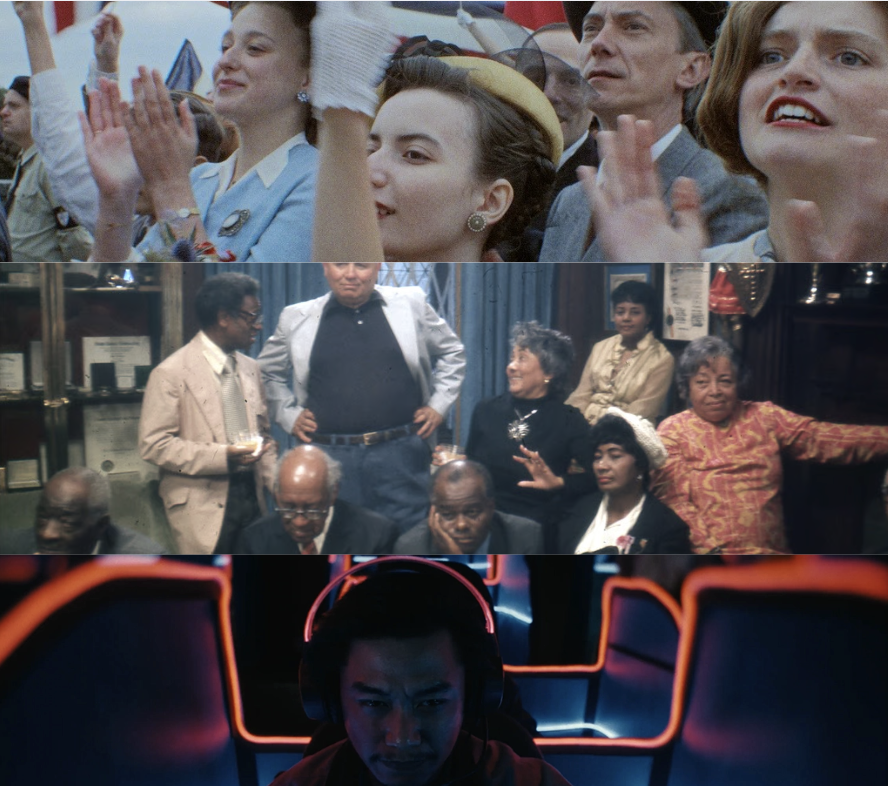
Every film is a portrait of the community that made it. No artist works alone, of course. Yet even the smallest no-budget movies require dozens of people in front of and behind the camera — background actors, set decorators, lighting supervisors, production assistants, color correctors, you name it — to make their way to events like the New York Film Festival, where a whole roster of other people step in to scan tickets, print posters, brew coffee, and make sure that everything is projected in the correct ratio, and (hopefully) in focus. It takes a village, or perhaps an army, to bring feature films to our screens.
So it makes sense that so many of the movies at the sixty-fourth edition of NYFF would take community as their theme. Yuval Abraham and Rachel Szor’s new documentary NAZA arrived with threats from the Israeli government and protestors in tow. None of these people had seen the film. It had played briefly at the Venice Film Festival, where it won a special jury prize, and has only just begun showing at a single theater in New York. Building on and reiterating Abraham’s own reporting at 972 Mag, it records a number of interviews conducted in the peripheral spaces of Tel Aviv: rooftops, darkened alleys, vacant parks. Their subjects are anonymous members of the IDF, including soldiers, officers, and elite members of the Military Intelligence Directorate, who describe in immense concrete detail the structure and function of the many digital systems used to surveil, target, and annihilate targets in Gaza.
The testimony assembled here is substantial and damning. It describes a network of interlocking, AI-assisted systems that exist to convert human beings into data points, and then into corpses. The film takes its title from the Hebrew acronym for collateral damage (nezek agavi), registered in the system numerically: one civilian = one NAZA. As revealed, most targets in Gaza are tagged with dozens to hundreds of NAZA; one officer confesses to ordering a strike that killed more than five hundred civilians, and another describes attaching twenty-plus NAZA to every Hamas target in Gaza — a number of acceptable deaths that, as Abraham points out, would be larger than the entire remaining population of the Strip.
Yet this kind of technologized generalization is precisely the point; the easier it is to speak in numerical abstractions, the easier it is to order an air strike on an apartment building because, the system says, ‘only’ twenty-five percent of its civilian inhabitants remain inside the target zone. The systems that create thresholds for human life also create the terms by which that life can be legally annihilated. While their subjects talk, the camera pans across the cityscape of Tel Aviv, peering into apartment blocks and catching residents as they watch the news, have dinner, do yoga. The IDF has its headquarters in the center of Tel Aviv, and its officers live all across the city. Abraham and Szor leave very little to the imagination, but they let you draw that particular conclusion for yourself.
Though it should be seen as an urgent journalistic work, NAZA is also a portrait of a technologically-mediated community, a collection of scattered individuals networked together by the anonymizing apparatus of computer programming. The IDF’s systems excuse their particular actions even as they facilitate them, personal innocence attained through collective guilt. It brought to mind another highlight from the festival: The Remotes, a strange, slinky experiment in smartphone-noir from the Filipino director John Torres. In contemporary or even near-future Manila, Detective Mijares (Alchris Galura) is investigating a series of crimes without suspects or even, necessarily, victims. He has become convinced that a growing number of seemingly-random traffic accidents are the fault of an Uber-style app that can command and eventually control those who download it onto their phones. When users activate the app, they relinquish control over everything: their movements, their goals, their future. They become the instruments for strange and mysterious forces, renouncing their individuality in order to attain meaning as mere nodes in a larger project.
What their acts (and their manipulators) actually mean, though, is impossible to know. Torres constructs his film associatively, slipping freely through time like someone clicking through folders on a Google drive. The story’s technological framework expands to include other forms of remote activation: hauntings, dreamstates, even spirit possession. Mijares begins to circle a pair of sisters played by Gabby Padilla and Julia Richards, who seem at times the app’s backers, at others its target. Yet as the detective hands over control of his own life and enters their world, they transform into something closer to digital ghosts, figures without fixed meanings or identities who only grow fuzzier with time.
Whether you find this intriguing or impenetrable is entirely to taste; I definitely shifted a little in my seat. But The Remotes has remained in my mind, and that’s more than I can say for Paweł Pawlikowski’s Fatherland. Cool, classy, and colorless as ever, the film dramatizes a 1949 trip taken by Thomas Mann (Hanns Zischler) and his daughter Erika (Sandra Hüller) to a newly-divided Germany, where the father is to receive two different prizes, one capitalist and one communist, and both named after Goethe. They discover there a pair of societies, each seeking to expiate (or perhaps just obfuscate) its Nazi-era guilt beneath the rapidly-assembled trappings of the Cold War. The West offers consumerist kitsch; the East, revolutionary austerity. Both mean to claim and cleanse German culture, or at least to submerge fascism in the wash bucket until it stops kicking. Yet as Erika’s brother Klaus (August Diehl) tells her from his degenerate life in Cannes: the sins of the Third Reich have sunk deep beneath the German soil; in such a world, perhaps there is no reason to continue on.
Fascism, of course, did not go away; it blooms today in the former DDR. Yet Pawlikowski is too haughty an artist to get his hands dirty. His square and symmetrical compositions are filled with jostling movement, with crowds gathering and dancers moving, but their period detail is entirely superficial, informational filigree, rather than meaningful texture. His read on Mann — stuffy, aloof, dangerously behind the times — seems taken from the haute bourgeois reserve of his prose, rather than the repressed, contradictory impulses always writhing just beneath it. And his screenplay is similarly schematic, always ensuring that his ideas about art, politics, and tradition correspond neatly in the narrative mirror. Whatever life Pawlikowski sought in this story, he did not find it.
Hüller gets a bit closer in Rose, the other historical black-and-white Academy-ratio drama about a German woman struggling to find her place in an oppressive community to screen at the festival this year. Markus Schleinzer’s film won Hüller the Silver Bear for her performance as the titular Rose, a soldier who arrives in a small German village, scarred by the Thirty Years War and in possession of the deed to a derelict farmstead. The locals don’t trust the newcomer; no one remembers him, and everyone wants his land. But with work, money, and marriage, he is brought into the folds of the community.
Schleinzer brings to life the rules and rituals that shape community life, a group pageantry that erases distinctions between the public and the private. As we learn from the start, Rose is concealing a pair of secrets: the farm is not hers, and she is not, in fact, a man. This might seem a small betrayal, but not within the village; to undermine the structure of one family would be to remove a crucial support holding up the whole patriarchal edifice. This is a man’s world, and Rose’s ultimate crime was to believe that she could play some part in it. Schleinzer’s framings (and ultimately his costumes) recall Dreyer’s Passion of Joan of Arc, another story of a (young) woman destroyed for the power she (briefly) wielded over men.
This is all well-detailed, and Schleinzer’s point is well taken. But it robs any element of surprise, and thus of art, from the story itself. Rose delivers ever-so-slightly more on its premise than expected, but not by much. I was much more impressed by Emmanuel Marre’s A Man of His Time, a vivid, intimate vivisection of the mindset of a collaborator, one rationalization at a time. Swann Arlaud stars as Henri, a shifty, down-on-his-luck rightist who has made his way to Vichy to serve the Petain regime. Henri wants to make France great again: he has written a book entitled Our Salvation (Notre Salud — the film’s French title), and preaches the return of authority in familial and social life, with the father and the General on the top rung. He’s also hoping to reform himself: with a criminal record and a failed business behind him, a new life seems to be awaiting him among the collaborators.
As Marre notes in the end credits, the character of Henri was inspired by the director’s own grandfather, a Vichy bureaucrat who died in Spanish exile. His screenplay won a prize at Cannes, and for good reason: it presents an uncomfortably intimate illustration of the minute gradations of calculation and justification that allow a seemingly amoral man like Henri to facilitate the most horrendous atrocities. A patriot and a management theorist, Henri believes himself not to be a fascist. But his dream of erecting a French state on the basis of his values — and his persistently unrealized desire for professional and intellectual respect — reveal him as a born collaborator.
Shooting in an abrasive, grainy digital palette, cinematographer Olivier Boonjingp keeps things urgent and immediate, refusing the kind of cold observational distance that too often traps period pieces across the gulf of the past. This is history, flashlit, a portrait of the conformist as an insecure opportunist—a psychological profile you find everywhere, once you know to look. The cuckolded businessman at the heart of Andrey Zvyagintsev’s Minotaur gives us another. Gleb (Dmitriy Mazurov) is a man of no clear principles, no real allegiances. He does not support Russia’s invasion of Ukraine, and continues to pay employees who have fled abroad. But as a member of his small city’s provincial elite, he must still support the war, signing over just enough staff to fulfill regional draft quotas without bottoming out the local economy.
The war is ever-present, but only as an inconvenience, an irritant. Gleb is far more concerned with the affair his wife Galina (Iris Lebedeva) is having with a younger man, though that might give you the impression of a film moving with some sort of urgency. Unfortunately, with its lead-footed pacing and slate-gray color palette, Minotaur is a deliberate slog through the muck of wartime morality. In this Russia, violence is omnipresent but unspeakable, the lifeblood of a culture trying to shoot its way out of a dead-end. This is all conceptually plausible, but it is not especially convincing; Zvyagintsev arranges his domestic with all the warmth of a death march, and less pop than a glass of tap water. Surely, this is intentional; the director fled to France in 2022, and has been labeled a foreign agent by the Putin regime. But these are questions of political status, not artistic achievement, and despite the film’s Grand Prix-winning pedigree, there’s not much to be gained from talking about Minotaur, and less still from watching it.
Not every film at the festival took quite so skeptical a stance. I especially liked Once Upon a Time in Harlem, and its portrait of an artistic vanguard sorting out its collective legacy in old age. Assembled by David Greaves from footage his father William shot in 1972, the film documents a gathering of painters, poets, journalists, actors, and politicians, all of whom contributed in their way to the Harlem Renaissance, but still unsettled on what all that particular work meant. Bounded by two half-centuries — their youth, and our present — these old friends, colleagues, and rivals recite poems, recall dead friends, and debate the relationship between the artistic and the political. The footage is riveting, hilarious, and often quite moving in its evocation of two different eras, both lost to us now.
Greaves pays some tribute to his more avant-garde father, splitting the screen between multiple images and drawing our awareness to the presence of the filmmaking team, but his goal is to construct a complete film from footage the elder Greaves could never quite fit together. Some of these — the in situ talking head interviews, the archival artistic materials — are welcome; others, especially the nametags which he never stops affixing to his speakers, only distance us from the material, reminding viewers of the great gulf between the subjects and themselves. William was documenting the last flame of something still living, and his cameras capture an artistic community with some fire still in its belly. But as David’s title says, this all happened long ago. Only the images survive.