
In the small hillside village of Bubbio, home to a collection of steeply planted parcels of Moscato Bianco and a few hundred piemontesi to tend to them, I lodged for a night on the top floor of a converted farmhouse. It belonged to an old man called Giovanni, who had a reedy voice and a firm, textured handshake. I had told him I was in the Langhe to research the writer Cesare Pavese, but when I informed him that tomorrow I’d be venturing twenty kilometers through the hills to Pavese’s hometown, Santo Stefano Belbo, he seemed reprompted. “So, you’re writing on Pavese?” he said, putting his hands in the threadbare pockets of his pile fleece. He then reeled off the titles he’d read as a youngster. “See if I remember… There was Lavorare stanca. La luna e il falò, of course… and something with occhi… What else?” I named a few of the late novels. He asked if I was more interested in his novels than his poetry. I said I was. Then he nodded demurely to himself, seeming to recall something, and showed me to my room.
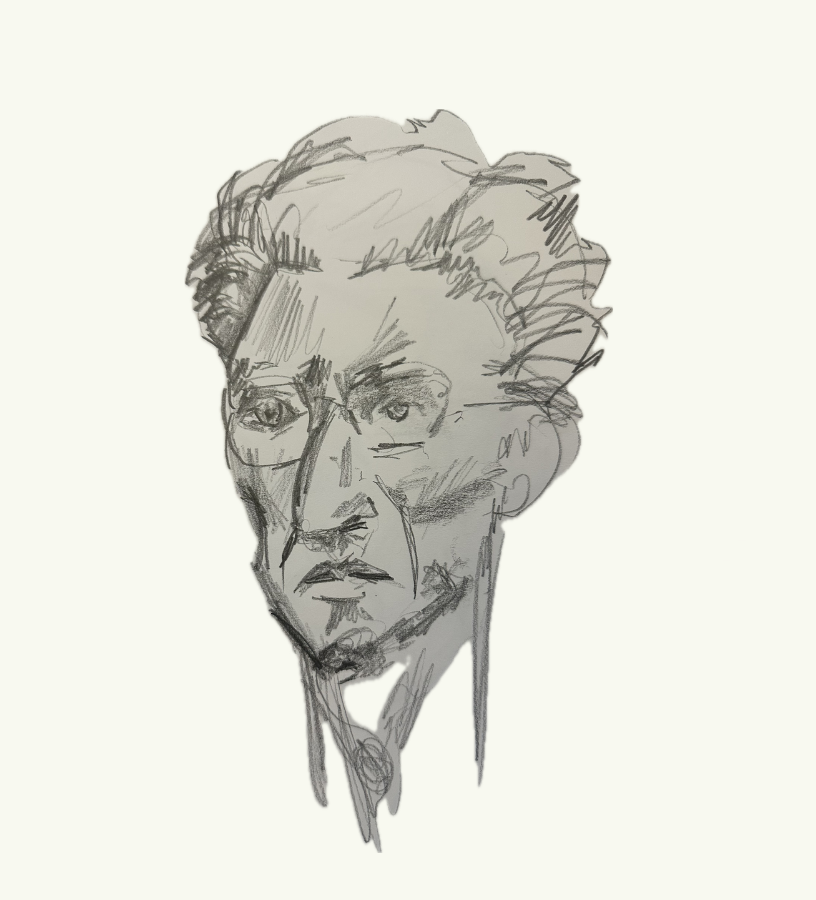
This was my entrée to what, over the course of the next four days, I discovered was something of a regional obsession. It seemed almost everyone I met in the environs of the Belbo valley had read Pavese, loved Pavese. Staying in old farmhouses, warming myself in cafés, I seemed to spot his picture everywhere, framed and mounted — the anguine face, the reticent expression. In the center of his hometown is the Fondazione Cesare Pavese, a four-story extension of the deconsecrated church he was baptised in. Really the whole of Santo Stefano is a shrine, a collective incorporation of Pavese’s memory made quite literal in 2001 when the townspeople dutifully organized a repatriation of his body from Turin to the cemetery on the outskirts of town.
In the spirit of the chapel it abuts, the foundation functions like a Pavesian reliquary. Displayed in glass cabinets are his handwritten letters, his well-worn editions of Thomas Mann, his glasses, his pipes. In a small room upstairs, a video tribute to Pavese’s literary legacy gives the novitiate the basic points of the Pavese story. But it comes with a curious slant. His career begins in earnest with translations of American colloquial authors — Melville, Anderson, Dos Passos, Steinbeck — which the video positions against the anti-fascist circles Pavese was then running in: translation as defiance, activism. Eventually his literary associations with Giulio Einaudi, his friendship with Leone Ginzburg, and a few stray letters lead to his arrest in 1935 by the blackshirts and a sentence of exile to Calabria. Little is made of his life in wartime and even less, for reasons that eventually become clear, of his brief and ill-fated turn to the Communist Party — an unfortunate sidenote in what is otherwise a fable of principle, opposition, and literature as a means of resistance. Quotes from his friends Natalia Ginzburg and Italo Calvino make sonorous endorsements not just of Pavese’s brilliance but of his ethic too.
And yet, how do we square this ethic with the fact that when the iron got hot, when the Nazis and partisans and his fellow piemontesi were unleashing their sacrifice of flesh upon the Belbo valley, Cesare Pavese was fifty kilometers north, in a hilltop village, paying as little attention as possible? Only those who traverse the unflinching hills of the Langhe and Monferrato will find anything resembling an answer. The region’s high provincial roads are dotted with reminders of the time when these hills were a disquieted battlefield, loyalists and republicchini alike coming to annihilation upon the soil. One of the more resonant monuments the walker comes across sits at the crest of the Falchetto hill, a rise which opens straight onto the entire Belbo valley, with Santo Stefano directly below. Strips of metal, contorted into the shape of a many-sharded flash stand on a plinth above a plaque that reads: “PER LA PACE UN PUGNO DI SANGUE.” For peace, a fistful of blood. Four dead partisans are named; one plaque reads IGNOTO. And somewhere down the valley, an hour by foot, a video installation is playing, turning an avoidant writer into one of Piedmont’s great anti-fascist heroes.
Pavese loved to walk. His city friends knew him as a compulsive itinerant traversing the streets of Turin, walking on the banks of the Po. Those who knew him in his home terrain — paesi suoi — remembered him as constantly afoot, climbing and descending the hills of the Belbo. When he was young he roamed to hunt snakes and gaze at the trees; when he was older he walked in search of quiet to read and think.
Traveling on foot suits the fervent mind: the somnambulant repetitions of each forward step, slowly guiding the thinker through an open landscape, help him carry himself off into some place deeper — and stay there. In the case of rivers, they seem an almost too-right metaphor for the conscious journey down the channel of ideas, which could be why, when we think of the great rivers, the Danube, the Volga, the Yangtze, we think of the minds they fostered. Turin’s neck of the Po might superficially remind one of the Viennese Danube — so august, so placid — but as one follows its curves southward, as Pavese liked to do, the river’s unkempt banks and gurgling tides become a remnant of a primordial world.
In testing times and in spiritual strife, Pavese sought out these two terrains — river and hill — like an addict compelled to his fix. If the Po was a more routine salvation — for a period in the early ‘30s he walked or swam it every day — the hills were usually reserved for more precipitous crises of conscience. His escape to Serralunga di Crea in 1943, his trips to the Belbo hills in the nadir of his postwar communist association, and his final journey to Santo Stefano in the late summer of 1950, months before his suicide, would all seem to indicate truly dark nights of the soul. And as went Pavese, so went his characters. One thinks of Anguilla’s fated homecoming in The Moon and the Bonfires, the moral void of the river in ‘Summer Storm,’ or poems like ‘South Seas,’ ‘Passion for Solitude,’ and ‘Ancestors.’ The hills were his lieu de retraite, in fiction and in life.
Pavese’s diary reads like a sequence of interrogations conjured during one long walk, one long escape of the mind. The issue is that, where the Po and the Belbo valley inevitably end, Pavese’s mind couldn’t. What begin as recapitulations and self-admonishments of his relationships, his earlier works, the tics of his literary style, give way to a Dante-esque descent into relentless self-flagellations in the second-person, tormented diagnoses of his inviolable character flaws, even corrections of his earlier entries. Yes, Pavese admonishes the admonishments. “He does not describe himself, but addresses himself,” wrote Susan Sontag. “He is the ironic, exhortatory, reproachful spectator of himself. The ultimate consequence of such a bracketed view of the self,” she continued, “would seem to have been, inevitably, suicide.”
The diary gives one the sense Pavese would have preferred to stop thinking — and writing — altogether. But his temperament didn’t allow it. His was the genre of svelte, diffident demeanour that could only suggest a rampant intellect beneath. The giveaway, for his friend Natalia Ginzburg, was his compulsive habit of taking a strand of his hair and curling it around his fingers. “We saw quite clearly the absurd and twisted mental convolutions in which he imprisoned his simple soul,” she wrote.
Were his wanderings merely a way of unyoking the mind, carving space for it to run free? Not entirely. In some senses they reprieved him of thought. In Santo Stefano he could revel in the simple pleasure of the Langhe’s distinctive dialect, still heard in the hills today. That slightly Gallic softness, mingled with that way Iberians have of circling around their sounds, requited his passion for linguistic sonority and vernacularism. He seemed to understand it automatically. The Langhe sunk him into a species of knowing that existed beyond thought, something innate — what he called “the stamp of your own knowledge of the world.” He gave it a symbolic dramatization in The House on the Hill, when Corrado flees the enemy through the woods and hillsides and ravines, guided only by his inborn regional memory, a compass bestowed by birth.
But what really drew Pavese out into the Langhe was the potent premonition that a sacred tissue connects spirit to earth. One of his recurring, almost talismanic images was of a soil “drenched with blood.” He got this from his home country, cultivated for centuries upon the terminal toil of its inhabitants. In the years of Italian Fascism the image became more than symbolic. Pavese’s country was sensuality, bloodlines, the trees of Virgil, freedom, love and death, humanism, eternity — in short, it was the realm of myth. “Whenever you are seized by the thrill of mythology,” read Pavese’s diary from August 1946, “you have in mind the tree trunks, the river, the hill with the moon behind it, the highroad, the scent of field and meadow of your own homeland.” It is impossible to walk the ridges and valleys and vineyard paths of Piedmont without gaining something of a slightly subterranean intuition. There is something unreal about them. The road appears as if dug out of the hill by hand, mounds of soft earth piled high by the shoulders and turns. In the vineyards, impossibly steep, one sights the occasional line of footprints in the damp foliage, a trace of an unmarked track, a silent songline in the vines. At midday a spontaneous chorale of churchbells, seemingly harmonised by the valley’s echoing outlay, reminds one to gaze upward, high towards the Moncucco hill, where standing watchful sentinel over Santo Stefano is a towering church dedicated to the Madonna.
Pavese spent the bleakest days of World War II beneath the penumbra of another hilltop sanctuary. Serralunga is a small village perched on a low hill about half the height of its neighbor, the sacred hill of Crea. Foneglio, a commune midway between them, is so wholly ensconced by both hills that one imagines it in almost permanent darkness. Small stands of grapevines cling to the scraps of light they’re offered; the houses are mossy and wet. Which makes the ascent to Serralunga something of a miracle: a five-minute climb extricates you out from dark and onto a rippling panorama of lands, distances, motions. To the east, the autumnal hills; to the north, the low plains leading to the highway connecting Monferrato to Turin; to the west, looming in the distance through a hazy sky, the snowy abutments of the Graian Alps; and looming up before you to the south the sacred hill, crowned at its peak by the stony outline of a tower where Cesare Pavese, for a summer and two winters, dissolved the reality of wartime in the unearthly shroud of God.
He was never made to be a soldier — his slender frame, his slouch, his bad eyesight, and finally his asthma wouldn’t permit it. Despite being drafted into the army in March 1943, he was given convalescence and forgotten about. Six months later, with Turin reduced to rubble, he was in Serralunga, reading Marlowe and Shakespeare and Milton, books on Hellenism, liturgy and tragedy. Less Gramsci’s man of flesh and blood, more Thomas Mann’s man without politics, the unpolitischen. His diaries from 1943 to 1945 scarcely mention the war at all.
When he wasn’t reading he was wandering up to the sanctuary on the hill. If the slopes of the Langhe were “the animal world, the eternal past, the unconscious mind,” Monferrato was the spiritual turned sacramental. In Santo Stefano he found myth; in Serralunga he found God. The hills of Piedmont are replete with sanctuaries and shrines, but few feel as dignified and impenetrable as the Sacro Monte di Crea. The potency of its iconography, its frescoed chapels peopled by life-sized terracotta Madonnas, pulled Pavese into a world outside the world. He indulged in the Petrarchan view that questions of earthly intrigue paled beneath the greater Christian questions: guilt, tolerance, the desire for solitude. Needless to say that, during wartime, these were hardly considered relevant questions. But Pavese, safely concealed by the sacred hill, had dropped all notions of the real. Only when news came of the death of his friend Leone, in the chambers of a Roman prison, did some shrill actuality interrupt his reverie. And even then his cure remained the same: he took to the winding road, ascended the hill on foot, and like one of Du Fu’s recluses, withdrew into the mist, alone.
The only detail we have of Pavese’s pre-WWII life that vaguely foretells his postwar liaison with communism is that, in the mid-30s, he bought his pupil Paolo Cinnani a copy of Das Kapital. Other than that, “libertarian” is the only descriptor that fits Pavese’s pre-1945 orientation and even that implies a little too much rectitude for Pavese’s political shrugging. “The society, completely controlled economically, is a contradiction of a society with complete spiritual freedom,” he wrote in his diary in February 1940. A month later he railed against the threat of “science-to-come” upon “the personal and physical life of the individual.” Then he hectored with finality: “All this talk of revolutions, this craze for seeing history in the making, these monumental posturings, are the consequence of our being saturated with history. We have grown used to treating the centuries as if they were pages in a book, and claim that we hear the trumpet blast of the future every time an ass brays.” Hardly the words of a comrade.
Pavese always had an abiding humanistic streak, a condolent feeling for “the peasant,” “the old gent,” “the hermit.” Still, however tangible a presence they played in his returns to the Belbo, his literary instincts always took over. He poeticised them in Hard Labor, allegorised them in The Harvesters. Whatever affinity he felt for the proletariat was not the stuff of ideology or doctrine. It was a sensibility, the resonance of shared myths.
A few years later, our recalcitrant ideologue’s identification with the toiling countryside constituency morphed into a fetish for the working classes. After so long residing in the ethereal realms of the fantastical, he had decided, finally, to fashion something concrete from the myth. Life in Turin is rather suspicious of myths; framed by the linden trees of Piazza Statuto, Pavese’s favourite square, an enormous fountain pays tribute not to the deities or spirits but to the engineers who drilled a tunnel in the Col du Fréjus. Pavese’s Turin was the city of the worker, the city of soot and the flesh, the iron protectorate of Italian industry. A city of metallurgy, textiles, manufacturing, and, of course, automotives — and the proliferation of industries engendered a swelling body of laborers and their factory councils. When Mussolini visited the city in October 1923, only a year into his not-yet-consolidated rule, he could scarcely hide his disgust. So many disobedient workers, all in one place? Workers overheard him saying they should starve to death. His tempestuous visits in the ‘30s hardly cooled his sentiments. The city became a crucible of agitation. Factories were raided and workers were disappeared.
Pavese often wrote about Turin as a city of death, of lonely suicides, of spiritual decay. This darkness was given its fullest articulation in Among Women Only, his novella about the moral degeneration among Turin’s postwar cultured classes, adapted with consummate dourness by Antonioni in 1955. (Sontag considered Pavese and Antonioni a perfect match.) But for years before then, this decadent death-drive had been sprinkled not only into Pavese’s work but into many of the literary missives dispatched from the city’s arcaded streets. “It has a modern form, but its spirit is that of a grave . . . antiquity,” said the traveler Elizabeth Missing Sewell, visiting in 1862. Giorgio de Chirico called Turin “the most profound, enigmatic and disturbing city not only in Italy, but in the world.” Its beauty, he said, was that of the Gorgon: it “can in some cases be fatal.” He was probably thinking of Nietzsche, who went to Turin, spied the spirit of “my Zarathustra,” and then collapsed into complete insanity.
Pavese swooned for Turin — if Santo Stefano was his “mother” or his “sister,” he wrote, Turin was his “lover” — but it was a love affair of douleur exquise. His Turinese tales featured men beating their women and throwing them into the Po, lifelong friendships disintegrating beneath the lights of a café, and miserable love affairs ending in a gas-soaked bedroom. “The city’s essential nature is melancholy,” wrote Natalia Ginzburg; a characteristic which, “we realize now, resembles the friend we lost, who loved it dearly. It is industrious, as he was, frowning in its fevered, stubborn busyness, yet at the same time indolent, inclined to be idle and dream.”
Pavese’s decision to join the PCI smacked of this Turinese dualism: a dogged act performed by an idle mind. Smacked, too, of a need to compensate for what had been, up to 1945, a rather lackluster political record. His exile to Calabria in 1935 was the sole action of note, and even that felt somewhat happenstance. Within his circle of Turinese literati in the 1930s, Pavese was, famously, the group’s noncommitted member. They signed manifestos; he derided such foolhardy gestures. They talked of revolution; he, the diffident equivocator, advocated “enjoying things as they are.” When his friends asked why he was so indifferent, he would say demurely, “Only I know.”
But he had a sense of the propriety of brotherly bonds. After the arrest of Leone Ginzburg, Pavese had suggested to his boss, the publisher Giulio Einaudi, that he might take his best friend’s post as editor of Einaudi’s left-wing periodical La cultura, leading to his arrest in May 1935. At his trial he said nothing. Of a three-year sentence of exile in Brancaleone, he was released after ten months, unradicalized. His overriding memories of Calabria, he later recounted, was a boredom with the region’s scorched oceanside terrain, and a nostalgia for having endless time to think.
Perhaps one could have made the tortured case that Pavese’s translations for Einaudi were his act of resistance, though Pavese himself did not imply that he felt that way about this work until many years later. “Italy in those days,” he wrote in 1948, “was estranged, barbarized, and calcified. It had to be shaken, decongested, and re-exposed to all the spring winds of Europe and the world. . . . We discovered Italy— this is the point— seeking the men and the words in America, Russia, France, and Spain.” But an attempt to synthesize a new strain of Italian idiolect, modeled on American vernacular, was hardly so striking an ordinance. Not when, all across Europe, men of letters were turning men of war: vocally supporting the Marxist cause, escaping from the clutches of the Gestapo, commandeering war bombers without a pilot’s license, keeping the Nazis out of Strasbourg, and writing their books.
On the other end of the scale were authors like Jean Giono who, witness to the unsparing obliteration of human life in the Battle of Verdun, hardened into a staunch and unswaying pacifist for the rest of his years. But Pavese had no such principle. Surrounded as he was by “committed” writers and thinkers, he could only try to ape their partisanship by finding his own way into it. That way was, one might say, literary, an interest in the “ideas” of it all. He dwelled at the point where practice could be raised to myth, myth lowered to practice.
Then again, he was viscerally affected — and how could he not be — by the comprehension that, while he’d been studying the Shakespeare collectanea, his friends were being imprisoned, interrogated, tortured, killed. Word arrived that even one of his students, a young man named Gaspare Pajetta, had given his life for la patria. “Remember, Gaspare,” Pavese had once told him: “today one cannot be a good Italian if one does not kill a German.” It turned out a tragic prophesy, made inescapably real by Gaspare’s death. There was only one solution: an act of self-annihilating recompense.
Pavese joined the cell of the PCI named after Gaspare, and with the phlegmiest of rhetorical throat-clearings he committed to the part. He began penning editorials for L’Unita, doling out the obligatory “comrade,” talking of “man” and “the people.” “In our trade,” he wrote in May 1946, “there is not a moment in which one can decide to write from now on in a certain way, to speak for a certain class or for certain interests. We can do it but then we sell out, even if the group which buys us is the working class. In our trade one does not go toward something: one is something.” Those who didn’t buy the bombast, who broke from the Party over a perceived threat to “liberty” — the same threat of which he was once so cognizant — Pavese denounced as quixotics who “ought to ask themselves what they would do with this liberty that they are so concerned about.”
It was the kind of extraordinary volte-face that only an extremely skilled and extremely deluded writer could pull off. His biographer Davide Lajolo — himself a committed communist — presents it as a product of Pavese’s almost inevitable realization, amidst the rubble and wreck of the fascist years, that art and politics were inseparable. One can’t help but feel a suspicion of the biographer projecting upon the subject, especially when Pavese’s own reasoning was so tendentious. In 1946 he was asked warily by the Party why he’d bothered joining. “Is it possible for someone to become a Communist out of love for freedom?” he returned. “It has happened to some of us. . . . Nothing of value can come from our pens if not as the result of a collision with things and men. He alone is free who becomes part of reality and transforms it, not one who lives in the clouds…” Pretty words, pretty sentiments, but coming from the man who perceived blood in the hills and the looming shadow of the subconscious in everything, it is clear how blind the great seer could be if, in the moment, it suited him.
It was inevitable that the carapace would collapse. Pavese never could lie for too long; his inner needs always overcame his outward appearances. In short order his relationship with the PCI grew strained, and as the Party adopted the Zhdanovist position — that no art wander astray from the party line — Pavese’s half-dormant aestheticism was violently reawakened. He grew disillusioned and cynical. “A meeting of the Party,” he confessed in June 1947, “has all the characteristics of a religious rite. We listen to be assured of what we already think, to be exalted by our common faith and confession.” Communism, for Pavese, was an intellectual exercise, and once it had dried of its potency, he relinquished it. Away from the social(ist) realism of his former comrades, away from the neorealism prevailing in the national literature and cinema — up and off he flew, once again, into the realm of the imaginary. First he concocted a book of invented conversations between figures of Greek mythology, Dialogues with Leucò. Half-heartedly he attempted to propitiate his critics with a “party line” novel, The Comrade, before promptly dropping all trace of its programmatism and receding into a newly synthesised strain: what he called “symbolic reality.” The products of this period are his masterpieces: The House on the Hill, The Devil in the Hills, Among Women Only, and finally, The Moon and the Bonfires.
In them, everything “real” is elevated to symbolic proportions. The conversations in Devil read like a volley of allusive innuendos among immovable caricatures. The streets of Turin in Among Women Only are a mirage reeking of rancid bouquets. The Moon and the Bonfires, most bracing of all, is the culmination of his lifelong investment of hills, earth, of life itself with quasi-divine properties. Predictably he’d written it after fleeing to the Belbo in his hour of disquiet, as the communists were stomping their feet and he felt his political affiliations “crushing” him. Sensing his looming temptation to suicide more strongly, he channeled almost two decades of passions, obsessions, images and reveries into this, the finale of his oeuvre. The book ends, typically, with disillusion and a coup de grâce of communal violence.
He finished it and felt so completed, so emptied out, and so accomplished in his art that he decided he needn’t write anything further. He told the critic Aldo Camerino in May 1950, “The Moon and the Bonfires is the book I have carried in me the longest and which I most enjoyed writing. So much so that I think I shall do nothing else for a long time — perhaps forever.”
“My lot is to hug shadows,” he wrote in a letter dated July 6, 1950. One month later, across from the grand glass façade of Torino Porta Nuova, and just a short walk from the somewhat plain apartment where he’d lived for twenty years with his sister, Pavese took a five-by-three room in the Aubergo di Roma, lied down on the bed, and ingested sixteen packets of barbiturates. He was found the next evening by a hotel employee, alongside a suicide note echoing Mayakovsky’s, inscribed in a copy of his Dialogues with Leucò: “I forgive everyone and ask forgiveness of everyone. Okay? Not too much gossip, please.”
In a small square chamber on the third floor of the Fondazione Pavese building in Santo Stefano, Pavese’s copy of Leucò, opened to his faded fountain-pen suicide note, brings a shiver down the spine. At first he was memorialized as a lost genius; eventually came the censures. Moravia called him a “decadent.” Calvino, who’d worked under Pavese’s wing at Einaudi, mourned the waste of a mind: “a child in the world of adults, a man without a profession in a working world, without a woman in the world of love and the family, defenseless in a world of bloody political battle and civil duties.” Even Natalia Ginzburg couldn’t avoid it: he “lived in the city like an adolescent,” she wrote, “and lived that way until the end.” Nobody seemed surprised at his death. Something in his philosophy had made it inevitable, a natural devolution of an idea he had concretized in his youth. As he put it in 1937: “Almost all men can retrace, in their childhood, the signs foreshadowing their adult agony. . . . Contemplate this horror always: what has been, will be.”
Which is what made the sight of that book so disturbing. Here was a man chained to the fate of his self-committed demise; in a sense, his entire life was a journey towards that book, those faded words. His burden was the belief that man was unchanging, unchangeable, and that the remedy was not a struggle but a renunciation of life. It was a worldview he borrowed, predictably, from antiquity. “The theme in Greek tragedy is: what should be, must be,” he wrote in 1942. The emphasis is his. And it was what, ultimately, estranged him from his age. In a time and a culture that wanted to believe, more than anything else, that the mutable human psyche could be guided towards the utopian ideal, that a social fabric could be unwound and rewound, that to continue the struggle was virtuous and that our human condition accommodated the freedom of agency, there was Pavese, believing none of it. Pavese’s man was a lost wanderer rooting his choices in an inner soil soaked in the blood of the past. As I stared at that book, the old saying suddenly seemed true to me: run all you like, but you can’t hide from the world. It was Pavese’s ethos, his cursed philosophy, and, in the end, a rather unpolitical position.