
Yasujirō Ozu is from a different time and place in the sense that in the place where he is from, time does not behave the way our time does. Shigehiko Hasumi, the Japanese literary and film critic and Flaubert scholar (who drew on the methods of the Cahiers du Cinema critics of the ‘50s in his work), keyed into the mysterious realms of Ozu unlike most others, as the small butte of English-language Ozu studies recently grew with the translation of Hasumi’s 1983 book Directed by Yasujirō Ozu. The work’s glittering kernel concerned how most everything the Western critics thought about Ozu, though well-mannered, was misguided because of their fetishization of Japanese culture. Hasumi: “There are details that clearly appear extraneous when viewed through the lens of social realities like the dissolution of the household, and it is with the purpose of affirming these details that we have introduced the concept of the thematic system . . . what requires attention in cinema are traces of these palpable things ingrained on the cinematic surface.” In other words, disregard the themes and watch the films. Open up your eyes to see what is there.
Hasumi instructs that “in cinema, the tendency to overread often corresponds to the poverty of what one has seen. People compensate for having left things unseen by thinking and talking about shots.” The objects are there because we live amongst objects. Of course, when we see an Ozu film we know it’s either from the ‘30s, ‘40s, ‘50s or even the first few years of the ‘60s, though the lush color of those later films does something special, they lacquer and present as the deep color blocks of painters, particularly Manet, whose patented flatness created a unique modern perspective with which to view the world.
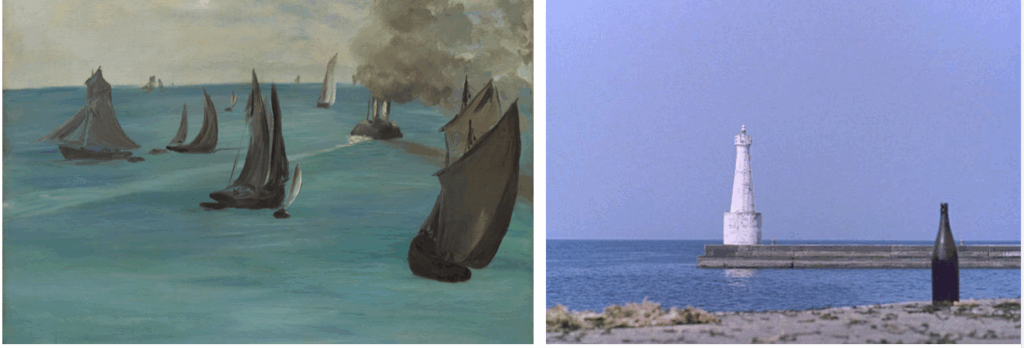
Here is Manet’s Steamboat Leaving Boulogne from 1864. And the first shot of Ozu’s Floating Weeds, 1959. Side by side one wouldn’t think these pictures were made 100 years apart. But Ozu’s films (he employs a 50mm lens, the closest to human perspective that also flattens the image) are from an everlasting time that never stops, that keeps giving and going — Merleau-Ponty knew: “When we confront a genuine [artwork] we know that a contact has been established with something, that something has been gained for men; and the work of art transmits an uninterrupted message. But the meaning of the work for the artist or for the public cannot be stated except by the work itself.” How does Ozu’s time compare with the way time functions in the films of directors with whom he is often grouped? Carl Dreyer (1889–1968) is from another time in a much different way. How about Kenji Mizoguchi (1898–1956)? John Ford (1894–1973)? They all started in silent film. Take the year 1955, in which they produced, respectively, Ordet, Clan Taira Saga, Early Spring, and The Searchers. Dreyer and Ozu films have more surface affinities, as do Mizoguchi and Ford. The first two are more indoor, the latter are drawn to landscape and larger staging, with greater movement in the camera, though of Ford Jean Renoir once said, “Today Ford taught me how not to move the camera.” In some respects Ford and Ozu have more in common since they depend more on editing than long takes, as Dreyer and Mizoguchi are more given to the longue durée.
.jpg)
Tokyo Story is 136 minutes long. How long is that in Ozu time? Does it take place on the same earth we are sitting and standing on? Since people are eating and laughing and crying (plus disappearing up stairs from the ground floor and reappearing on the second) it certainly seems so. Ozu’s films were created in studios in Japan before and after the war. Certainly they take place in the country called Japan. Buddhism left its mark in these movies — there are scenes of traditional singing, Noh theater, temples, altars, and prayer. Are pillows as common and ordinary a fixture of our lives as they are in Ozu’s universe? Leigh Singer writes: “In between Ozu’s carefully composed scenes are seemingly random shots, held for several seconds, of everyday life: of seas and mountains, boats and train tracks, public buildings and private rooms.” We set the scene before us all the time. The brief static shots have often been called “poetic” — images and metaphors for other emotions, other feelings.
The pillow shots also broach his concept of character. His men are often seen in the process of working, tabulating, ordering, while the mothers stay home, do the housework and watch the children, or, as young women, work office jobs as secretaries. In the way that pillow shots are soft and breezy, Ozu’s characters are gentle. In Ozu’s films, people smile and put on a happy face with others, especially non-relatives. At the end of Tokyo Story the father smiles as he speaks with his neighbor about his dead wife. His honor and respect are part of the art on which people depend on Ozu to provide — we want to be nourished by his humanity.
How does one get to Ozu’s universe? In The End of Summer there is a shot that has never been duplicated in cinema history — at least as far as I know. It appears when the family in the film goes to the Hozu River and two sisters walk to the water and kneel down beside it.
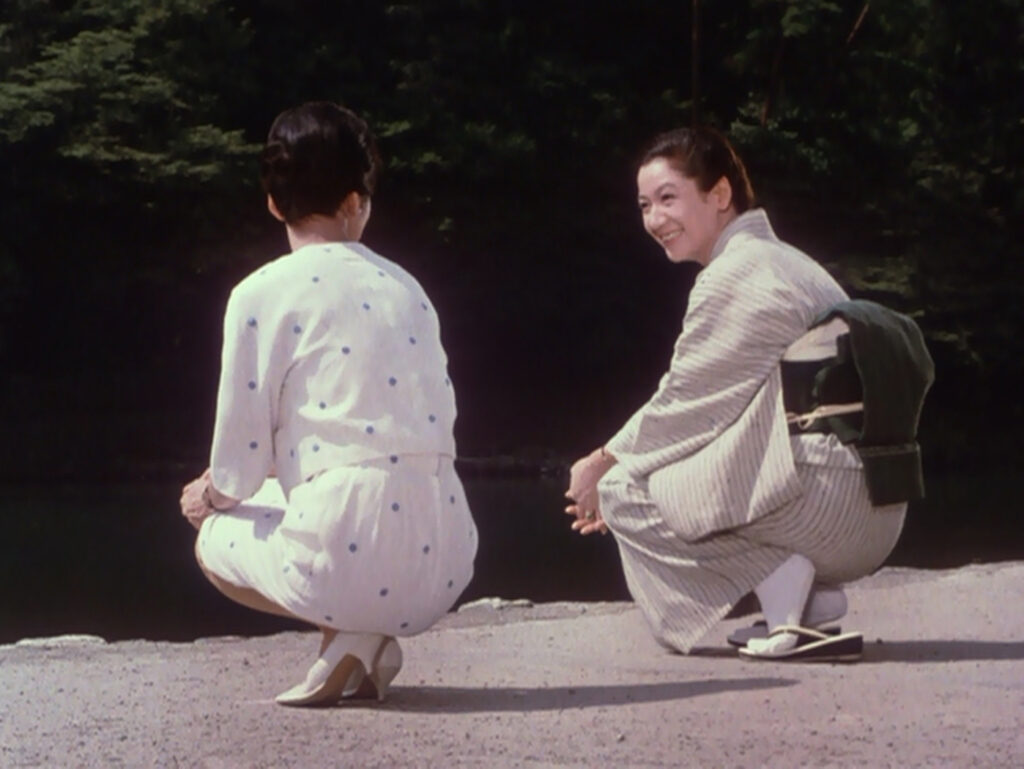
The End of Summer (1961); 53:22
Outdoor disclosures in Ozu tend to be either euphoric or biting. Think of the parents in Tokyo Story or the sisters on the hill in Early Summer. While they might be revealing, more or less, they are of a certain tang and vibrancy, given the outdoor world they speak in. This is true in our universe too: having trees and water nearby changes the tone and shape of words and sentences, concepts, trains of thought, and so forth. A dialogue takes place in Late Spring between the father and his friend while they are sitting on the steps of a Japanese garden. Afterwards, the friend notes that the father has permitted his daughter to leave the family home to get married and the father responds:
“But a son is better than any daughter.” (They look out.) “Raise them and off they go. If they’re unwed you worry. But if they do marry you feel let down.”
“But didn’t we marry other men’s daughters?”
“You have a point.” (They laugh and look out at the garden.)
One wonders how Ozu came to “write” such human scenes? It is known that he wrote the screenplays together with a collaborator, Kōgo Noda, but he also crafted his cinematic space. How did he do that? The color films from 1958 onwards introduced a new them — laughing at death — that reached its highest expression in Late Autumn, which begins at the celebration of a man who died six years before, the husband of Setsu Hara’s character and the father of Ayako, who doesn’t want to get married. When the three friends of the dead man are alone, two talk of him and his widow:
“A man who marries a woman so beautiful is destined to die young.”
“Miwa used his luck up too fast.”
One of Hasumi’s chapters is called Looking. In it he writes:
In Ozu, people who are intimate do not face one another directly. They look out at something instead, casting parallel gazes as the camera films them from behind and at a diagonal. They express their empathy with their backs, their waists, sometimes their legs. Lyricism in Ozu reaches its highest expression through backs that exhibit exceptional eloquence without so much as a hint of movement.
One scene in Late Autumn demonstrates something akin, though they are not side by side. The mother and daughter at a country resort eat and then, after the mother says, “I’ll always remember our meals here together,” they slowly look out the window at the V-shaped verdure of a small mountain with a river below it:
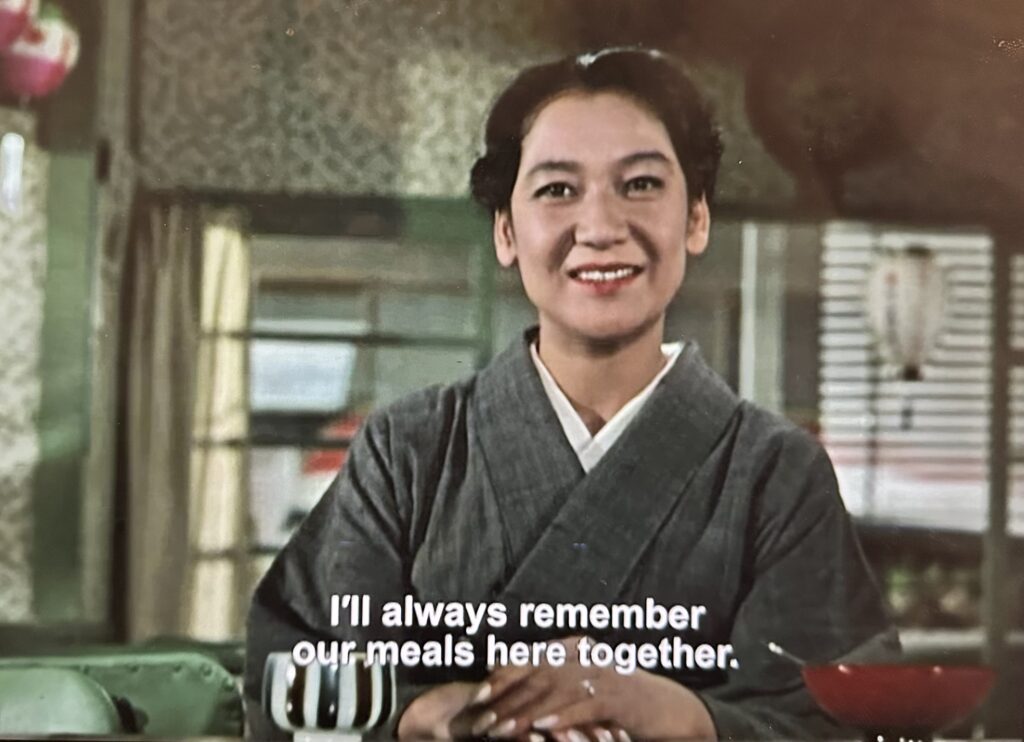
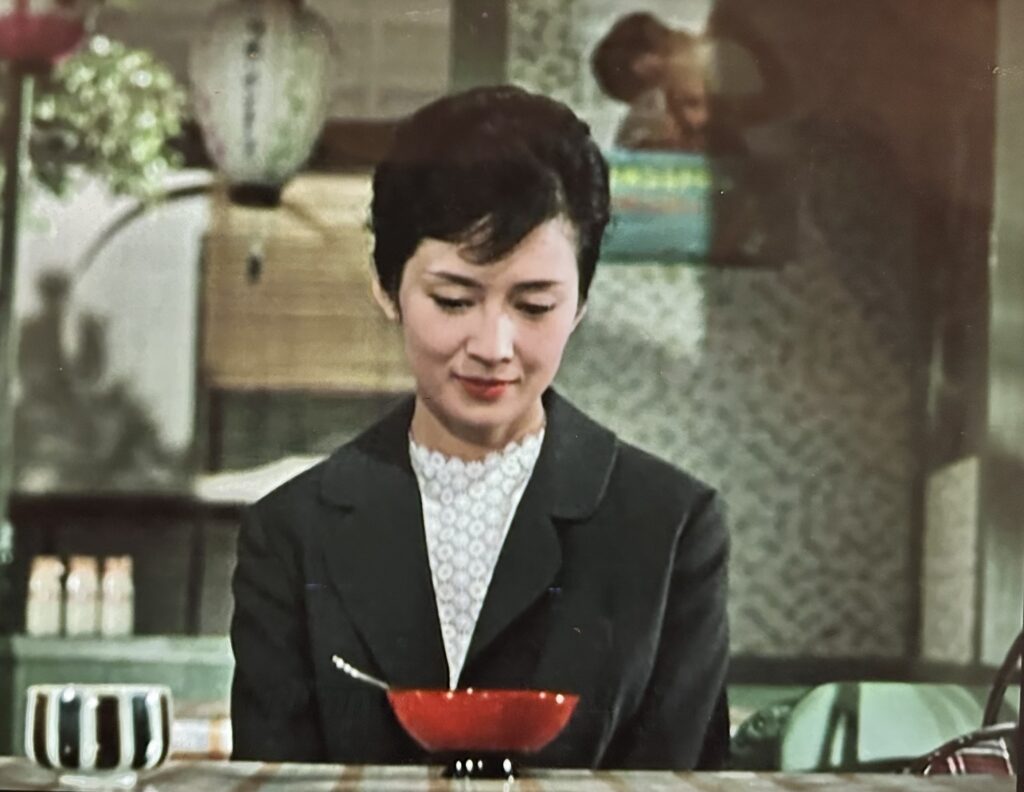
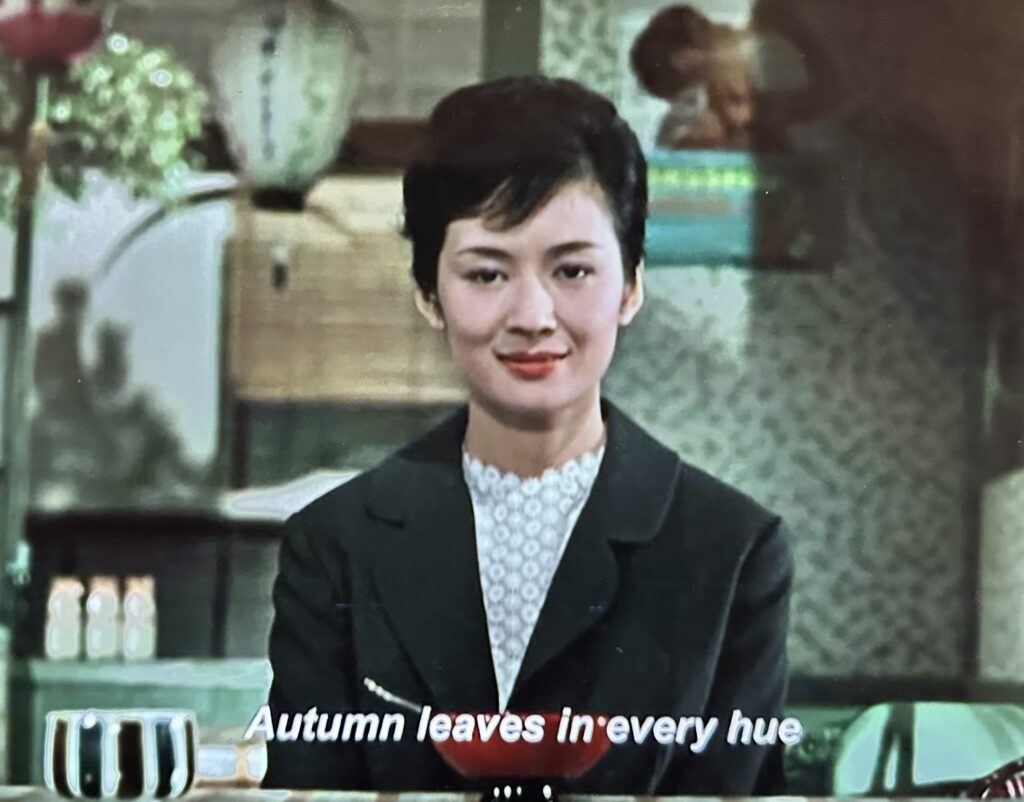
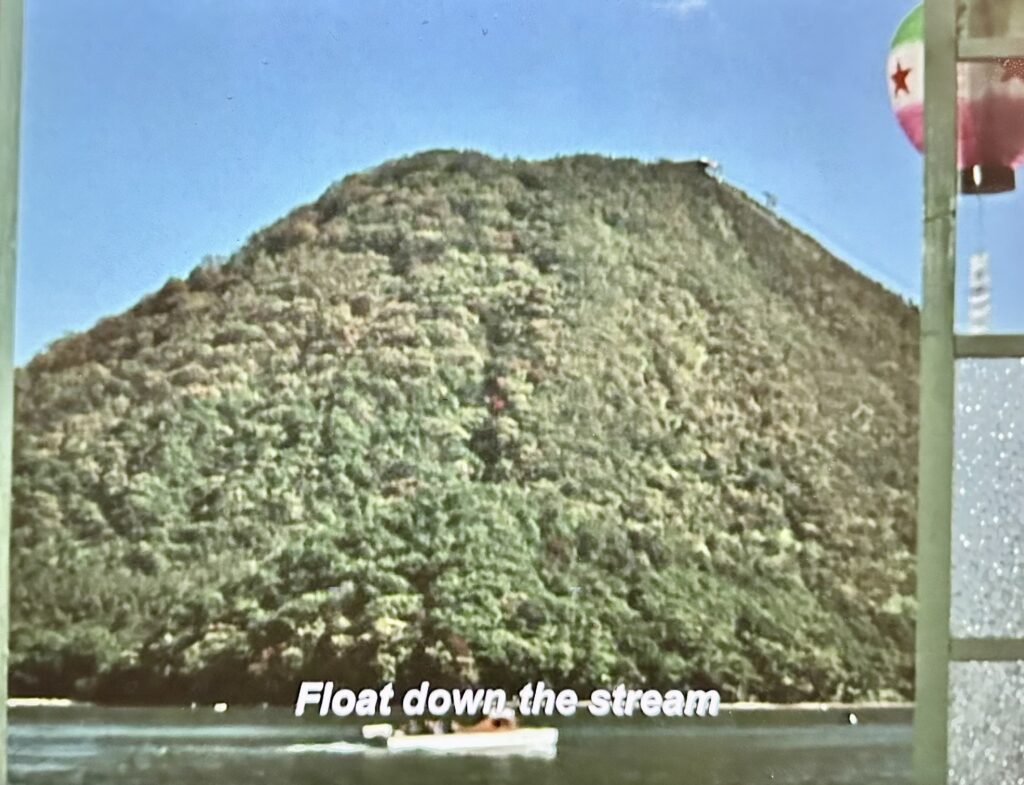
Late Autumn (1960); 2:00:19-2:00:31
Does this evoke a sense of “empathy” truly? Empathy is a tricky emotion, it slides into and out of itself. Emerson: “Our moods don’t believe in each other.” Don’t we look at nature when we need our unspoken emotions to bounce off the verdure, rock, or water? Fernando Pessoa’s poet Cairo wrote, “To think about nothing / Is to fully possess the soul.” That tall mountain of green in Japan is not just for the characters — it’s for us, the audience, which gives us a chance for some feeling of our own to be evoked or not, though to be “evoked” is perhaps too harsh an expectation. One can go back to Bresson:
Art is both abstract and suggestive at the same time. You can’t show everything. If you do, it’s no longer art. The great difficulty for filmmakers is precisely not to show things. Ideally, nothing should be shown, but that’s impossible. So things must be shown from one sole angle that evokes all other angles without showing them. We must let the viewer gradually imagine, hope to imagine, and keep them in a constant state of anticipation. . . . Life is mysterious, and we should see that on-screen. The effects of things must always be shown before their cause, like in real life. We’re unaware of the causes of most of the events we witness. We see the effects and only later discover the cause.
When Ozu’s characters look at something which the camera does not show, the audience sees the people looking, watching them to see what they see. Ozu does not show what a character experiences (a la Bresson), but suggests it in metaphors, so we can experience better what Ozu elicits in us. The world in which his characters live establishes a corollary world in us. For instance, in the middle of Hen in the Wind, Kinuyo Tanaka and her friend sit on a hill watching the former’s 3-year-old son play (he survived a night in the hospital three weeks before). Her friend says, “He’s at the happiest age . . . I wonder what we were doing at his age. What was on our minds then?” to which Tanaka responds, “They say I wanted to marry a policeman. My departed mother used to tell me that.” As I watched this I heard my wife cleaning the kitchen (lazy me), which brought back my own childhood memories of my mother cleaning in another room or cutting coupons. My private Ozuesque memories were imbricated by this scene in Hen, in which it seemed the characters were talking to me, the viewer, telling me about their lives so I could tell them about mine. I was on the hill with them (hills are key in Ozu). What was I doing at this age? I was waiting to watch the garbage men early on Tuesday morning. Here is the golden chamber of the Other Place.
In addition to dialogue and shots there is also the Other Place of films behind films as Hasumi writes about in his conclusion:
The shots that make up the whole of Tokyo Story, a film in which there is not a single drop of rain, hide the shots that do show rain in Floating Weeds. The fact that all the shots in Early Summer exclude stairs hides the staircase shot that does appear at the end of An Autumn Afternoon . . . shots in Ozu only hide other shots, or else they simply lay themselves bare under the radiating brightness of the midsummer sun. In looking at a shot, the eye either becomes suspended in midair or else slides sideways toward other shots.
This is the best approximation of how an oeuvre settles into the dusk of our evenings on earth. Our cinematographic memories of one great artist’s work reverberate across the landscapes, spaces, actors, and colors that mix in our minds so we can speak of the feeling of “Ozu” as one as multifaceted as the word “logos.” Though it goes beyond music and motion, laughter or crying. And in Ozu’s case, his films were not widely seen until the 1970s — only for fifty years or so has Ozu’s impact been felt on a large scale, as opposed to the hundreds of years that Shakespeare and Poussin have influenced.
There is no violence in Ozu aside from some tart recriminations — and the few early crime films — though there are certainly deaths, most of which occur off-screen. The cycle of death is interwoven into the seasons (those title-markers), as Hasumi points out:
Without exception, the elderly breathe their last on cloudless sunny days. Tokyo Story is an especially significant film in this respect, because the clear weather and high temperature are captured in black and white. The later color films lack the dull, dry texture of the images described here. No other films evoke the glare of sunlight quite so cruelly as this one, despite the fact that it contains not all that many low-angle shots directed at the sky.
Ozu’s oeuvre could be considered an almanac in a way, as he works throughout all the seasons, though winter is mostly only pictured in Tokyo Twilight and Good Morning. And no consideration of Ozu could stand stolid without words about his acting troupe, particularly Hara and Chishū Ryū. I have rarely seen such looks of disdain as when Ryū speaks to Hara in Tokyo Twilight. Hara can simultaneously be a Medusa and an angel, even in the same film. Hasumi sums up Ryū as stepping into the roles of the sometimes unaware widower with a young daughter to marry off, as he writes: “When . . . Ryū receives Ozu’s gaze through the camera, he transforms with a smile into characters of all kinds . . . if [he] is an uncanny presence, an actor who is at once any character and no character at all . . . it is because of the way the expressionlessness of this man . . . exposes a shape-shifting vacancy . . . like that of a ghost.”
And as the year swept into the beautiful warm light of October, I whispered to those who had not seen him to seek out Ozu so as to cleanse and transform their notions about life. I had become the older friend who first set the kindling of Ozu to my feet thirty years ago. Pondering Ozu, I often begin to think of the question: How and why do we show Ozu to others? What do we get out of it? They are being taken to the Other Place or to a place that can become the Other Place for them, whatever that is. Think of the early scene in A Hen in the Wind where the toddler of Tanaka almost dies in the hospital. After he survives (and is sleeping soundly), she hovers over him while speaking a heart-hurting monologue: “If anything had happened to you, I would have gone with you. I’m glad I didn’t have to do that. . . . What shall I do about the payment? I don’t have the money. What should I do?” By watching such harrowing scenes with people we are brought much closer together and maybe are impelled to share more. It’s a wondrous experience — the showing and sharing of art, the nestling of light and love with other human souls — we are living to remember those who passed on but also to be intimate with those living, to tell them our secrets and dreams, to love.
And in the dreary cold light of the last day of November, it came to me how I had always wanted to share art with other people, mostly films — and to control our time together, yes… but also to take comfort in that sharing, whichever ways those heat mists and electricity between people might run, either to sharer, sharee, or both. Comfort in this case meant one didn’t have to think of death or barely at all since Ozu was doing that for us. And because I had this thought, other water courses on my old mountain opened and I could feel the feelings that I had shut off — I could talk about my parents and their families and all the suicides contained in those old photographs that few knew about. I spoke about these events and the past like someone out of Ozu. The hangups were gone and the rituals could continue, because in the streams of honor and remembrance (the core of many later Ozu films) fear dissolves and at times, by being in the moment, is almost swallowed up — as all fear is being afraid of the moment to come. Ozu films were no longer the therapy against the tragic befalling our life, they were the monuments that glittered in the ruins one must search around in after the inevitable tragedy hits. An astute but unheralded commentator on a film website said of Ozu’s films that his characters demonstrate one truism — the older one gets, the more they sense the coming of nothing and they push away from it. I refer to this because unlike many of those characters I was not pushing away, I let it happen, and in terms of the Faulknerian equation, I took grief rather than nothing. And even if his characters did not take grief all the time, Ozu certainly did.
Like the sun, Ozu was there for me until I wasn’t there for me and when I came back to myself, Ozu was still there. He had needed me to look at my fear of death in the same cinematic ways he had, instead of frozen in anxiety, playing endless reels of fear-based imagery and words while I stalked around New York City and watched technology turn us into the quietest savages in human history, with myself as case study number one. This is why the death of the father at the mistress’ house in The End of Summer is so astonishing — the audience doesn’t know he’s dead for some minutes, only puzzling this out from how people talk about him. His family gets the call from the mistress that they should come over. Before they arrive, the mistress and her daughter talk while the former fans the man laying before them. The daughter says she should have claimed the mink stole that the man wanted to buy her, but does she say that because he is sick or because he is gone? The children arrive but the mistress does not answer the question, How is he doing? They kneel beside him when she finally says, “It happened so suddenly. The time was 8:23.” Now the audience realizes this is a dead body before our eyes — what are we supposed to do with that? But we have no choice — it’s there already and one must repair and make amends. And this is what art gives us. It lets us practice for the real thing with a work that is true.