
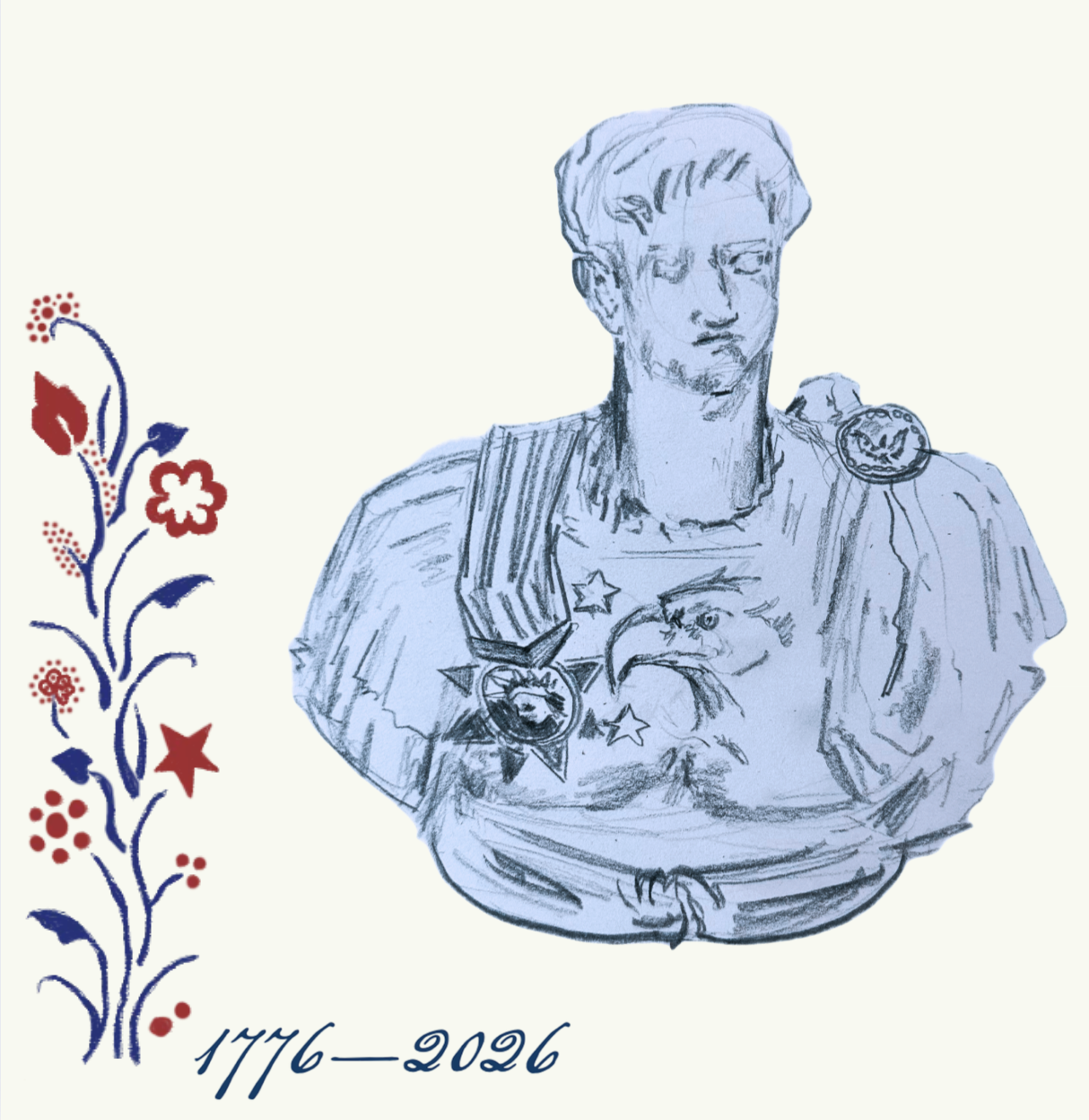
It is a very unhappy birthday for the American Republic, to say the least. These days, barely a week goes by when Franklin’s admonition upon leaving the Constitutional Convention “ — if you can keep it” doesn’t echo in the mind. As the inauspicious sestercentennial approaches, the summer is already shaping up to be a season of ludi saeculares — full of jingoistic pageantry, military parades, the World Cup, gladiatorial games at the White House. The Roman Republic inevitably comes to mind (as opeds about America the world over attest). So many things are reminiscent of the ancients: wars in Persia, the erection of triumphal arches; the president gifting his subordinates oversized shoes that they obediently clomp around in (a detail Suetonius would have loved); and of course, the odious executive, in all his philistinism, cruelty, solipsism, sin, and ignorance, has never been more deserving of Tacitean scorn.
Perhaps this is why I’ve lately been immersed in the classics, returning to those great chroniclers of the end of the republic (Cicero, Sallust, Appian), searching not for History’s repetition, but some kind of rhyme. This feeling was recently reinforced when I read Bruce Ackerman’s 2010 book, The Decline and Fall of the American Republic. Despite its Gibbonian title, Ackerman is anything but a cynical declinist. He is less concerned with vague notions of moral rot, withering leadership, loss of economic or military supremacy, than he is about institutional pathologies. A legalist, he is preoccupied with structures, not personalities. Published at the height of the Obama era, and what Ackerman dubs a misplaced “triumphalist” phase of Constitutional thought, he identifies several currents that portend the rise of a dictatorial presidency. What will such a presidency look like? He predicted:
(1) the evolving system of presidential nominations will lead to the election of an increasing number of charismatic outsider types who gain office by mobilizing activist support for extremist programs . . . (2) all presidents . . . will rely on media consultants to design streams of sound bites aimed at narrowly segmented micropublics, generating a politics of unreason that will often dominate public debate; (3) they will increasingly govern through their White House staff of superloyalists, issuing executive orders that their staffers will impose on the federal bureaucracy even when they conflict with congressional mandates; (4) they will engage with an increasingly politicized military in ways that may greatly expand their effective power to put their executive orders into force throughout the nation; (5) they will legitimate their unilateral actions through an expansive use of emergency powers, and (6) assert “mandates from the People” to evade or ignore congressional statutes when public opinion polls support decisive action; (7) they will rely on elite lawyers in the executive branch to write up learned opinions that vindicate the constitutionality of their most blatant power grabs.
The above, Ackerman argues, represents “the dynamics of decline and fall for the American Republic” — while hastening to clarify that, “the fall of the Republic is compatible with the continuation of American empire.” This shouldn’t come as news to anyone. The trends and precedents outlined here have been developing for decades. Still, it is remarkable to look at this prognosis, written during the peak of Obama optimism, and not see our present situation. The collapse of any system is never one thing. The causes are multifarious, and Ackerman looks at other phenomena as well — the politicization of the military, the demotion of legacy media, the manipulation of public opinion through strategists, polling, and new outlets that allow presidents to bypass institutional channels and speak directly to their base; but his main focus is on the enlargement of the executive bureaucracy, which he calls “the most dangerous branch.”
The Framers didn’t foresee the modern presidency as a swollen bureaucracy, as they could not have foreseen the rise of the modern administrative state in general. They could not have anticipated, for instance, that the number of positions the president is now able to appoint exceeds over 4,000, of which, only about 1,200 require senate confirmation. The staff of the Executive Office in the White House ranges anywhere from 400 to 500. Many of these, the so-called “Czars” (not a term one would wish to use under any circumstances) are not senate-approved and often wield more power than cabinet secretaries, operating with little accountability. The president is therefore likely to fill these positions with loyalists, compromising (what should be) the neutrality of agencies that are nominally independent of the White House. We have seen under the second Trump administration the ways in which the presidential bureaucracy is guided by a kind of Führerprinzip, where a batch of sycophants fight amongst themselves to get closer to some vague understanding of what the president desires. Those who fail to do the president’s bidding are summarily fired and replaced with even more servile lackeys. Those who succeed, but do so in a way that provokes public outcry, likewise have their heads chopped off. The lesson is learned: loyalty to the president, not the duties of the office, is a precondition for the job, and no one is safe.
The White House Counsel and Legal Counsel of the DOJ are the most crucial, the chorus of lawyers ever in Caesar’s ear, advising him on the finesseable constitutionality of his every move. Ackerman cites the “Torture Memos” drafted by John Yoo during his time as legal counsel for the Bush administration, in which he privately advised the president on the legality of blatant violations of executive privilege, habeas corpus, the Geneva Convention, and the Declaration of Human Rights, among others. Unsurprisingly, Yoo has since written a grovelling apologia for Trump’s dictatorial ambitions and has argued that the president has the inherent authority to subjugate all government agencies to his will in a time of national emergency (however vaguely defined). The current legal counsel, T. Elliot Gaiser, a Trump stalwart, has rejected the results of the 2020 election and drafted memos defending the legality of the kidnapping of Maduro and U.S. Airstrikes on alleged drug boats in the Caribbean in 2025, making a mockery of the War Powers Resolution.
The Constitution gives the president a “first-mover” advantage, which allows them to act and then have the constitutionality of those actions challenged later. But, as Ackerman points out, the first-mover advantage means a very different thing now than it did when the Constitution was drafted. Now a vast, unapproved bureaucracy (full of extremists and loyalists) can bend government agencies to its will, engineer constitutional crises, issue a flurry of diktats and “create sweeping changes that will be very hard to reverse once they are set in motion.” Add to this a partisan court, which also has its own policy-making power through judicial review, a House that is half-impotent and half-intransigent at best, and you have the makings of a dictatorial executive who can blatantly exceed the limits of the office and violate the law with no real restraints or consequences.
All other fetters put in place to limit presidential power have been removed or rendered unenforceable. The congress has willingly ceded the bulk of its legislative agenda (even the basic responsibilities of purse-power, like the imposition of tariffs) to the president. The War Powers Resolution is a fig leaf, and as I write, the president is in open violation of it, and the Senate, reduced to a sideshow, is powerless to uphold it. The Patriot Act and the Authorization for the Use of Military Force, passed in the wake of 9/11, give the president almost unlimited leeway to deny habeas corpus, spy on American citizens, and unilaterally order military operations. Even if the president can’t command the loyalty of the Pentagon, he now has at his disposal a de facto paramilitary force: ICE falls under the Department of Homeland Security and can therefore be deployed as the president wishes — to control the border, absorb local law enforcement, patrol polling stations, and suppress any kind of dissent. The Supreme Court, also lopsided with loyalists, has destroyed the ability of Federal Courts to block executive orders (to date there have been approximately 13,000 total — not a single one of them sanctioned by the Constitution); and as of 2024, it has ruled that the president has absolute immunity and cannot be prosecuted for any crime he commits while in office. If this isn’t the triumph of Caesarism, then what is?
We should remember that the presidency wasn’t conceived with such powers in mind and that since its creation it has dilated well beyond the authority originally granted to it: to offer pardons, to veto and sign bills into law, and to act as the commander of the armed forces in a time of war. In this respect, Hamilton likened the president to being much more like the governor of New York than the King of England. Unfortunately, he said one thing publicly and privately recommended another, arguing at the Constitutional Convention that the presidency should be a lifetime office, along with the Senate and the Supreme Court, leaving the legislature as the only elected body (alas, Hamilton had a certain philia for the British House of Lords and for an august executive). He wasn’t alone. Gouverneur Morris also advocated for lifetime office, arguing that the president ought to be a “guardian of the people,” protecting them from themselves and the tyranny of the legislature, which “will continually seek to aggrandize and perpetuate themselves and will seize those critical moments produced by war, invasion, or convulsion for that purpose.”
The Framers were far more afraid of democracy than they were of monarchy. As much as they feared an out-of-control executive, they feared the demos even more. The “abuses of liberty” were just as dangerous as the “abuses of power” (Hamilton, Federalist 63). Hamilton and Madison, the two men who had an outsized influence on the Constitution, regarded not the presidency, but the legislature as the most dangerous branch and the body most likely to be corrupted by the passions of its occupants. The House was conceived to be the first branch of government and was therefore considered the most susceptible to dominating the others. Madison shows his hand in Federalist 10 and makes known the dangers of runaway popular will formation. And in No. 71, Hamilton cautions: “The tendency of the legislative authority to absorb every other, has been fully displayed and illustrated by examples in some preceding numbers. In governments purely republican, this tendency is almost irresistible.”
That the president would become a Caesar was, in their eyes, a less likely scenario, and with the example of Washington in front of them (emulated for decades after), they seemed temporarily confirmed. Term limits and checks on power by the other branches were considered good girdles against executive overreach. The electoral college was an additional backstop (as Ackerman says, “By giving local notables in each state the right to choose the president, the Founders hoped to avoid the Roman Republic’s decline into populist demagoguery and imperial dictatorship”). That the president would himself become a manifestation of the popular will — channeling the grievances of the demos and appealing to them directly over the heads of the representative body — was something the Framers did not foresee. Ackerman points out the ways in which the modern president has become a plebiscitarian figure, as a way for “We the People” to register their displeasure with their institutions, effectively becoming a referendum on the functionality of government itself, thereby giving the executive a sweeping popular mandate to impose whatever changes he wishes. This was precisely, and unsurprisingly, the justification given by the Trump team (and its eminence gris, Elon Musk) in the early months of the administration, as unelected and unappointed stooges began ransacking government agencies: the people voted for us, so we get to do whatever we want.
The president as a vessel of the popular will can be seen in the State of the Union address, an event that Jefferson shunned for its resemblance to the King’s Speech to parliament. The optics of the State of the Union are very clear: the president literally and figuratively sets himself above all other branches of government and dictates policy to them, and they are expected to rise obediently and applaud. Ackerman points out that it was Woodrow Wilson who first transformed the State of the Union into a media spectacle, but that Wilson also began holding press conferences directly with journalists in order to bypass congress and speak directly to the people. From there, FDR’s Fireside Chats meant that the president could be in every home at once. Trump’s Orwellianly named “Truth Social” is but an extension of this. The president is now able to sidestep all institutional channels and pour vials of lies directly into his supporter’s ears, creating a parallel universe in which to fashion a spurious general will. The corruption of the people and a runaway executive now reinforce one another.
The Framers were no fools. They understood very well something that was already a truism in their time: if men were angels no laws would be necessary. Adams wrote that a Republic ought to be a “government of laws, not of men” — but he was careful to add that one cannot hope to have stable governance of any kind without virtue. Madison makes clear in Federalist 55 that no system of power should rely on the good nature of a single person, and yet, “[T]here are other qualities in human nature, which justify a certain portion of esteem and confidence. Republican government presupposes the existence of these qualities in a higher degree than any other form.” The presumption of virtue is necessary in any political system (one wouldn’t willingly entrust power to anyone without it). We should never be surprised when it’s wanting, but for the avoidance of pure cynicism, a certain expectation of virtue needs to exist. To do otherwise is to invite men to be devils within the limits of the law.
A simultaneous strength and fatal weakness of the American political project — coming as it did out of the ideals of the Enlightenment — was its assumption of virtue and self-restraint. This applies to the presidency more than any other branch. Ever since Adams, the history of the office has shown clearly that once a precedent is set for the abuse of executive power, no future president will miss the opportunity to take advantage of it and push it a little bit further. To take one example: no law requires the president to ask congress for a declaration of war. It was simply a long-held tradition. After Truman unilaterally launched a “police action” in Korea, no American president ever again bothered to ask congress for a declaration. The story of the modern presidency, certainly from the Roosevelts onward, has been the slow erosion of these norms. A century of crises — the Great Depression, the Second World War, the Cold War, the Vietnam War, the War on Terror — have all, under states of emergency, provoked breaks with tradition and dramatically expanded the powers of the presidency, establishing new precedents that, with the help of legal creep, remain and can be easily appropriated even in peacetime.
Making the vice president responsible for certifying the vote for the incoming president is one such foolish assumption of self-restraint that Ackerman identifies. In a scenario like the 2000 election, Gore, who lost the election and was in a position to contest it, was a good sport and decided not to produce a constitutional crisis by refusing to certify the vote. In 2021, Mike Pence did the same, defying the president who instructed him not to. (Will J.D. Vance do the same in the event of a contested election next time around?) Ackerman rightly says that we should not praise Gore or Pence for their decency but “condemn the system that generates [this] dilemma.” In an office that assumes a certain degree of self-regulation, what are we to do about an executive who is hollow and corrupt and does not have a single virtuous nerve in his entire ganglion? This is bad enough, but when the institutional hedges at the limits of virtue no longer hold up, how can one hope to restrain a deranged emperor?
Here, an important parallel with the Roman Republic emerges. The Roman system of government had nothing like the constitutional foundation that the American system has. There were the Twelve Tables, of course. But a great deal of how the Roman political system functioned was based on the mos majorem, or “way of the elders,” a respect for and adherence to the way things have always been done, such that to break with tradition and set a new precedent was treated as deeply suspicious and dangerous. Velleius Paterculus, who had a front row seat for the rise of the Principate, serving through the reigns of Augustus and Tiberius, put it well: “Precedents do not stop where they begin, but, however narrow the path upon which they enter, they create for themselves a highway whereon they may wander with the utmost latitude . . . no one thinks a course is base for himself which has proven profitable to others.”
Comparisons between the American and Roman republics tend to be superficial and overdrawn. Still, a few are worth mentioning, as they illuminate our current situation. After all, it was the republic most on the Founders’ minds and the one they were most consciously emulating. Washington, of course, modeled himself on Cincinnatus. Madison and Hamilton adopted the pseudonym “Publius” in The Federalist (which, we should remember, means “people pleaser”). But for all their reading of history, the Framers said very little about the threat of Caesarism in The Federalist and in the comments recorded at the Constitutional Convention. Hamilton makes one reference (in No. 70) to the office of dictator in the Roman Republic and its dangers, only to dismiss it: “There can be no need, however, to multiply arguments or examples on this head.”
Fresh off Shays’ Rebellion and facing down calls for land redistribution and the cancelation of debts incurred by the Revolutionary War, the Framers understood all too well that these very same movements set in train the collapse of the Roman Republic, and they deliberately designed a system that would prevent such popular discontent from ever gaining an outsized influence over the law-making arm of government, while at the same time underestimating the ways in which it could be exploited by a depraved outsider who could rise to power by capitalizing on the resentments of the demos. This was the worst of both worlds: a corrupted public entering into an unholy alliance with a charismatic executive who fraudulently proclaims himself to be their saviour. The Framers assumed that any president would surely be a man of property and therefore represent the interests of his class. Restricted franchise and official appointments of presidential nominees by party chieftains was taken out as additional insurance (Ackerman cites the creation of primaries, which agitate the base and demote party gatekeepers, as one of the triggers for decline and fall). They didn’t foresee a Gracchi-type situation, where an aggrieved elitist would ally himself with the interests of the plebs, and even if he did, checks were put in place to make sure he wouldn’t get far.
Though they feared monarchy and hoped to guard against the pathologies that led to the Roman Republic’s collapse, the Framers seemed to overlook the fact that Rome didn’t transform into a monarchy at all, but into a dictatorial bureaucracy, and in a way that required no change of attitude or title (the emperor was referred to as “Princeps” long after it meant nothing). Many of the institutions of the Roman Republic were kept in place. Augustus kept the senate pacified and made them feel useful by meeting with them regularly and delegating honors and responsibilities, while at the same time the administration of the whole empire shifted under their feet. The lesson that should have been kept in mind is that institutions can remain in place while real power relocates; bodies may continue under their sacred duties while their ability to carry them out evaporates.
The deterioration of the mos majorem in Rome didn’t happen in a vacuum, and so a few more parallels are worth mentioning. Like the Roman Republic in its late days, the American Republic has had to reckon with the breadth of its domain. Dangerously overextended and overcommitted, it can’t hope to function except through an enlarged executive bureaucracy. It has had to deal, for nearly a century now, with being sucked into skirmishes at the edges of its imperium, and it has had to deal with a series of crises (empires being crisis-prone) that have necessitated fast executive action. It finds itself under increasing pressure to deal with massive inequality of wealth and opportunity (which it continuously refuses to redistribute), as well as the immigrant populations it has drawn into its orbit, which it is now spitefully rejecting and depriving of rights. The credibility of elections and their results are being disregarded. And the example of January 6th has shown that armed insurrections and attacks on the Capitol to overturn elections are not only an option to be emulated in the future, but that such attacks will be met with impunity, and even reward.
Crucially, the entrenchment of factions is now so deep that for one side to gain power over the other has become an existential threat. Those who currently enjoy unrestrained power know all too well how dangerous it is to let that power fall into the hands of one’s opponents. Raising the stakes to such a degree means that losing is no longer an option and therefore the goal becomes to never lose again. As Sallust wrote: “It is this spirit which has commonly ruined great nations, when one party desires to triumph over another by any and every means.” This was the position the Roman Republic found itself in by the beginning of the first century BCE, and we all know the story. And this is now exactly where the American Republic finds itself.
The Framers were concerned, perhaps above all else, with the durability and equilibrium of the Constitution because they understood from history that the lifespans of republics are short. In 250 years, the American Republic has never had its constitution overturned, even after a civil war. (The French Republic, kickstarted roughly around the same time, by contrast, is on its fifth constitution.) There is certainly something to be said about the durability of the American Constitution. Large parts of it still remain intact. But the institutional norms that make up its load-bearing white space have now completely collapsed. It is foolish to think that this is simply a temporary convulsion. The abuses of power that we see under the current president are symptoms as much as they are the cause, and they are the result of long-term trends that will only get worse if unaddressed. Though every day seems like a new nadir for the American Republic, we won’t know where true bottom is until we are there. And by then it will be too late.