
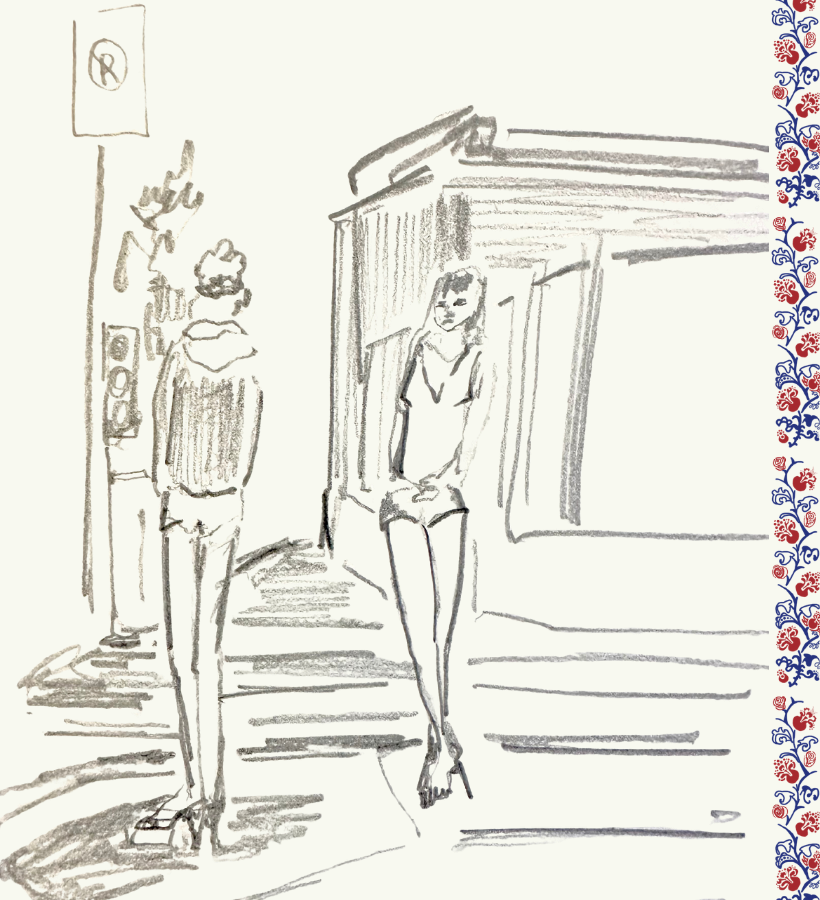
On Figueroa Street in Los Angeles, the prostitutes are as young as 13 years old. They walk the sidewalks in heat and cold waiting for men to stop their cars and beckon to them. The girls have a nightly earnings quota. If they don’t reach it, their traffickers will punish them.
The customers want girls who are as young as possible, so the younger girls earn the most. Older prostitutes sometimes assault the young ones and take their money. At 13, the average American girl is not far away from playing with dolls and jumping rope. At 13, the average American girl ought to be listening to Taylor Swift, playing youth soccer, and dreaming her dreams. On the streets of Los Angeles, children that age are serving men, dodging the police, and trying to stay in the good graces of their traffickers.
A New York Times story tells how two sisters started selling themselves on and around Figueroa. Ana and her sister were “foster kids turned runaways turned recruits, drawn in by a new friend on Instagram who offered to help them get by. The friend dropped Ana and her sister off at a motel on Figueroa and handed them lacy bikinis. Ana asked what they were for. They needed to turn in $800 each by morning, the friend said. They stood on a corner, shivering. It would take at least half a dozen customers each.” They were 11 and 13 years old at the time. And, the article is careful to make clear, Ana and her sister were not anomalous on the stretch of California streets. 11- and 13-year-old girls being sold on the streets of the most powerful and prosperous nation in the history of the world! How can this be? Why is it not a national emergency? The destruction of childhood innocence should be a scandal that surpasses virtually every other. But apparently it does not — the practice continues, not only in Los Angeles but in other large American cities.
Two hundred and fifty years ago William Blake, the great British Romantic poet, looked out on another major city rife with prostitution. In his grim lyric poem “London,” he writes about “the youthful harlot’s curse” echoing through the streets. She curses a society that subjected her to a life of degradation. Why does this still happen? Why does our society not do something? Blake may have some answers.
In “London,” Blake saw a fiercely capitalist economy, where getting and spending were the primary motivators of human behavior. What he called “the dark satanic mills” kept on grinding raw material for market and they grinded human beings, too. We should know what Blake understood so well. In a world where profit can matter to the exclusion of other values, humans beings can also be turned into commodities and sold at market.
Few things angered Blake more than the exploitation of children. He felt that the measure of any society is how it treats its young. His marvelous collection, Songs of Innocence and of Experience, is full of poems about the degradation of children. Blake believed that, if you arrive from foreign parts to this or that nation and you want to know its nature, you need only ask one question: How are children treated here? Do they learn to read and think for themselves? Do they play freely in nature? Do they get decent food and enough rest? To Blake, what a culture does at its worst to children is what defines it. America was a nation that Blake particularly loved. He wrote a powerful poem in tribute to our revolution. If he visited Figueroa Street today, he would be shocked by what he saw.
Blake’s representative child was the chimney sweep. Sweeps stood on London street corners advertising their services. They were needed in late 18th century London to clean out chimneys and in order to prevent chimney fires, which once started could destroy city blocks. They stripped naked, wriggled their way into the chimneys and went to work. Their lives were short. They died of lung disease and accidents, falling from roofs, or from getting stuck inside the chimneys. Blake depicts one of them, standing on a corner soliciting business, crying, “Weep, weep, Weep weep.” The little boy is so young that he cannot pronounce the word Sweep. What he does say is more eloquent. Weep.
We still have “youthful harlots.” Do we have chimney sweeps? In a manner of speaking, Yes, we do. The Times also ran a piece about children, many of them illegal immigrants, who work in American industries. “These workers are part of a new economy of exploitation: Migrant children, who have been coming into the United States without their parents in record numbers, are ending up in some of the most punishing jobs in the country. . . . This shadow work force extends across industries in every state, flouting child labor laws that have been in place for nearly a century. Twelve-year-old roofers in Florida and Tennessee. Underage slaughterhouse workers in Delaware, Mississippi, and North Carolina. Children sawing planks of wood on overnight shifts in South Dakota.” Their work is ill-paid, dirty, and dangerous. Children are harmed and exploited in our factories, just as they were in London’s eighteenth century chimneys. Child prostitutes, children in servitude in factories: As a society we do not seem to care, though our traditions tell us that crimes against children are among the very worst of crimes.
Blake took inspiration from the Hebrew Bible. He sometimes saw and styled himself as a Jewish prophet reborn into late eighteenth-century England. The Biblical figure who moved Blake the most, though, was Jesus. “Jesus was all virtue,” Blake says in The Marriage of Heaven and Hell, “and acted from impulse not from rules.” Blake is not inclined to think of Jesus as the Son of God. In certain moods, in fact, he satirizes Yahweh as a sterile retributive figure: Nobodaddy (Nobody’s Daddy). Blake’s Jesus is largely de-divinized. He believes as Blake does that no society that systematically harms its children can be called decent or just.
Jesus does not get angry very often. In The Gospels he chases money lenders from the temple; he denounces the Pharisees as hypocrites; and once he blasts a mustard tree, for reasons unknown. I cannot imagine he was speaking equably when he said that it would be better for a person to place a millstone around his neck and hurl himself into the abyss than to harm a child. To reach salvation, you must become a little child again, he says. Innocent children should be in some measure our teachers and guides and treated with respect. In our largely Christian nation, these words seem to have been forgotten.
Why do we not follow Blake and Jesus and fall hard on anyone that harms a child, especially those who crush children’s bodies and spirits to make money? Blake may know. The children that Blake chooses to illustrate the perfidy of England have a quality in common. They are poor. In one of his chimney sweep poems, the sweep begins by telling us that he was sold to his master when he was very young. Sold the way the little prostitutes are sold.
There are more than a few reasons that we allow the exploitation of children in this country. There are lax laws, corrupt police, officials who turn their eyes away. There are corporate liars who say that they obey all the child labor laws, then contract their work out to subsidiaries that do not. But to Blake the salient reasons are simple. The exploited children are poor. They are poor and they are alone in the world. They have lost their mothers and fathers and become surpassingly vulnerable, like the children in our factories and the little girls sold for sex. Blake — and Jesus — believed that a decent society should do everything it can to take care of children who are impoverished and alone in the world.
If the children in our factories and on our streets had emerged from the suburbs, the private schools, the world of SAT prep and travel soccer, we would hear thunder and see lightning. This plague would end in six months. Jesus said the poor would always be with us. But he meant that we should succor and as far as possible we should love them, not that we should turn them over to degradation and servitude.
Of all the hideous sins of which our nation is currently guilty, there is none more heinous. Whither repentance?