
“The Territories,” Yeshayahu Leibowitz’s once-obscure 1968 essay on the outcome of the Six Day War, has achieved wider fame in the years since October 7. One need only read it to understand why: Leibowitz predicts, with eerie precision, the ruinous effects of Israeli rule in the West Bank. At a time when many thought Israel’s overwhelming victory over surrounding Arab states would secure its safety, Leibowitz warned instead of endless war: “Without an agreement imposed from the outside, our situation will deteriorate to that of a second Vietnam, to a war in constant escalation without prospect of ultimate resolution.” Through the victory of that war, Israel had secured control over the whole of Jerusalem and the Biblically significant land in the West Bank. Many Israelis interpreted this triumph as prophecy fulfilled, but Leibowitz warned of the rise of a “counterfeit religion” corrupted by politics: “As for the ‘religious’ arguments for the annexation of the territories — these are only an expression, subconsciously or perhaps even overtly hypocritical, of the transformation of the Jewish religion into a camouflage for Israeli nationalism.”
When Leibowitz drafted that essay, most Israelis believed their political institutions were on sound, democratic footing. But he predicted democratic doom — in a passage so prophetic that it deserves to be quoted at length:
A state ruling a hostile population of 1.5 to 2 million foreigners would necessarily become a secret-police state, with all that this implies for education, free speech, and democratic institutions. The corruption characteristic of every colonial regime would also prevail in the state of Israel. The administration would have to suppress Arab insurgency on the one hand and acquire Arab Quislings on the other. There is also good reason to fear that the Israel Defense Force, which has been until now a people’s army, would, as a result of being transformed into an army of occupation, degenerate, and its commanders, who will have become military governors, resemble their colleagues in other nations.
In the following decades, as his fears became manifest, Leibowitz’s predictions became increasingly dark. In a 1983 Ha’aretz column, he wrote that Israel had only two options for its future: “either the catastrophic solution of war until the bitter end, or the division of the country between the two peoples.” In a 1990 interview with the filmmaker Eyal Sivan, he warned that “we are heading towards the certain destruction of the State of Israel which, I think, will be transformed into a Judeo-Nazi state.”
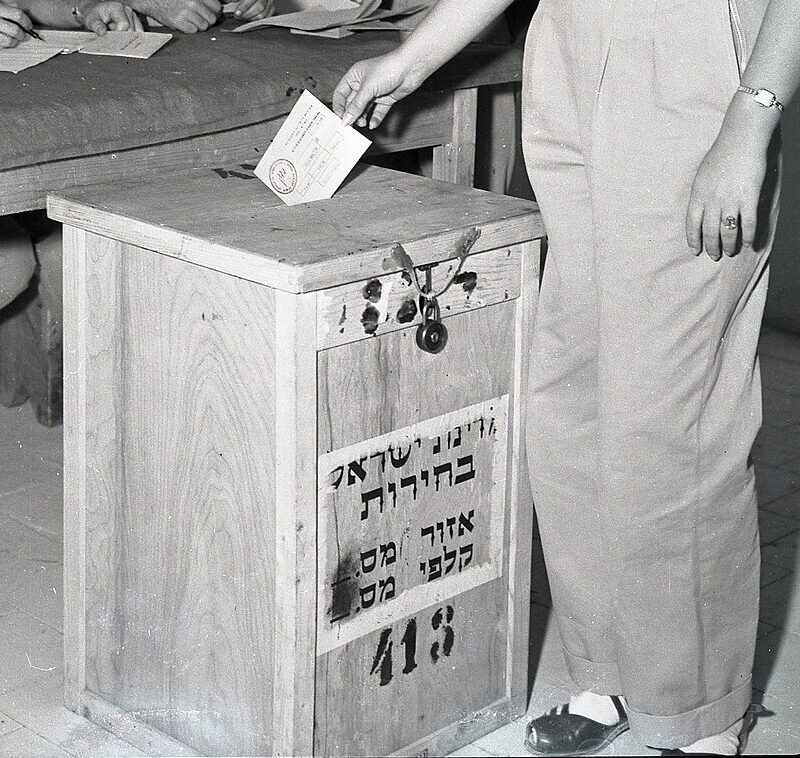
As such, Leibowitz was controversial even on the Israeli left. In 1993, after a committee awarded him the Israel Prize, Prime Minister Yitzhak Rabin announced he would boycott the ceremony — leading Leibowitz to turn down the honor. (“Why should I cause this tangle for the prime minister?,” he said). Today, this controversy feels like something taking place in another country. Israel no longer awards its highest prizes to internal critics of its treatment of the Palestinians; it threatens to revoke their citizenship. Its government is not led by men like Rabin, who concluded the Oslo accords with the Palestinians, but the ideological allies of his killer. Between the slaughter in Gaza, de facto annexation of the West Bank, and assault on democracy west of the Green Line, the country has increasingly come to resemble the monster of Leibowitz’s nightmares. Israel’s upcoming election is, at heart, a referendum on how much further Israel wants to go down this path. It is not hyperbole to say that another Netanyahu term could mean the end of competitive Israeli elections for the near future — an outcome that would lock in the mutually reinforcing dynamics of occupation and democratic collapse Leibowitz anticipated so many years ago. The most optimistic and realistic alternative is likely to be some kind of indecisive muddle rather than a full-scale unwinding of what Netanyahu’s Israel has become. But such a muddle could at least potentially produce something better — whereas we know what lays at the end of the current road.

I do not believe that Netanyahu will simply declare that there will be no more elections after he wins. That is not how democratic backsliding works — as Netanyahu and his allies learned painfully in 2023. That year, they announced a sweeping overhaul of the judiciary that would, in a stroke, have made Israel’s Supreme Court a wholly-owned extension of the legislative majority. Since there are few other checks on the Knesset’s authority, this would have in effect given Netanyahu extraordinarily dangerous concentration of power — and Israelis knew it. Alarmed citizens mobilized the largest protest movement in the country’s history, forcing the government to withdraw the bill. After October 7, the government shelved the bill entirely. The efficacy of the protests shows Israel is more genuinely democratic than many believe — but it is a kind of schizophrenic commitment. The Jewish majority believes in democracy for themselves so thoroughly that they are willing to fight for it in the streets week after week for months on end — something few other democracies can manage. Yet on the whole, they do not extrapolate from this belief that they must also virulently oppose indefinite military rule over West Bank Palestinians. Anti-occupation demonstrators were, in the largest demonstrations, relegated to a special physical zone to avoid offending others.
Netanyahu and his allies do not suffer from a similar incoherence. Their effort to suborn democracy is motivated in no small part by a belief that the institutions of Israeli democracy are barriers blocking the path to permanent annexation of Palestinian land. Democracy must die for Greater Israel to be born. It’s certainly true that there are other reasons for Netanyahu and his allies to slice Israel’s democratic fetters. Netanyahu personally is desperate to avoid jail time for prior corrupt and anti-democratic acts, and he considers personally concentrating power as his best way out. The ultra-Orthodox parties are primarily concerned with securing their own special privileges, like exemptions from military service. But for many members of Netanyahu’s Likud, as well as the entirety of the far-right Religious Zionism and Otzma Yehudit parties, the land is the ultimate prize.
So after the judicial overhaul failed, they did not give up their ambitions — they just switched tactics. Rather than going all-in on a single bill, they employed a more incremental strategy: making smaller changes that were each individually too limited or technocratic to serve as a lightning rod for the mass public. Political scientists call this salami slicing, comparing each legal and normative violation to a thin cut of meat. I prefer, as a metaphor, the Ship of Theseus: a vessel in which each plank was removed, one at a time, and replaced with new ones. Unlike in the typical thought experiment, in which the new planks are implied to be similar to the old ones, these are unmistakably different.
So far, these incremental accretions of power have not been enough to sufficiently erode democracy for Israeli citizens. Opposition parties have been able to run a competitive campaign on largely equal footing. An effort to ban Arab parties from competing was overridden by the courts. But in the event that Netanyahu wins another term in October, it is very likely that we will see the same amping-up of authoritarian energy as we have in Trump’s second term. Only Netanyahu is a far cannier policy mind, and he is backed by a loyal legislative majority unconstrained by the filibuster or (if they have their way) the courts.
When you speak to those Israelis who still hold fast to liberal values, they often reference Hungary under Viktor Orbán as a comparison point. They’re comparable situations: both small countries with a highly specific language and culture led by once-center right prime ministers who fully embraced authoritarian populism during their second stints in office.
After Orbán was ousted in the 2026 election, the country has become a symbol of hope for democratic leaders around the world — with liberal Israelis, who paid especially close attention, seeing it as a sign that they are poised to oust their Orban. But it may be worth tempering that enthusiasm.
Orbán’s defeat this year was less a typical electoral loss for an incumbent than a kind of regime change; it required an extraordinary constellation of factors for Hungarian democrats to overcome the systemic barriers to their success. Absent the conjunction of Orbán’s economic model collapsing and the emergence of a generationally talented opposition leader, there is a very real chance Hungarian authoritarianism would still have prevailed (as it did in 2022 when faced with a less-effective opposition unity candidate),
What has distinguished Israel from Hungary so far, in institutional-democratic terms, has been Netanyahu’s far more limited ability to manipulate law in his favor. Unlike Orbán, whose Fidesz party won a two-thirds majority in 2010 and held it for 16 years, Netanyahu’s Likud has never had anything close to a full majority. From 2009 to 2021, his coalitions contained at least some parties that might oppose his efforts to centralize power. In fact, his defeat in the 2021 elections was driven in part by defections from his former partners — like Naftali Bennett and Avigdor Lieberman — who had read the clear signals that Netanyahu was a dangerous authoritarian whom they could no longer trust.
Since returning to power in 2022, Netanyahu has had a coalition that would back his authoritarian moves. But Netanyahu ran into yet another roadblock Orbán did not face: checks and balances. Both the Supreme Court and Attorney General Gali Baharav-Miara, who enjoys significant legal independence, have repeatedly blocked Netanyahu’s most aggressive efforts to consolidate power. Both have protected each other; Baharav-Miara has used her position to oppose the judicial overhaul agenda, while the Supreme Court stopped Netanyahu’s attempt to fire her in 2025.
If Netanyahu remains in power for another four-year term, these two final bulwarks are likely to fall.
After the swearing-in of the next government, a key aspect of the judicial overhaul will go into effect. This law changes the appointment process for Supreme Court justices, removing the veto power of the justices and Israeli Bar Association and instituting an explicitly political system. With as many as two-thirds of the Court’s justices set to retire in the next four years, the new law would allow Netanyahu to ensure that at least three new justices fit his worldview — reshaping the court in his favor. Likud MK Simcha Rothman, who wrote the legislation overhauling Supreme Court and Attorney General appointments, has also vowed to pass another bill sharply limiting the court’s power to review legislation.
In January 2027, a separate law stripping the Attorney General of key powers will take effect. Under the new rules, Baharav-Miara will lose the power to issue binding legal rulings — effectively making the Attorney General more of an advisor to the prime minister than a constraint on his power. The law also politicizes the AG appointment process, replacing the current non-partisan process with one controlled by the ruling coalition. Baharav-Miara’s term ends in 2028; under the new law, her replacement would certainly be a Netanyahu loyalist.
There were two other less formal constraints on Netanyahu’s authoritarian impulses: the protest movement in Israel and the United States under Joe Biden. The former is currently dormant, and it is an open question whether it could reconstitute after the demoralizing shock of another Netanyahu reelection. The latter ended with the 2024 election, and Trump would likely applaud Netanyahu for acting much in the manner that he has in his second term.
What would likely happen, were Netanyahu to win reelection, would be the rapid Hungarianization of Israeli democracy. By that, I mean the imposition of enormous barriers to opposition political viability that would dramatically tilt the playing field towards Netanyahu and his allies — effectively rendering them similarly non-competitive as those held under Orban’s rule. This is not conjecture, but simple extrapolation from what they have already attempted.
The Supreme Court and the Attorney General have prevented the banning of Arab parties from competing in elections, stopped a law that would hand the government enormous control over Israeli media, and impeded multiple efforts to politicize national police and security agencies. The coalition has proposed, but not yet passed, Putin-style legislation that would impose an 80 percent tax on NGOs who receive donations from foreign governments. This would almost exclusively affect left-wing organizations, as right-wing ones get large donations from rich foreigners rather than foreign governments. Netanyahu has also proposed a bill that would punish people who allegedly slander the IDF, enabling either stripping their citizenship or enormously punitive lawsuits. He specifically cited a statement by Yair Golan, the head of Israel’s largest left-wing party, as an example of the kind of IDF criticism he would seek to punish.
And this is to say nothing of the ultimate anti-democratic project in Israel: the increasingly openly stated plan to either ethnically cleanse Palestine or force Palestinians to live under indefinite apartheid. This project, which is the ultimate cause of Israel’s anti-democratic drift west of the Green Line, would proceed with no legal checks at all — and a US administration that has little interest in punishing Israel for its conduct in the territories.
In effect, Israel would become locked in a vicious cycle. The anti-democratic political system west of the Green Line would ensure that only governments committed to territorial maximalism and anti-Arab brutality could wield power; Israel’s conduct in Palestine would continue fueling efforts to curtail remaining democratic structures and forces standing in the way of said conduct. In that sense, “Hungarianization” may actually be understating the risk here. Orban treated migrants harshly, but he never even attempted anything like Israel’s mass killing in Gaza, or the settler terrorism in the West Bank. A government capable of that is capable of nearly anything — including a far harsher form of authoritarianism even for Israeli citizens.
The simplest way to avoid this nightmare is for Israel’s opposition to outright win the election.
While the Jewish anti-Netanyahu parties are fractious, spanning what used to be the far-right all the way to the left, they are united in one basic goal: reversing Netanyahu’s centralization of power. Their victory would likely yield the repeal of the laws targeting the Supreme Court and Attorney General, effectively staving off the short-term doom scenario for Israeli democracy. However, if current polling is accurate, these parties will not collectively win enough seats in the Knesset to form a majority government — and neither will Netanyahu and his current coalition. Barring a major polling error, the survival of Israeli democracy will come down to coalition negotiations with outside parties.
The opposition has a straightforward path: partnering with Arab parties. Either by including Mansour Abbas’ Ra’am in government, as the last non-Netanyahu government did, or by striking some kind of supply-and-confidence agreement for outside support from Ra’am and/or the Joint List, they would almost certainly have enough seats collectively to command a majority.
Yet it appears they will not — so much so that Israeli poll analysts rule them out of coalition math as a matter of course. Either out of their own racism, or fear of their voters’ racism, most of the leading figures in the opposition have ruled out forming a government with Arab support. Netanyahu sees this as such a weak point for the opposition that he has made Mansour Abbas, the head of the Arab party Ra’am and member of the last anti-Bibi coalition, a central target of his attack ads — to the point where the New York Times recently wrote that “a casual consumer of the advertising ahead of Israel’s Oct. 27 election could be forgiven for thinking that the gravest threat to the country’s future is a dentist-turned-politician named Mansour Abbas.” If the Jewish opposition does not forsake their pledge to eschew Abbas and the other Arabs, or find some kind of narrow loophole, they will have lost the most obvious means of forming a stable government.
That means much will depend on which small non-aligned parties will clear the 3.5 percent threshold in the national vote to enter into Israel’s Knesset — and with whom those parties decide to partner. Once this kind of intricate coalition negotiation begins, all bets are off. One could imagine either major bloc striking a deal, or even wilder outcomes (like everyone failing to negotiate a coalition and a politically paralyzed Israel heading to another round of elections).
But even if all goes right, and Israel’s next government is one that is seriously committed to at least some democratic values, the root cause of the problem — the occupation — will almost certainly remain unresolved for the next two years.
There is no plausible world in which the left and Arabs, the most committed pro-peace factions in Israel, are the dominant voices in the next Israeli government. At least two of the key anti-Netanyahu parties are led by men (Bennett and Lieberman) who have themselves lived in West Bank settlements. And while Israeli public opinion is generally hostile to Netanyahu’s attacks on democracy for them, it is at present equally hostile to any serious peace push that might give Palestinians democratic rights of their own.
Absent some kind of change to this equilibrium, the threat to Israeli democracy will remain. What Leibowitz diagnosed over sixty years ago, that the mechanisms of Israeli democracy are structurally incompatible with ruling over millions of disenfranchised Arabs, remain true today.
There is a slight ray of hope down the road. Shorn of the ideologically radical voices that dominate Netanyahu’s coalition, the opposition might be more open to compromise on peace issues if given a powerful incentive to do so. The international turn against Israel after Gaza already puts on some pressure, but the United States remains by far the most important actor here. A Democratic victory in the 2028 American election could very well produce a president willing, for the first time in history, to apply enormous pressure on Israel to reverse course in Palestine.
But getting there first requires that Israel remains at least a partially democratic state. Which means that everything, peace and democracy, rides on October’s vote.