
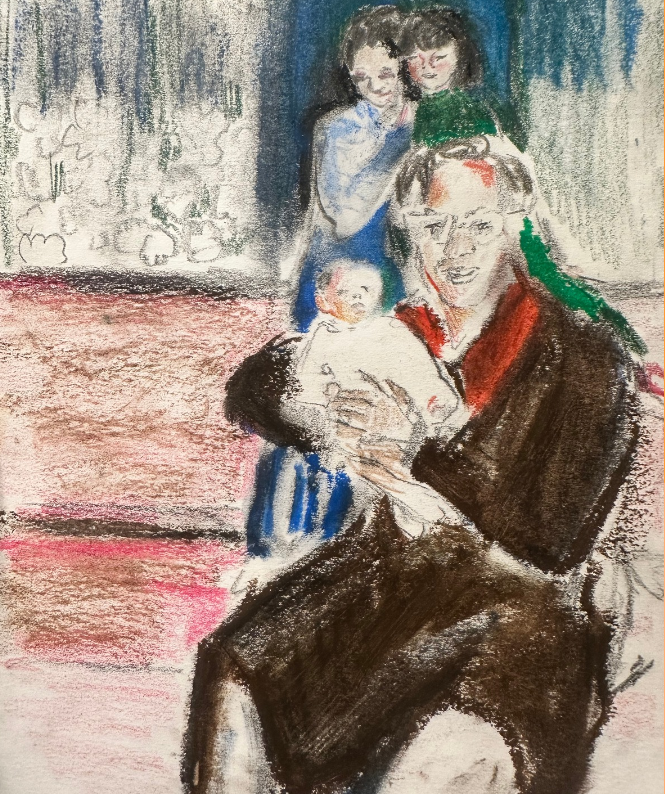
The room is dark save the flickering TV light. You, baba, are sitting in a corner in a heavy wool robe or a cotton undershirt depending on the season. A gas heater is emitting a yellow-orange glare, or, depending on the season, a loud fan is adding to the cacophony of sounds coming from the television: ambulance sirens, angry pundits debating politics, melodrama actresses sobbing…
This changing-yet-stagnant image encapsulates the coziness of home for me. From thousands of miles away I often shut my eyes and summon that lost space — the world outside me simply disappears and our living room materializes. I can feel my body shivering under a thick blanket or sweat beads forming on my forehead. I smell sweet tea with cinnamon, scrambled eggs with cumin and zaa’tar mixed with olive oil. I conjure all these warm sensations and wonder what draws me so magnetically to this modest place on a residential street lined with plain trees in a troubled city, Tripoli, in a troubled country, Lebanon. And then comes the weight of the secrets I never shared with you, heavier and heavier, interrupting my fantasies of home.
I think of you, baba, sitting there, night after night, for years, for decades, absorbing the world jumping at you from the screen. Invasions, car bombs, shattered bodies, cheesy Egyptian and Turkish soap operas, protests, chants and tear gas, music concerts, variety shows… I hear your soft laughter, your angry outbursts and sometimes I see your tears. I feel your anxiety suspended in the room like a constant hum as the country moves from one crisis to another. And yet, I also sense vibrant moments of optimism — your infectious enthusiasm, for instance, at the sight of a youth revolt even when you were well into your 70s. You spent most evenings in this room watching television, sometimes with my sisters and me when we were visiting from near, or far, or very far, but often alone while my mother watched her favorite shows in another room.
Unlike you, baba, I spent my life running away. I don’t know anymore what I was trying to escape: the lack of job prospects, the chronic political instability, the homophobia, the fear of being ostracized or even jailed. My fears were not concrete, based on rational analysis. They were an amorphous unease, a knot in the stomach or a feeling of suffocation. Even when in the most socially progressive cities, anxiety never left me. I am old enough to understand that the West has offered me only a semblance of normalcy with respect to my sexuality and robbed me in return of many other forms of security. How many times did I avoid your inquisitive questions about why I was still unmarried! You would interrupt any political or mundane conversation to return to that question. Year after year. Like a sneaky dominant beast, your acute sense of worry would nestle itself between us. Time after time, I found myself lying, invoking personal choice, environmental disasters, the Anthropocene… But usually I was too tired to argue with you and simply resorted to that magical Arabic word that puts an end to any discourse by invoking the futility of human endeavors, Inch’Allah. Baba, you wanted reassurance that I could never offer you. Since the world around you was collapsing repeatedly, you needed to know that I, your only son, had at least a stable, happy life. I considered coming out to you, yet I worried it would crush you. I could not bear the thought of the intolerable inner pain it would cause you, a revelation so big that it would shatter your whole belief system anchored in the ideal of the wholesome family.

Baba, you were a child of pan-Arabism, of Arab hope and its sequentially crushed dreams. You were born in Cairo the same year Lebanon got its independence from France. You were raised in the popular neighborhood of Shoubra, where Dalida, the famed Italian singer, spent her childhood. You were part of the Lebanese diaspora in a cosmopolitan Egypt teeming with Italians and Greeks. As the Ottoman empire had crumbled and national borders were starting to regiment ideas, values and lives, your father had settled there, traveling South from Tripoli by land and crossing swiftly through Palestine; a road trip that my generation could never experience. The product of a renewed dream of Arab unity and prosperity, you were educated under the aura of Abdel Nasser. You were never a practicing Muslim, but you saw Islam as a powerful binding force of collectivity. You considered yourself open to the world, and valued knowledge and education. Self-sacrifice for your family was what defined you to us; a gift my sisters and I embraced, yet one that left us burdened with a gnawing sense of obligation. How could I break your heart? How could I choose to clear up your confusions with words that would be unbearably alienating to you?
When you were a young man, your mother became very sick. You often boasted about carrying an oxygen bottle on your back for miles to bring back home to her. Her illness precipitated her untimely death and these traumas inspired your determination to become a doctor. Your father insisted that you study engineering, lured by Nasser’s promise of construction projects of dams and infrastructure for the new nation, but you dug your heels in. When you arrived in Lebanon as a confident adult with a degree in medicine, life seemed hopeful. You started a professional life and a small family, but the Civil War erupted soon after your arrival and speedily put your capacity for self-sacrifice to the test. You shielded us as children from the ugliness of the war. Yet the big hole in the living room — now completely covered with cement even if traces of shrapnel are still apparent on the outside of the building — testifies to the brutality of a past you’ve often avoided discussing. It wasn’t until much later that I understood that your absences from our household were filled with spectacles of blood and injuries. You wore hard work as a cloak, wrapped yourself in it, and slept twice a week or more at the emergency section of a nearby hospital for many years. You were resigned to the relentlessness of Lebanon’s struggle and so your only focus became the success of your children. You showed this commitment again when, after the war was over, the challenge of the dire economic situation started hurting families like ours, and you felt the pressing need to earn a living elsewhere. So you left us for four years to work in Saudi Arabia under strenuous conditions. Outside the circle of our happiness, I witnessed how you denied yourself many small and big personal pleasures. Yet I saw your eyes glimmer when you talked about your childhood. Oh, Alexandria! Iskanderiyah! Playing soccer by the beach in the scorching heat for hours on end; a time when the past had no weight, and the future did not seem endlessly doomed. You told us how you spent whole summers with your four siblings and mother at the home of family friends. It was normal to do so back then, you would say. When I am alone in my empty apartment, I like to imagine your hustle and bustle playing with all the other children crammed into one house. This thought stretches the limits and potentials of hospitality, a virtue that has only an emaciated counterpart in my current world.
I felt so lost when I first moved to California. The roads and landscapes felt immense. I longed to brush shoulders with passersby on the street. I had to learn the intricate gymnastics of keeping a safe distance from other people. Everybody spoke about private space. I struggled to understand what that meant. And space was never merely physical. My earliest memory of the war invokes the reassurance of proximity. I was six and my youngest sister was in a crib. All the families of our six-story building were packed in the underground shelter taking refuge from the bombing of our neighborhood. I did not understand the fear I saw in the face of the adults around me. I simply remember the candid joy of having my friends around me and playing the games our parents came up with to distract us. I understood later the geopolitical dimensions of those days when pro-Syrian Palestinian militant factions fought against the Palestine Liberation Organization. The “battle of Tripoli,” as it was called, ended with Arafat and the PLO leaving the country and brought to a crushing end an important chapter in the struggle for Palestine — one that preceded other violent moments: the Israeli invasion of Beirut, the massacre of Sabra and Shatila… And there were many more horrors to come leading to an excruciatingly painful ongoing episode of our contemporary history that you were luckily spared from witnessing.
You picked up on my loneliness in California, baba, every time we talked on the phone. You reassured me that I was building a future for myself. You loved to repeat magnanimous words like perseverance and patience and resolve. They sounded like lines from an Egyptian TV series. In Tripoli, they called you al-masri, the Egyptian, even though you were from a family deeply rooted in the North of Lebanon. You never managed to completely shake off your Egyptian accent. All the drama and magic of Egyptian cinema were safeguarded in your voice. On the phone, you always had more questions to ask me, more news events to discuss with me. Fool that I was, I would grow irritated and make up lame excuses to cut our conversations short. I never doubted your genuine concern but, baba, there was always a barrier preventing me from sharing how I really felt with you.
For almost two years now, the phone calls have stopped. Your little universe has become an intricate bundle of fading memories. I struggle to penetrate them, to find solace in small details that make me laugh or provide much-needed comfort. An image often comes to mind. On one of my last trips from San Francisco to visit you, I arrived late, well past midnight. But as usual, you were committed to waiting for me. I remember your frail body and your beaming big smile when you opened the door. I don’t think I will ever receive a warmer hug than the one you used to give me. Your body was shrinking and it was evident your chronic back pain had ravaged your freedom of movement. That was my last return to a home imbued with your physical presence. You were eager to hear my latest news; to learn about America, its society, and its foreign politics. As a dignified Arab, you were very critical of western powers and their unfair support for Israel at the expense of Palestinians, yet proud that your son had succeeded to live and work there. “Seek knowledge even if it’s in China,” you loved to say repeating a widely circulating Arab proverb of doubtful attribution to the prophet Mohammad. My distance was a bitter relief despite your yearning for the lively reunion of our family under one roof. Like many shattered Lebanese families, you thought your children’s future ought to sprout elsewhere in an imagined utopia you never experienced. A year after I was born, you moved to London to pursue a medical residency. You struggled with the limited English you had learned in Egyptian public schools. And you found the city too cold, both literally and metaphorically. You liked to tell us about the austere old lady who ran the dorms you slept in. She would scold you, you would recall, if you did not finish the bland food they served you. “Maybe in your country they waste food; but here, we don’t,” you liked to remember her saying to you. You came back to us just months after arriving in the United Kingdom. The Civil War was escalating and the thought of leaving your burgeoning family behind weighed on you.
We spent long, silent hours together in the intensive care unit. You realized that your body was failing you and it must have been terrifying. You gasped for air, and clinged desperately to life. Powerless, I sat by your side raising your hospital bed then lowering it. You were trying in vain to find a comfortable position to breathe. You understood that you were a victim of a country that was collapsing with all its institutions. You were not going to be saved by a medical facility experiencing the stress of a crippling financial crisis. It saddens me to think that you lost your life in a hospital, a place where for decades you tirelessly worked to save the lives of others. You could barely talk during those few interminable last days. And I didn’t know what to say. I remember the last glance of panic you threw at me before they put you in a short-lived induced coma. The sequence of events that followed are blurry in mind.
I remember being at a mosque on the floor with your coffin next to me. It was packed for the Friday prayer. I don’t remember the sermon. I had not been in a mosque for many years. I had abandoned faith in religion a long time ago. But I was grateful for all the funerary rituals that strangely comforted me. When the main prayer was over, the imam announced that a member of the community had passed away and asked whoever wanted to stay to pray for your soul. I was so moved to see dozens of strangers answering his call, this patriarchal community that I so often found oppressive. Bodies of men lined up with shoulders touching tightly. The imam warned that the devil could sneak through any space between our bodies. ]I felt that I finally belonged in that tight-knit community. The powerful impressions of my childhood in my pious grandmother’s home in the mountains resurfaced: The smell of jasmine emanating from her prayer rug; Her frightening Qur’anic stories about doomsday and hell on starry evenings; The big tray of drying apricots on the rooftop by the tent where she slept with my grandfather on hot summer nights. That was a fleeting moment of solace. As I sat down to receive condolences for the next two days, I felt suffocation from the extended family’s incessant suspicious questions about my celibate life. Many repeated that it was time for me to be the head of the family. I showed them the face of an irritated mourning person begging to not have to respond and said: Inch’Allah while assuring myself I would soon be on a plane taking me far away.
Do you remember, baba, that our living room in Tripoli once saved me? I was a child playing there with my sisters on the Persian rug. My mother asked me to go down to a nearby store to buy some groceries. I protested grumpily, insisting that I finish playing first. A short while later, a bomb exploded on the street of that grocery store. I remember that day only vaguely. When I travel to our living room mentally, I mostly think of the lighting. So many of my memories of the Civil War are linked to power cuts: the light of candles, of battery-generated neon lights, of the orange butane gas lantern. Our fields of vision were determined by these various light sources. After the war was over, we had to wait for the government-powered electricity — which became more and more scarce over the years — to turn on the big crystal ceiling chandelier. But this only happened when we had guests. Most of the time, we relied on a small table lamp or simply the TV light. The economic situation never improved, and you always felt the necessity to be frugal. I remember when you installed that chandelier. It was my mother’s way of asserting our place in a middle-class that was only dwindling. It was kitschy but as a queer child I loved it. It reminded me of the extravagance of the variety TV show Fawazeer that played during the month of Ramadan: a mix of colorful and glitzy riddles, folk stories, and dance numbers.
I faintly recall one specific evening in the living room. It was my first year as an undergraduate student at the American University of Beirut. I was describing enthusiastically to you a lecture about homosexuality in my psychology class. The whole topic was fascinating to me. I was still not even out to myself. My understanding of sexuality was very limited in the mid-90s. There was no representation or sources of reliable knowledge of gay life. I struggled with the rigid norms of masculinity which suffused my childhood. I couldn’t belly dance or be soft or play with barbies. I learned to become gender-disciplined and suppress the traces of femininity in my daily gestures. As a child, you took me with you to the popular souks to buy fruits and vegetables and dragged me to official and family funerals and events. You wanted to teach me how to be tough, how to be a “real man.” But you never truly meant it.
You bound all my childhood drawings into a small book, including one I cherished dearly of a ballet dancer in a pink tutu. I was overjoyed when you bought me the latest tape of French songs by Liliane, my favorite TV hostess, as soon as it was released. It came with a booklet containing all her song lyrics. I spent days practicing those songs in front of the big mirror in our living room. But that night in my freshman year of college when the word homosexuality was uttered for the first time in your presence, I was struck by an overpowering burst of anger I had never witnessed from you before. I recoiled, retreated into the kitchen and I think I broke a plate to release my frustration. Since that moment, I never even came close to telling you about my intimate life with men. You met many of my lovers and boyfriends. They were always my buddies, my good friends, to you. You valued true friendship among men and did not see it as threatening. But homosexuality to you was an aberration. I sometimes regret not confronting you about it. You were smart, baba, and you loved to argue for hours about international world affairs. Yet your notion of a heteronormative family was unwavering. I never managed to shake it.
In our living room, a large picture of our family tree framed in gold dominates one of the walls. It was created in 1990 and claims descendancy from Omar Ibn Al-Khattab, the second Caliph (after the prophet Mohammad). The tree was a source of profound pride to you, even though I had seldom seen you pray or fast. Yet your attachment to your roots and to community was ironclad. Maybe because you had always harbored a deep sense of exile having been cut off from your family. Cairo, the city you lived in until you were thirty, never left you. Al-masri, indeed. On a small branch of the family tree, my name is written, neatly. My two sisters are leaves destined to fall off as they find themselves offshoots of other patriarchal families. My branch is an extension of yours and of my grandfather’s. Since my two late uncles did not have children, it was my ethical duty to ensure that our branch thrived. It never did. And I felt your deep disappointment. A “sacred” lineage had to be perpetuated.
My grandfather, you often told us, was an ambitious orphan raised by his uncles. He proudly held a teacher’s diploma; one of the first, you boasted. In the 1920s Tripoli experienced an invasion of western cultural influence. My grandfather must have felt these new ideals encroaching on a long legacy of ancestors comprised of Muslim theologists and judges. But he embraced the full possibilities of a new world opening up to him. I learned from you that he embarked on a trip to Argentina. I still hold on to a yellowed document in Spanish with his photo, a business patent dated in 1929 from the region of Santa Fe allowing him to work as a peddler. I wonder what he sold in the new world. You told me how after two years abroad, he had to come back because his religious, conservative uncle who married him to one of his daughters did not approve of her living so far away among the kuffar, the disbelievers. But Tripoli was too small for my grandfather. He longed for the excitement of Cairo in the 1930s with its cabarets and department stores. He was a poet and a failed businessman. You often told us about his big store in Cairo, where he sold everything from needles to bridal gowns. After he went bankrupt, he moved, just like you decades later, to Saudi Arabia where oil money was flowing. He became an Arabic language teacher and wrote praise poetry to princes and dignitaries. I only knew him as a child. I remember him as an aloof old man in a wheelchair. I struggled to understand his poems which were written in a rigorous, classical Arabic. I recently read the introduction to one of his poetry collections; a thick book with the drawing of a camel and two palm trees on its cover. In it, he wrote of himself in the third person and mentioned how lonely he felt as a writer and an intellectual.
At the end, I don’t think you cared much about the family tree. You wanted me to feel the incomparable happiness of bringing a child of my own into the world. You could only see your life complete through my sisters and me as your own life had been an avalanche of national and regional failures. The collapse of the banking sector was the last one to hit you hard. All your sacrifices and years of hard work at the very moment you were ready to finally retire were squandered by a web of corruption and geopolitical pressure on Lebanon which was punished for siding with the “axis of evil”: Iran and Syria. Baba, I thought you were stagnant all these years, stuck in the living room, night after night, encountering the rest of the world only on television. You surprised me one day during one of our passionate discussions about the West by using the word mithliyeen to refer to queer people. You never talked about sexuality with me. How did you know the progressive term for homosexuals in Arabic? Why didn’t you use a more prevalent term like luti or shaz (pervert)? Were you changing your staunch opinions about life while I wasn’t paying attention to you? You said there are things that you can’t understand like homosexuality and cohabitation, but you sighed then admitted that the world is changing and that you have to accept that. Was this your hint for me to finally come out to you? I panicked and changed the subject.
You spent your last years learning English. It killed you to stay idle. You went to your run-down, dusty clinic in the morning, often on foot to defy your aging body and probably to save money. You were obsessed with the mandate to leave us a good inheritance even as we assured you that we did not need it and that it was finally time for you to retire. You spent your afternoons on the balcony surrounded by my mother’s geraniums and fern plants. In a notebook, you translated sentences from Arabic to English with the help of a dictionary or maybe a language textbook. You summoned the world in the notebooks you patiently filled day after day. “I like arts especially films.” “There is a path from my house to yours.” “This definition of family has changed.” Hundreds of mundane and deep sentences stacked page after page: a hodgepodge of fragments of life that I cannot manage to decipher. What were you thinking about, baba?
A wise friend told me that this was your cryptic way of communicating with me; of telling me that you knew and that it didn’t matter. I sometimes glance at your photos to remember what it felt like being with you. But I still don’t have the courage to hear you speak. Your many voice notes are stored in my WhatsApp. Words of encouragement and much medical advice. Asking if I had checked my blood pressure and reminding me to add less salt to my food. I wonder if I will hear new words of wisdom when I have the strength to play them. I read that Edison invented the phonograph so that the dead could communicate with us. If I listened to your voice messages again, would I glean your rida? (Rida, the contentment or approval of one’s parents, is one of the accomplishments Islam most values). I remember closing the door of your bedroom and sitting on the floor by your bed. They had just brought you home from the hospital shrouded in a white cloth, kafan. Your body laid stiff, and your face was emotionless. I remember vomiting words to you. Things I never told you over the years. Fragments of confused confessions that didn’t make sense, punctuated by my helpless tears. I was finally telling you about the many intimate moments I experienced in my life. The love I received and gave. The many families I belonged to and the old and new ones I continue to rely on.
I remember the tragic morning my middle sister and I drove you to the hospital. We naively thought it was for a simple procedure. You reassured us as you always did. And we believed your medical discernment as we always did. We were oblivious. And you were cheerful. My sister asked you how you felt. You said you were optimistic. You tried to recall the English word for it. You insisted that we not tell you. All the innocence and excitement of childhood animated your eighty-year-old face as you tried to remember. “Ostimistic,” you finally said looking quizzically at us. No matter how we tried to teach you the correct pronunciation, you couldn’t utter it. We all laughed. A nurse abruptly knocked on the door. It was time to take you to the operation room.
Baba, I often think of how light, objects, and bodies shape the space of our living room. I wonder if the aura of your missing body has carved a permanent presence for you there. I wonder if the many words and emotions that were never communicated, yet repeatedly screamed in silence, resonate still, in our living room. And if the soft flickering light of the TV fills the space in your absence with the world.