
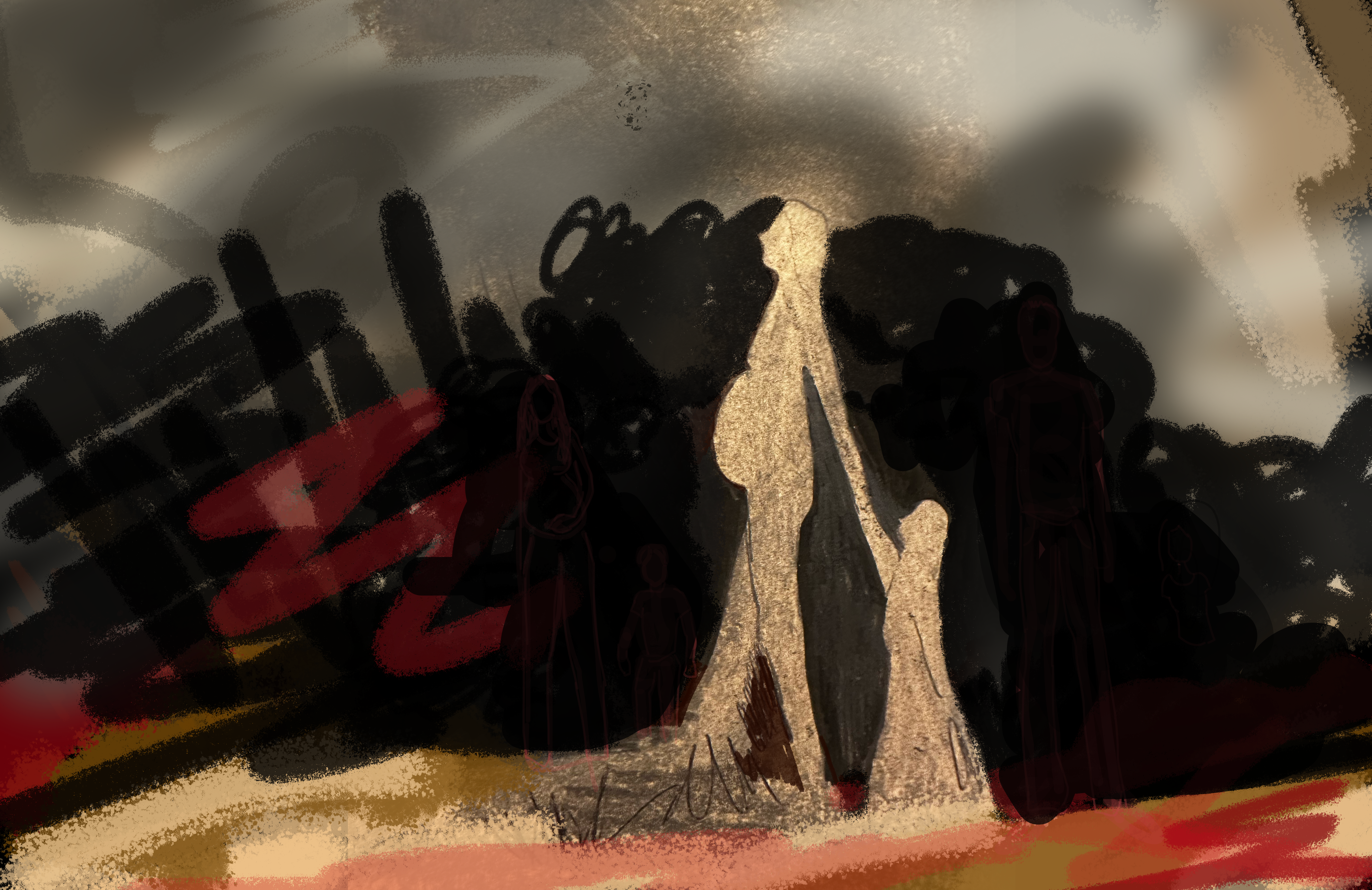
I: Safaa and a Design from the Heart of Survival
In the visual grammar of Safaa, a 24-year-old graphic designer from Gaza, “contrast” is not merely a tool for aesthetic clarity; it is the vital tension between the ash of her reality and the colors of her resilience. Safaa does not introduce herself with a title or a description of endured tragedies. Instead, she says: “I do not define myself through words; I define myself through my work — colors born from the heart of the ash. Every design I create is not just art; it is a message of survival.”
The Midnight Bag and the Morning Shroud
Safaa’s life with her husband, Majd, was the embodiment of “a small family and a big love.” They were architects of a shared future, meticulously planning every detail: from furnishing their second home to awaiting the birth of their second child. Their greatest dream was “Aleef” — a pet café and sanctuary they built for innocent creatures. It was scheduled to open on October 7th, but the war moved faster than their dreams. The site was targeted, and its innocence was slaughtered before it could even begin.
On January 17, 2024, the world recalibrated. Majd stepped out to buy a carton of juice for their five-year-old son, Muneer. Within minutes, a “quadcopter” drone bullet struck him. For a night that felt like an eternity, his fate was withheld from his family. Safaa sat at home, her body heavy with the final month of pregnancy, counting the imaginary days Majd would spend recovering in a hospital bed. By 11:30 AM the next day, overcome by an eerie, maternal exhaustion, she prepared the “baby bag” for her unborn son. Before the bag was even zipped, the news arrived: “Majd is a martyr.” Safaa ran into the streets in her ninth month, driven by a primal need to disprove the impossible. She reached the hospital only to find her “safe haven” wrapped in a white nylon shroud. “My mind refused to believe it,” she recalls. “I kept telling my mother: Mama, Majd loves me, he wouldn’t leave me.”
Exodus Under Fire and the Digital Trench
The tragedy of Majd’s death was compounded by the terror that followed. Only four days after his martyrdom, Safaa and her family were besieged for three days under relentless fire. On January 25, they were forced to flee Khan Younis while the sky rained shells, a heavily pregnant woman walking through a landscape of ruin. She had to leave behind more than just her two pulverized homes and the “Aleef” dream; she had to leave Majd himself. “It haunts me that he is buried alone in Khan Younis,” she whispers. “A place he didn’t like, and a place I cannot reach.” Yet, Safaa refused to remain a silhouette of grief. After months of psychological exhaustion that sapped her of the energy necessary to even play with her children, she reclaimed her identity. She bought a laptop and returned to her clients, forging a visual language where every pixel is a refusal to be erased. Behind the screen, she is an artist in a digital trench.
“Baba”: The First Word of the Reclaimed Future
On February 19, Ibrahim was born into this landscape of shadows. Safaa’s existence became a marathon of “Super-Motherhood.” Her greatest design project, however, was her son’s memory. Haunted by the fear that Ibrahim would grow up a stranger to his father’s face, she resuscitated Majd’s presence by placing photographs throughout the house. She prayed aloud so the infant would know his father’s name before he knew the taste of bread. She told him of Majd’s tenderness and his rituals with Muneer — how they would visit the animals and how Majd would bring home a new “toy car” for Muneer every single day.
The triumph of her labor came when Ibrahim spoke his first word. It was not “Mama,” but “Baba.” Now, whenever the toddler sees his father’s image on the laptop screen — the same screen where Safaa creates vibrant identities for global clients — he points his small finger and says “Baba” with unwavering certainty. Salvaging nothing but her house key and their photographs, Safaa remains the “Super-Mama” her children deserve, designing a future from the heart of the ash.

II: Um Muhammad’s Chronicle of Absolute Loss
Naifa al-Taluli (Um Muhammad) was once a woman whose fingertips wove Palestinian identity into intricate embroidery that traveled out of Gaza and reached the West Bank and even America. She built bridges of silk to secure a future for her children. Today, those same hands have shifted from weaving thobes to documenting total loss, as she finds herself the “sole journalist” left to recount the stories of her children. These lives, whom she raised to be witnesses to the world, have now tragically ceased to be the storytellers, becoming instead the very news the world watches.
Execution on the Wheelchair
The agony began on December 15, 2023, in Tel al-Zaatar. Her husband, a patient, disabled man, attempted to flee on his wheelchair (the corsa) as the army entered the area. His disability offered no sanctuary; he was shot in the heart while trying to reverse his chair. He was found martyred in his seat, his posture suggesting a desperate, failed attempt to stand — a body too weak to escape the treachery of a bullet.
Maryam: A Forbidden Farewell and the Bitterness of Compliance
Her daughter Maryam, 24, an English Literature student who documented the suffering in the North, was shot while trying to save a wounded youth near “Abu Zeitoun” schools. She fell before her mother’s eyes. Um Muhammad pleaded with the soldier: “I want to bury my daughter.” His response was a blow from his rifle butt, shoving her away. In that moment, the mother faced an excruciating choice: stay with Maryam’s body or save her other daughter from potential abduction or death. With a shattered soul, she complied with the orders to evacuate, leaving Maryam behind without a grave or a final goodbye.
Ahlam: The Camera That Never Fell
The tragedies followed like unending fire belts. She lost her daughter, the journalist Ahlam, 33, in a brutal carpet-bombing in the Al-Mukhabarat area. Ahlam carried her camera like a shield, refusing to abandon her humanitarian duty. She stayed at Kamal Adwan Hospital to document violations against civilians, ignoring her mother’s pleas to stop risking her life under the shells. Ahlam was the family’s provider after the disappearance of her brother, Nemer, 27. Nemer vanished two years ago, in March of 2024, on Street 10 while seeking food for his three children (twin five-year-old girls and a two-and-half-year-old son). He never returned.
The Sleepless Nights and Distant Graves
Today, Um Muhammad resides at the far end of Al-Baraka Street in Deir al-Balah. Her body is racked by spinal pain, but her soul bears a far heavier burden — the agony of being physically separated from her daughters’ graves, whom she was never granted the chance to bury. She survives on sedatives that rarely quiet the noise within. Before she sleeps, her mind is crowded not only with the faces of her daughters and her missing son but also with the haunting images of her brother and his family, who were bombed without warning and remain under the rubble to this day. With a bitterness that stifles her words, she says: “We are a mistake made by others, for which we paid the ultimate price.” The woman who once exported beauty and silk to the world now asks for nothing but “a better life for the girls” who remain by her side, and an end to a war that has executed everything except her dignity.
III: Maysaa’s Battle for Survival Behind Locked Gates
In Gaza, death does not only arrive from the sky; it creeps through the silent siege that devours weary bodies from within. Maysaa Eliwa, a young mother, finds herself caught between two merciless foes: breast cancer that has spread to her right lung, and a war that has padlocked every gate to her survival.
Forced Senescence in a Young Frame
Maysaa, once vibrant and full of life, has been stripped of her charisma by the dual cruelty of illness and war. Chemotherapy and the agony have claimed her hair, her eyelashes, and even her teeth. When she looks in the mirror, she sees a woman in her sixties, aged prematurely by suffering, though she is still in the prime of her years. She lives with her children in the skeletal remains of a bombed building, where cracked walls testify to conditions unfit for any human being. The struggle to secure a single dose of medication takes fifteen days of harrowing effort. When she finally receives it, the chemical toxins leave her shattered; she loses the strength to stand — the short walk to the bathroom feels mountainous and impossible. Often, her body fails her halfway — a devastating loss of dignity that only the most resilient can endure.
Bleeding Fingers and the Smoke of Necessity
The absence of electricity has turned domestic chores into a form of torture. Maysaa is forced to wash piles of laundry by hand; with every scrub, her fragile skin splits, and blood seeps from her fingertips, mingling with the water. In a world without cooking gas, this ailing mother — exhausted and gasping for breath — must stand before open woodfires in the blistering summer heat to feed her children. Each breath of acrid smoke further chokes her cancerous right lung, turning the simple act of cooking into a life-threatening labor.
The Young Artist and the Burden of Deferred Dreams
Maysaa’s pillar is her daughter — a gifted girl whose imagination is filled with silhouettes of fashion and beauty. She dreamt of holding a brush to design vibrant dresses, but today, she carries the weight of an entire household on her narrow shoulders. Instead of sketching patterns, she scrubs laundry to spare her mother’s bleeding hands; instead of choosing colors, she gathers firewood. She is sacrificing her childhood and her talent to be the crutch Maysaa leans on.
Maysaa holds a medical referral — a fragile piece of paper promising treatment abroad — but she lacks a safe passage. She waits for a country to host her and a crossing to open before the cancer completes its final, lethal siege.
IV: The Unyielding Blueprint of Motherhood
The stories of Safaa, Um Muhammad, and Maysaa are not isolated fragments of a war; they are the structural pillars of a collective female architecture of survival in Gaza. In this landscape, motherhood has been recalibrated from a state of nurturing into a relentless, brutal act of defiance. Whether through the digital pixels of a design, the bloodied threads of embroidery, or the agonizing breaths of a failing lung, these women are rewriting the definition of “home” within the ruins.
Safaa designs a future from the ash of her husband’s dreams, ensuring his name is the first word her son speaks. Um Muhammad archives the memory of a family erased from the civil registry, standing in the crosshairs of a rifle to protect the children who remain. Maysaa’s daughter sketches silhouettes of beauty while her own hands are stained with the soot of necessity, acting as the crutch for a mother whose body is a besieged fortress.
Their lives prove that while geography can be occupied and bodies can be broken, the “blueprint” of their resilience remains indestructible. These mothers are the last standing journalists of their own lineage, turning their grief into a sacred architecture built on the ruins of their homes. They are not merely waiting for the world to notice; they are actively designing a dignity that no war can ever redact — raising a future from the very heart of a graveyard.