
2024
The hill I want to die on is Golgotha and the season is spring in the Gulf and the vista from the cross is a stretch of I-10 between College Station, Texas, and New Orleans, Louisiana, on the grim drive home after my brother Bryan died in 2024. Every 9/11 survivor will tell you they remember the cerulean sky during rush hour before the planes tilted the towers toward the earth. I do not remember the Sunday morning sky, only the words that my partner Chip spoke when I answered the call. It was early enough for a plush bathrobe and a french press, but I never felt the coffee hit my chest and abdomen; only later did I realize that the robe was ruined. I text a friend or ten before I even showered. I do not rank these friends by how close they are to me, but by proximity to death. Years ago, I’d met Ari at an academic wine and cheese in Mississippi, but we are both New Yorkers. Do your parents still live in the city? I ask him. My father does, he says. Without asking, I saw his mother’s headstone, but I did not note the phrase; we didn’t know each other yet. But the morning I lost Bryan I told Ari first, and then Jonathan, who lost both of his parents in a brutal year and a half. Then I called Keith and Mark, old friends who met Bryan a few times before addiction pulled him under. “It’s not lost potential,” Keith said. “He was enough.” By the time I got off the phone with Katie, Jonathan had Venmo’ed me $50 with instructions to eat. I find a Michoacana, a horchata, taco, and a Chupa lollipop and sit to watch the mendicants pour out of the Pentecostal chapel that shares the parking lot. I see well-heeled Southern Baptist ladies at the megachurch next door.
A death investigation delays a funeral and drains your capacity to plan or fly. As I drove into New Orleans, the religious billboards — the annuals and perennials — sprouted in the high grass and marshy margins of I-10. The tomb is empty. It certainly is not. He is risen. He never will. I do not know how a faithful Christian, deep in his own season of grief, feels in the presence of these billboards, always black with white sans serif lettering so God can shout in high contrast. I only know that rising was no longer the goal. Before I’d reached the ‘healthy’ metric of acceptance. I knew I would not bring Bryan back. In the final steps of the addict’s Way of Sorrows, he seemed so battered and weary. No condolences gave me as much comfort as the thought of him simply sleeping, rather than passed- or blacked-out. Past Easter, one of the billboards in Aggieland replaced the phrase He did not die with the words Safe Bryan. The town next to Texas A&M is named, like so much in Texas, after William Joel Bryan, an early Anglo settler. The billboard included a toll-free number for the metro’s community crime-watch. I told Bethany what I saw. “Bryan is safer than he’s been in years,” she said.
The tomb was not empty, but the receptacle where I’d kept all my terror and anticipation cracked when he died. I wouldn’t bring him back. That was heresy to grief.
Before
Somewhere in Wall, South Dakota, on the border of the Badlands, I clean a space on the back window for a decal. My traveling companion is a musician, a flaneur, a pilgrim, and a Petersburgian by birth, soul, and disposition. He immigrated young, but not too young to prefer Pushkin and Grebenshchikov to Melville and Springsteen. Wall Drug, the only real waystation in town, is pure Americana — a combination general store, tourist trap, taxidermy museum, and ghost town. Dan fits perfectly; he is a Jewish cowboy like James Caan, Deadwood’s Sol Star, or Solomon Nunes Carvalho, who took the first hazy photographs of the Wyoming frontier in 1853. We leave with metal belt buckles, their centers naked for the engraver. When we point the car toward Montana, the Spotify algorithm shuffles and serves us Andrew Lloyd Webber and Norman Jewison, who directed the film adaptation of Jesus Christ Superstar in 1973. Dan joked that he’s always wanted to play Caiaphas or Annas. The musical offers instructions on how to organize your revolution, he says; the leader stages his own spectacular capture, telling his inner circle not to resist. He orders one lieutenant to publicly deny him. After that, it’s a suicide bombing, or a bait-and-switch. I told Dan he could play both Caiaphas and Annas. For that matter, you could make the whole musical into a one-man show.
I told Dan that the show is still samizdat in red American towns; there are picket lines and parental exemption letters, because Jesus prays to an empty sky. God has no song in answer. One character is resurrected, but it is Judas, who returns in white fringe and feathers to demand, once again, evidence of this man’s divinity. We shift between exegesis of the musical and scream-singing into the changing American landscape. (Restless and under-stimulated in the Appalachian high school I attended after leaving New York, I asked my parents to send me away to a residential arts high school, where we shy writers once spent an afternoon rehearsing Jesus Christ Superstar with the theater kids, an exercise to expand our artistic discipline. By evening, I sang harmonies with the eleven boy Disciples, the certain fate of a girl tenor.)
The show’s seriousness is political, too; Dan noted that it reached cultural ascendancy in the years between Charles Manson and Jim Jones, and the cult aesthetic is imprinted on the film and other stagings. Jewison, a Gentile — as so many people seem surprised to discover — filmed Jesus Christ Superstar at the Herodium, West Bank territory wrested from Jordan’s control in the Six-Day War of 1967. The film reached the cineplex a few weeks before the start of the Yom Kippur War, but a heightened militarism is everywhere in evidence: Judas is pursued by surveillance planes, Tzukit on loan from the IDF. The Roman centurions are good-looking men in camos and tank-tops with massive Uzis to match. Ted Neeley, who has played Jesus more than any living actor, famously returned to the church somewhere along the road; only God could find him in all that mishigas. Other Christians in the cast, Neeley has said, were often moved to religious ecstasy during the final, brutal steps of the Passion. The film seems a portrait not only of place, but of a cruel exchange in the West’s relationship to Israel: Muslims and Jews must be scattered so that Christians are, simply, moved.
As a kid in the nineties, I was prematurely addicted to booze and irony, and went to college so ignorant of religion that I did not realize that Jesus was a name, and Christ, a title. When someone corrected me, I enrolled in my first religious studies class, a seminar called Minor Heresies. In exchange for two hours and forty-five minutes on a Monday afternoon, the late Hal French offered Salman Rushdie’s Satanic Verses (1988), Nikos Kazantzakis’s The Last Temptation of Christ (1955), and the writings of Baruch Spinoza. An insult for every monotheism. That was the only time I’d ever cheated in a class. I slept through an essay exam, and the tolerant Professor French let me make up the assignment in an empty classroom… unattended. He had important business, he said, which I imagined to be a generative debate about the flavor of communion wafers, or a passionate defense of women’s fitness for priesthood. I stared at the question on Rushdie, then fled across the quad to my dorm room, where I checked verses of the Qur’an I’d flagged the night before. By the time Professor French returned, I was in my chair, with my citations all in order. I didn’t believe a word of it, but I wouldn’t get a single syllable wrong.
2024
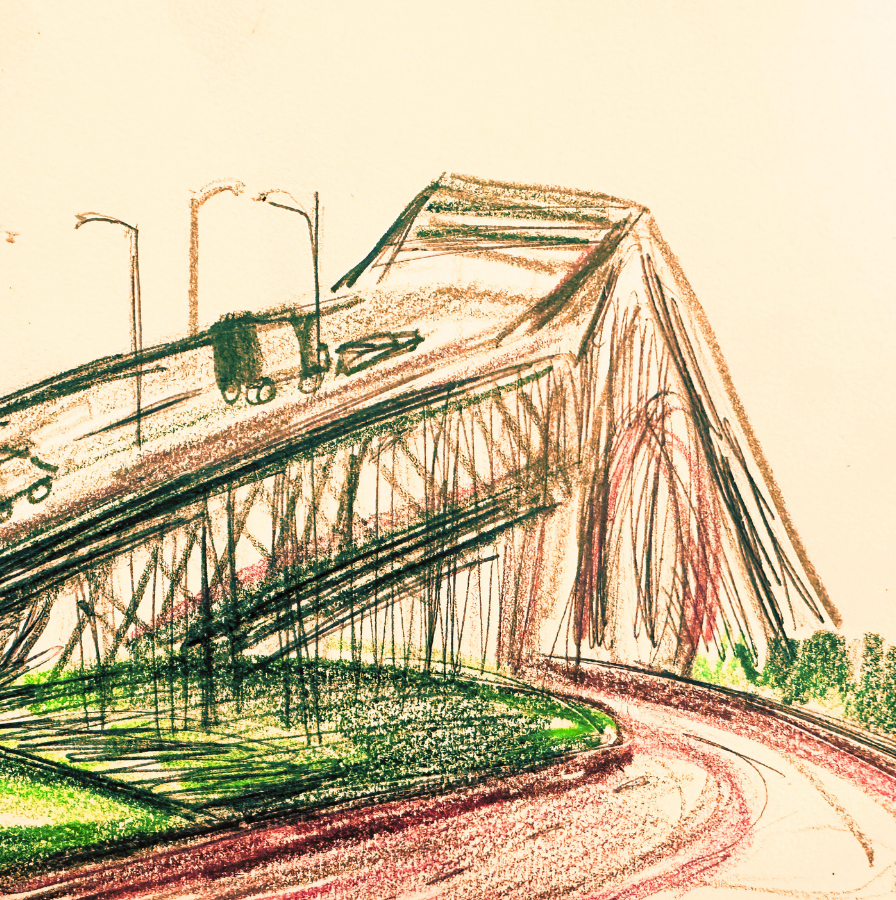
Soon after you cross the Louisiana border from Texas, you see the wide cantilever hoop of the Calcasieu River Bridge, soaring 135 feet above the water. It is too high and too old for the six lanes of traffic that it supports. You hold your breath as you cross. Commissioned by Governor Earl Long in 1951, it was initially decorated with 5,286 pairs of crossed pistols. Wherever you look, you are thinking of death, by gunfire or bridge collapse. Texas has no terrestrial gambling (yet) — just sports betting apps — and so the casinos cluster at the base of the hoop on the Louisiana side of the line. Years as an academic nomad left me with bad teeth, worse insurance, a driver’s twitch in my lower back, and ample free nights at Harrah’s Kansas City and the Horseshoe Lake Charles. When you cross the casino floor at the Horseshoe, you find a scene no less grim than the Via Dolorosa. Perhaps you will dodge the contempt of Longinus and the jeering crowd; perhaps Simon will carry your cross. I’ve heard solemn prayer from a widower, pleading with me to buy his dead wife’s ring in exchange for a little cash, a few more minutes of slot play.
If you withstand the grim temptation, you’ll find Lake Charles — the body of water, not the city — glowing through the glass wall at the far end of the casino. I wanted to use the lake to sink the objects I’d found on my walk the morning after Bryan died: a novena candle and a golf tee. The door between the lake and the casino floor locked behind me. Soundproofed. I couldn’t hear a jackpot alarm or a human voice on the other side, so I screamed BRYAN loud enough to shake the Texas geographies that shared his name. I drop the candle and the tee, the smallest implement of his favorite sport.
I followed the thin walkway, wide enough for one, that wraps around the casino and back to the parking lot. Every door I passed is locked; I could hear nothing but moving water, the 18-wheelers that rattle the hoop of the Pistol Bridge, and the hum of industrial air conditioners. Spring in the Gulf can bake or freeze. Carnival and other spring festivals comprise a single season, resistant to meteorology. Mardi Gras is a religious holiday, as Mark Twain said, though God’s been “pretty well knocked out of it” so that we may reach, instead, “the grace-line between the worldly season and the holy one.” In a good year, it feels like frenzy; in a melancholy one, every parade is a cortège for your dead siblings. I was saturated with sweat by the time I hit the leather of the driver’s seat, a solitary driver on the way to family. This time, I picked Jesus Christ Superstar as armor against the black-and-white billboards, with Texas entirely in my rear view. Ahead and behind, there was so much suffering.
“I don’t know what comes next,” I tell my sister Karen, although, with regards to Bryan, we both knew that nothing came next. He was truly gone. “No one knows,” she says.
She died awaiting a heart transplant a few weeks short of the anniversary of Bryan’s death.
“You have murdered me, murdered me,” Judas sings as he ties his noose. His death is the emotional nadir of Jesus Christ Superstar, but when he is resurrected to sing the title song, the anger of the young revolutionary has left him. The designated mourner for the dying Jesus is dead, too. “I only want to know,” Judas sings.
I am left with the ambivalent gift of no longer needing an answer. My brother and I were often mistaken for twins. One of us got sober, the other did not. There were five of us, but only one inherited a 6.6 centimeter aneurysm from our paternal grandmother. Beth, the youngest, died in childhood; we will never know if she carried the seeds of these later, but still premature, deaths. After Karen died, my last remaining sibling went to doctor after doctor; she wanted to see Karen’s surgeon, and know if the last face she ever saw was a “kind face.” (It was.) Both of our hearts are clear: unburdened of disease, at least.
I find some comfort in that certainty, though it’s a certainty that has left me lonely. Believers feel the little itch of doubt, but I know where I’m going when I die. Bryan meets me at the door, clad in white like Judas and Jesus alike, to tell me what we both know: it could have gone the other way.