
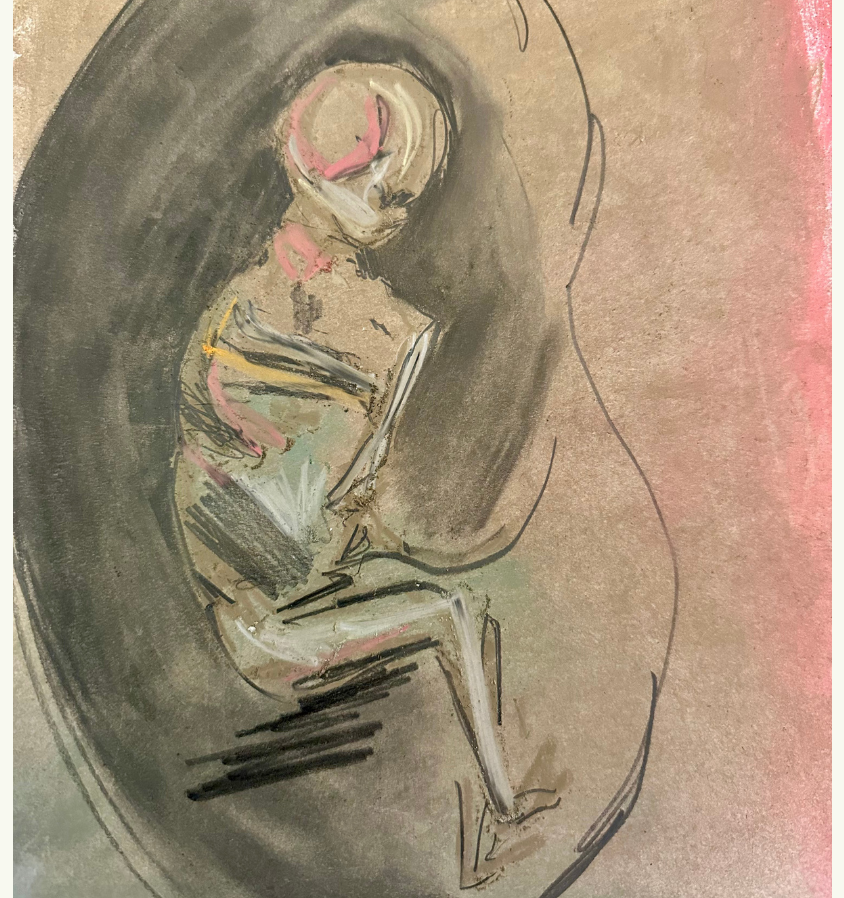
In Gaza, the womb has ceased to be a sanctuary. Beneath the scorching plastic of displacement tents, surrounded by air thick with toxic dust from relentless bombardment, carrying new life has transformed into a quiet, agonizing battle between the female body and an unyielding reality. Across the Strip, the months of pregnancy no longer carry the expectant warmth of a new beginning; there are no longer joyful gender-reveal gatherings where families and friends assemble in spaces filled with laughter to welcome a child. Today, brutal conditions and daily humiliation hem women in from every side. What is unfolding here is a relentless destruction of the future.

Consider the story of Ayat Abu Younis. After four months of enduring displacement, constant terror, and the total breakdown of a healthcare system, Ayat lost her fetus. Her body was so utterly depleted that she could neither stand nor speak to reporters. She lay stretched out on a thin mat resting directly on the sun-baked earth while her mother spoke on her behalf, describing her daughter’s fragile frame which was barely able to support its own weight.
Ayat’s story is not an isolated tragedy, but a single link in a chain of loss — her own, and her community’s. She had miscarried twice before, her body worn thin by a severe lack of basic nutrients and sustenance. During her most recent pregnancy, basic human necessities had become distant luxuries. Whenever a single egg appeared in the local food stalls, its exorbitant price left her family looking on in total helplessness. Deprived of protein and clean water, Ayat’s body reached a threshold of complete physical surrender.
When a mother’s body starves, breathes constant fear, and endures acute dehydration amidst the turmoil of war, it begins an involuntary biological retreat. Pushed to its absolute limits just to survive, the body begins to process the fetus not as a life to be nurtured, but as an unsustainable metabolic drain. Miscarriage, under such conditions, becomes a biological necessity incurred by an environment where everything needed to sustain life is slowly vanishing.
And how could it be otherwise? For over three long years, these exhausted bodies have been denied the bare minimum of care and nutrition required to harbor new life in their bellies. They can hardly survive themselves.
Ayat’s quiet tragedy was not anomalous. The conditions under which she is made to live are the shared baseline of daily life in Gaza. In the crowded halls of Nasser Medical Complex, 31-year-old Maha Al-Astal sat staring at a reality she couldn’t escape. During what was supposed to be a routine checkup, doctors told her the fetus she was joyfully carrying — just two months old — no longer had a viable heartbeat. The cause was brutally simple: years of malnutrition, bad water, and relentless strain had left her body unable to sustain a growing life.
“There are no treatments, no proper healthcare, and no vitamins to replace what our bodies have lost,” Maha shared, describing how even visiting a clinic meant navigating unsafe transport and standing in agonizingly long lines just to be seen. Her husband, Ahmad, tried to hold back his tears as he spoke of the nursery dreams that dissolved in a single afternoon: “We were picking out names, dreaming like any normal parents about building a future for our child. In one moment, it all vanished. Even if the bombing stops tomorrow, we are still fighting just to stay alive.”
A few miles away, inside a cramped classroom turned shelter, 43-year-old An’am Abu Fsaifes holds a similar grief. While carrying a fetus into its sixth month, An’am watched her pregnancy slip away simply because pregnancy-stabilizing medications were either nonexistent or financially out of reach. She regularly had to stand in endless lines under the beating sun to collect and then haul heavy water containers up school stairs, and then cook over choking firewood smoke.
An’am had held onto a quiet dream: that this unborn baby would be a girl — a sister for her 13-year-old daughter. Instead, her body gave out. Her loss, like thousands of others, is not just an isolated heartbreak; it is a fixture of a merciless environment.
Behind these raw numbers lies a quiet, clinical nightmare unfolding inside battered tents and collapsing health posts that can barely offer a clean bandage, let alone proper reproductive care. Driven to total exhaustion by constant displacement, heavy dust from air strikes, and dirty water, pregnant women are thrust against insurmountable barriers — brutal complications like placental abruption, heavy bleeding, emergency C-sections, and hysterectomies.
What makes this even more devastating is how completely stripped of basic medicine the process has become. All across Gaza, women are going under the knife — having emergency surgery, C-sections, and uterine clearings — with no anesthesia, no antibiotics, and no painkillers. They feel every incision, every tear. They are completely conscious as their bodies absorb the raw shock of the trauma. When it’s over, there is no recovery room. Mothers are simply laid back down on a thin sheet on the bare dirt, left to bleed and endure the pain.
The most harrowing aspect of this loss often unfolds in absolute silence. In bare-bones medical posts across the North, Central, and Southern Gaza Strip, diagnostic equipment lies smashed, rendered useless by long-term blackouts. And since the medical equipment that tracks the health of a pregnancy is not available to them, pregnant women do not know when they have lost their fetuses. These women navigate the muddy paths of displacement camps, hauling heavy water containers and dragging sharp firewood, completely unaware that the tiny hearts inside them had stopped beating days ago.
Without ultrasound machines or diagnostic tools, women heavy with pregnancy carry loss within them without knowing it. They endure long treks on foot and flee incoming strikes while carrying deceased fetuses, risking internal sepsis and hemorrhaging. The trauma strikes in two distinct stages: a physical toll borne without sterile equipment or painkillers, followed by a delayed, terrifying realization that their bodies had been harboring death while desperately trying to preserve life.
There is another grizzly chapter in this story. Prior to the war, countless families spent years navigating emotionally and financially draining fertility journeys, turning to IVF clinics as their last remaining hope to build a family. When major fertility centers such as the Al-Basma IVF Center were bombed and reduced to rubble, the destruction of liquid nitrogen storage tanks violently destroyed over 4,000 frozen embryos in a single instant. Years of patient endurance, medical procedures, and deferred dreams vanished.
The collapse of safe pregnancy conditions in Gaza is a direct rupture in the natural continuity of an entire society. When women are stripped of the physical capacity to carry children safely, when miscarriages multiply inside tents, and when fertility institutions are leveled, the impact is not confined to the present moment. Women like Ayat, Maha, and An’am — whether resting frail frames on the sun-baked dirt, staring at quiet ultrasound monitors in crowded medical corridors, or hauling water jugs up school stairs with fading strength — carry a grief that transcends individual heartbreak. They mourn our collective severance from hope. Their bodies bear the physical price of an environment where life is deracinated. By stripping an entire society of the basic material, medical, and biological conditions to reproduce, the collapse of maternal safety cuts the delicate thread between a people who managed to survive this hell and the children they hope will outlive it.
Since April, miscarriages in Gaza have surpassed 4,000 cases — averaging between five and ten miscarriages every single day. That translates to roughly 460 miscarriages for every 1,000 live births. These are not dry statistical records; they are a testament written in tears and blood to an ongoing erasure of unborn futures.