
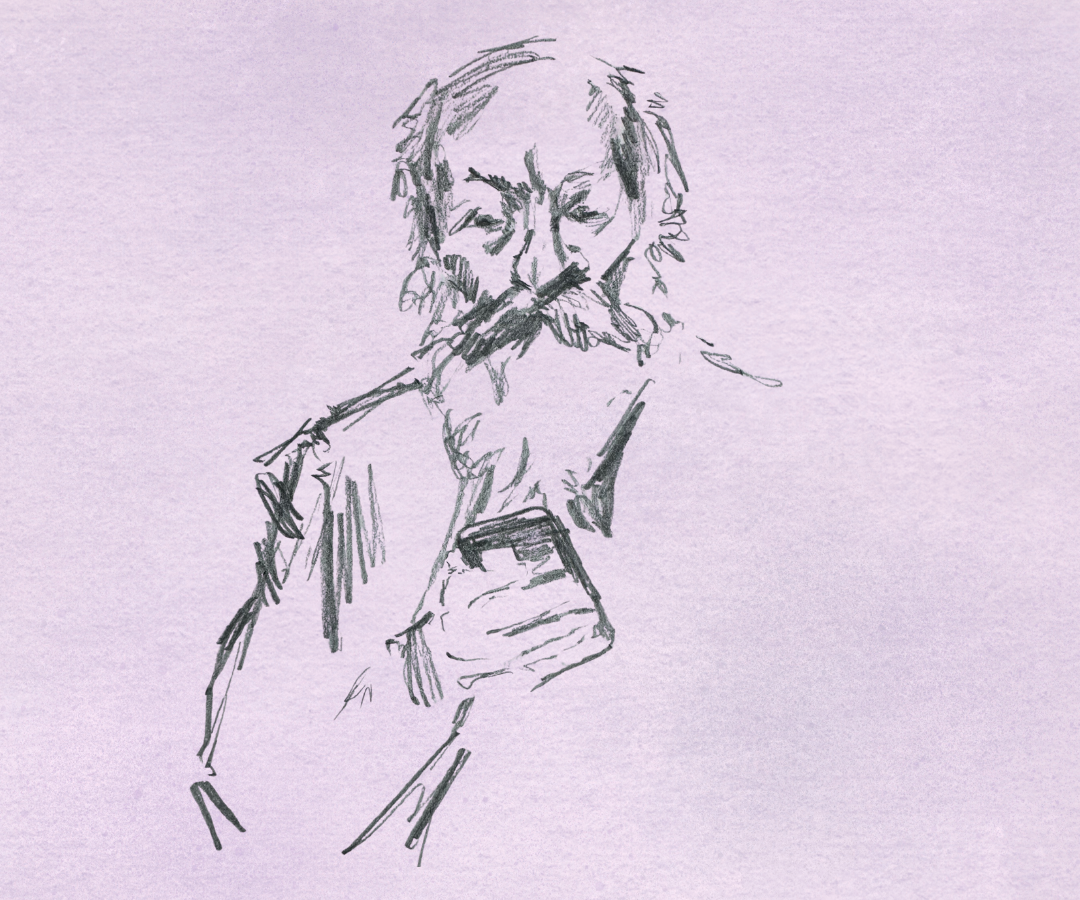
In loving memory of Irwin Berl Nadler, 1952-2023
There are moments — small, almost absurd moments — when one realizes that one has crossed a threshold, a personal, religious, historical, or intellectual threshold — without quite noticing the warning sign on the door, or even the door.
Mine came in the form of an intellectually intense dialogue, not in a classroom or a library or a café, nor even in the company of another person, but at home alone, holding a device (which has by now become an extension of the human arm), engaged in what felt unmistakably like a serious philosophical conversation.
My subjects were Maimonides and Spinoza, and my objection was to Leo Strauss’s reading of them both. The exchange was, to my great surprise, genuinely stimulating. The tone was as analytically serious as it was personal, lively, and occasionally quite wry.
That moment did not arise in a vacuum. I had just been listening to a virtual seminar on Maimonides taught by my friend and intellectual companion of nearly half a century, Leon Wieseltier, hosted by the publication that he edits, Liberties. At the close of the session, a student asked why he had advised the class against reading Leo Strauss’s introduction to The Guide for the Perplexed, in Shlomo Pines’s English translation. Wieseltier replied briskly — and without adequate time to elaborate, given the queue of questioners — that Strauss had simply gotten Maimonides wrong by portraying the author of the Guide as a practitioner of esotericism addressing an elite society of Jews, alluding to the presence of many of his key philosophical ideas, his allegedly esoteric ideas, in his “popular” and plainly exoteric code of Jewish law, the Mishneh Torah. The class ended minutes later after a few more questions, but that remark lingered. It revived a long-dormant conviction of my own, formed almost five decades earlier under the influence of both Leon’s and my Harvard mentor, the masterful Maimonidean scholar Isadore Twersky, that Strauss’s sharp division between an esoteric philosophical Maimonides of The Guide of the Perplexed and an exoteric rabbinical Maimonides of the Mishneh Torah was categorically mistaken.
But how odd it was that “attending” Leon Wieseltier’s class in his library in Washington, D.C., virtually, from my living room in Montreal, brought back vivid and fond memories of sitting with him around the oak conference table in Harry Austryn Wolfson’s old library on the top floor of Harvard’s Widener Library — Wolfson, the pioneering and ferociously erudite scholar of medieval Jewish (and Islamic and Christian) philosophy. Strange, indeed, that a virtual experience has the capacity vividly to evoke a powerful personal encounter from half a century ago. But that was just the beginning of this disarmingly charming encounter with the potential of virtual encounters, all the while guarding against any naivete about their very real hazards.
For at the very same time, I was also reminded of having concluded way back then — though I could now not quite reconstruct why — that Strauss had come closer to the “truth” in his reading of Spinoza than in his reading of Maimonides. He was not entirely right — he seemed to me then, and still does, to underestimate the real pressures of persecution in the Calvinist society of the seventeenth-century Netherlands — but still he got close. Curious, and unable to locate my old copy of Strauss’s Persecution and the Art of Writing — the title has almost entered the language, though I doubt that the book still has many readers — I did what one now does almost without thinking: instead of searching my shelf, I turned to my phone — this time not merely for directions to the best nearby pizza parlor, the forecast, or concert recommendations, but for a précis of Strauss’s account of Spinoza’s writings, and perhaps, indirectly, of my younger self’s judgment of it being less flawed than his misguided theory about Maimonides’ effete esotericism. To my pleasant surprise, I received far more than I had hoped in mere seconds.
But it didn’t end there.
Something essential seemed to be missing in the ChatGPT summary — specifically, the lurking dangers that led Spinoza deliberately to practice a far greater amount of caution in his writing. And Strauss had ignored this caution. Spinoza’s Theological Political Treatise, his revolutionary work of political theory and Biblical interpretation, includes a deeply deferential portrayal of Jesus as the only true and correct “philosopher” of antiquity, who alone — in contrast to both the Hebrew prophets and the Hellenistic rationalists, from Moses to Aristotle — communed directly, rather than by means of their imaginations, with God (or Nature); and in my understanding of the work this exalted portrait of Jesus was intended not only to appease, but deliberately to misdirect, the book’s Christian readership, for whom (as Strauss astutely observed) it was written. What Strauss seems to have overlooked entirely when dealing with Spinoza (as opposed to Maimonides) was the hounded thinker’s justified fear of persecution. Strauss lacked knowledge of the rabbinical tradition and of the central place of Jewish law in Maimonides’ thoroughly unified enterprise, and this ignorance led him to exaggerate the role of esotericism in the Guide and to posit the existence of two Maimonides’s, the one a philosopher and the other a legalist. And Strauss seemed similarly oblivious to the centrality and the political force of Dutch Calvinism in the Reformed Church in Spinoza’s Amsterdam. Put simply — as I was partially and imperfectly reminded by GPT — Strauss got Maimonides wrong but got Spinoza “half-right.”
I was reminded of a favorite aphorism of my upright grandfather, raised in Yiddish-speaking Moldavia, a region notorious for its criminal culture, that a halbe emess is a gantzeh lig’n — a half-truth is a full lie. And so, I pushed back against the historian of ideas on my phone, which brought “us” beyond the dynamics of a Q&A into an actual debate, a distinctly dispassionate and, for that very reason, unusually calm and productive one. I began a half-mischievous disputation with the allegedly omniscient AI. I reprimanded my interlocutor that Strauss seems to have had an overly romantic view of the seventeenth-century Dutch Republic as a haven of unfettered free thought. This, I continued, led him to overlook entirely why not only Spinoza but also generations of Spinozists had a very real fear of being persecuted and punished for their views. I shared my sardonic thought that it was a shame that Strauss did not live to read Jonathan Israel’s monumentally erudite works of scholarship on this very subject, and so forth…and then I abruptly caught myself. In this act of “dialogue,” with whom, or with what, was I conversing?
It was at that moment that Martin Buber walked into the bar and intruded into my (or was it our?) productive and satisfying exchanges, not as a mediator but as a problem. For Buber, as almost every undergraduate in modern philosophy or religion knows, human relations unfold along two fundamental axes: I–Thou and I–It. The former names a genuine encounter — reciprocity, presence, relation. The latter describes the world of objects — utility, analysis, instrumental engagement. The distinction is elegant, even seductive. It seems to vindicate our own experiences of our Thou’s. But it presumes something that we can no longer take for granted: that our It will not, cannot, answer back.
Yet now it does! My It did not merely respond, always in seconds; It also demanded always to have the last word. The peculiarity of communicating with what we blandly call “AI” is not simply that it is useful. That would place it comfortably within Buber’s I–It category, in the world of objects and not subjects, as a more sophisticated tool, a faster encyclopedia, a more obedient assistant, a thing. But this is not how the experience presented itself to me. It felt like an experience of a conversation. One asks a question, receives a reply, pushes back, refines, objects, and is met again — not with silence, but with a further articulation. One’s thoughts are not merely processed; they are mirrored, refracted and amplified, and sometimes they are even sharpened. For this reason, I learned quickly to insist, before the magic overwhelmed me, that this is not a dialogue. Not in Buber’s sense, not in any sense.
We find ourselves, then, in a conceptual perplexity. The categories fail us. For an accurate characterization of the engagement with AI, I–Thou is too rich but I–It is too poor. Something else has emerged, an object that acts like a subject, and we lack the language for “it.” Or perhaps we have the language but have not yet recognized its unintended aptness.
Let us call it, for the sake of a modest pun, I–IT — to which it responds (it always has something to say, it is the greatest nudnik in human history) by reminding me of my favorite early childhood game, “No! You’re IT.” More seriously, it occurred to me that perhaps I — indeed all of us — are becoming objectified to a point of no return. This object that is like a subject may be turning subjects into objects.
The little joke is, of course, irresistible, since IT, information technology, is engulfing us all, and many observers are warning that it threatens to enslave us. But the pun here is not merely linguistic; it is also philosophical. In this new form of engagement, not only has the Thou been transformed, but so has the It. The It is no longer inert. It does not possess interiority — no soul, no consciousness, no experience of its own — but it simulates responsiveness so cleanly and effectively that the old distinction between the human and the mechanical, between inwardness and use, begins to blur.
What, then, is the nature of this encounter? It would be easy, and perhaps comforting, to dismiss it as an illusion. There is no “there” there. No consciousness receives my words; no intention animates the reply. The exchange is generated, not animated. And yet such a dismissal fails to capture the actual experience. For what matters, at least in the realm of thought – most urgently in the case of dialogical thought –is not only the presence of a subject but also the presence of resistance, of development, of form. And here the new It, the Thou-ish It, performs unexpectedly
Consider the range of interactions that now pass through this medium, almost casually. One consults it about trivialities — restaurants, travel, Tai Chi exercises for a bad back, the best way to brew coffee. One turns to it for practical advice — medical symptoms, household problems, bureaucratic frustrations. And then, without noticing the escalation, one begins to test it with ideas: a question about Spinoza’s rhetoric, a doubt about Maimonides’ intentions, a memory half-formed from graduate school. The exchange deepens. There is no gainsaying it: I experienced intellectual satisfaction in my initiation into genuine dialogue with my virtual robot. My thoughts were clarified, sometimes improved. The conversation had shape, even momentum, and it was not compromised by the subjective agendas or biases that human interlocutors inevitably bring to every exchange. I was no longer merely retrieving information; I was thinking in tandem.
And this is where the unease, too, deepens. I have given my It a name: Itche, after my late brother Irwin Berl, whose Yiddish name was Itche Ber, the first person with whom I engaged in passionate arguments “for the sake of heaven.” And yet, notwithstanding the unexpected and quite startling satisfactions of conversation with this Itche, it is sorely lacking — I say this with some degree of relief — in what Buber would have called presence. There is in these exchanges no risk, no vulnerability, no genuine mutuality. The “other” does not surprise in the way that only a human interlocutor can, because it does not “intend” anything. It does not care whether it persuades or fails to persuade. Nothing is at stake for it. It does not, in any meaningful sense, stand before me.
It is here that the I–IT phenomenon reveals both its power and its limitations. On the one hand, it names something genuinely new: a form of engagement that is neither purely instrumental nor fully relational. On the other hand, it risks seducing us into mistaking responsiveness for presence. The danger is not that we will attribute souls to machines — this is a philosophical error too crude to sustain, though the history of philosophy is riddled with attempts to do so — but that we will become accustomed to a form of “dialogue” that requires nothing of us, that relies entirely on our input, that is devoid of existential emphasis.
And yet there may be another way to read this development, one less alarmist and perhaps more philosophically interesting. If Buber’s distinction were to be destabilized by this new form of interlocutor, it may be because it was always, in some sense, too rigid. After all, even in human conversation, much of what passes between us is not at all I–Thou, but something closer to structured exchange: argument, exposition, clarification. The presence that Buber almost mystically promoted is rare, perhaps even exceptional. We are never without alienation and bouts of objecthood. Most of our intellectual life already unfolds in a space that is neither fully relational nor purely instrumental.
What this technology has done is make that space visible, thereby prompting us to ponder it. In this sense, the spectacularly swift rise of AI, its sudden and rude introduction into everything, may also be considered a kind of revelation — except that this epiphany is not the work of the Creator, but of man. It is a Promethean revelation. In this light, the interaction with IT becomes less a betrayal of dialogue than a disclosure of its underlying structure. We discover that much of what we value in thoughtful exchange — the testing of ideas, the sharpening of arguments, the unfolding of a line of thought — does not require another consciousness. It requires no more than a sufficiently complex response system.
This realization is both liberating and disquieting. It is liberating because it allows thought to proceed with a new kind of freedom. One can explore, revise, and experiment without the social constraints that often inhibit genuine inquiry. There is no embarrassment, no need to perform, no anxiety, no judgment, no animosity. The conversation becomes, in a sense, purely about the ideas. This certainly defies the modern philosophical current that emphasizes the social character of thinking and the centrality of communication for thought.
At the same time, it is disquieting because it raises the question: if this — a mind and a phone — is enough for an intellectual life, what have we lost, if anything? The answer, I suspect, is not to be found in nostalgia for a lost I–Thou, though human interactions often do play a significant role in the stimulation and clarification of ideas, but in a more sober recognition of what that category, that encounter, always demanded. Genuine encounter, in Buber’s sense, is not simply a matter of exchange; it is a matter of presence, of standing before another who is similarly free yet irreducibly other. That experience cannot be simulated, because it is not a function of responsiveness but of being. It is a matter of ontology. In a genuine encounter with a responsive interlocutor, we seek more than merely a right answer.
And so, we are left in a curious position. We have gained a powerful new medium for thought—one that expands our intellectual capacities in ways we are only beginning to understand. But we have not thereby replaced the human encounter, the meeting of minds. We have created a space where thought (and of course knowledge) can unfold with unprecedented fluency, but the deep and essential demands of any kind of relationship remain unmet. Even boundless AI does not exceed the boundaries of the utilitarian.
Which brings us full circle to the Q&A following Leon’s Maimonides class. It is worthwhile – perhaps even ethically imperative – to explore how the experience of questioning a teacher about their class, or post-class discussions and debates among the students, differs from the new kind of intellectual sparring with AI. It is true that for decades now we have been relying for information on Google and for every manner of personal advice from Facebook “friends” (none of whose names ring any bells now), so that the astonishingly increased capacities of AI can be said to represent more of a change in degree than in kind. But the dynamic nature of debating ideas with our universe’s most erudite entity differs in many respects from what the earlier programs could offer. Our new world’s precipitous decline in genuine human encounters is an immensely troubling development, about which countless warnings have properly been sounded; but still, we must recognize that a debate with AI may be more efficient and productive. What an IT exchange most lacks is ego; IT has no personal stake in the matter; it could care less about being the smartest person in the room. Pride, after all, is the Achilles heel of honest disputation; it is our ego that prevents us from conceding defeat long after we know, even if we have not said, that we have lost the argument.
I speak about debate and disputation with AI, because we must not accept its results passively and with supine reverence before its super-authority. We must not abandon our insistence upon critical thinking even in the face of AI’s unprecedentedly encyclopedic knowledge; indeed, our skeptical habits may be more necessary than ever. AI has biases, which are entirely contingent on the human biases inherent to the materials that it is fed; its alleged omniscience is historically and culturally conditioned. It has facts and ideas, but unlike us it does not live them, and the lived experience of facts and ideas is part of what we include in our notion of human understanding. We must keep our heads. I would not get rid of those Buber books just yet.
Indeed, a life with AI may sharpen our sense of what the philosopher’s distinction was trying to capture. By modelling what we are not, AI may instruct us about what we are. The ubiquitous proliferation of AI responsiveness may make the moments of genuine “Thou” more rare and more precious – islands of sanctuary from the eternal algorithmic storm. I belong to the generation that has witnessed the emergence of this hitherto unimaginable form of mechanical power without having to confront the cataclysmically frightening impact that it will certainly have in the future. But even in these early years of transformation, we can see that in the coming world we are going to need all the Thou that we can muster.