
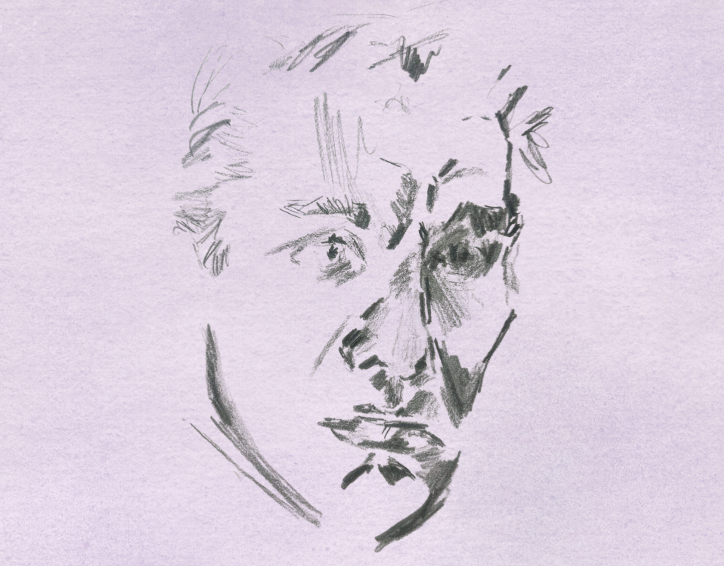
What do we want from our idols? Devotion to their ideals, of course, a keen sense of self-mythos, preferably an exalted capacity to live as they preach. On a cursory glance, Jack Kerouac appears to meet these standards. The Buddhist Years, a collection of Kerouac’s previously unpublished drafts, diary entries, poems, and scribbles, excavating his three-year infatuation with and subsequent estrangement from Buddhist theology, occasions more serious scrutiny. I approached it skeptically, my adolescent infatuation and disenchantment with Kerouac weighing heavy on my mind.
For many, the archetypal image of Kerouac remains the 19-year-old Columbia half-back, slyly grinning for the camera on their On The Road paperback. This was the glowing face of the Beats, the rugged band of bohemian outcasts with whom Kerouac bummed about in downtown New York. The Beats fancied themselves the next generation of Great American Artists. After ten years of relentless typewriter bashing in Tangiers, Mexico City, and New York, Kerouac, Allen Ginsberg, and William Burroughs began to carve their names into the literary world in the late ’50s. Of the three, Kerouac’s literary project was the least experimental, and the most ambitious. The Duluoz Legend is a thirteen-book encapsulation of Kerouac’s life, from birth, through adolescence, onto his endless, desperate nationwide road-trips, as depicted in his generational sensation On the Road.
What is it about Kerouac that still inspires such fervent devotion among impressionable 17-year-olds, nearly seventy years after On the Road’s initial publication? Kerouac lived the experiences that he wrote about, his novels weren’t sterile thought experiments written from the bowels of ivy-thick scholastic towers but muscular records of a life spent tussling on the forest floor. To his disciples, his spontaneous prose radiates wild, kinetic energy, a dizzying musical propulsion of words building on words building on words, the capstone of generative writing, frantic, compulsive hot wanderlust dripping from the walls as the sun rises up over the San Francisco Bay and gleams madly, gladly, while the — and so forth.
The language is florid and loose, Kerouac is always gesturing above the riotous parties and sweltering physical labour towards a greater meaning, a spiritual undercurrent. His travels are borne forward by this search for meaning, they are pilgrimages towards beatification, revelation, divinity. From The Dharma Bums onwards, this spiritual journey is foregrounded. Buddhist, Taoist, and Catholic teachings are fused together in his quest for a golden eternity. This is what I wanted to hear at 17, that the world is coming into itself, it is ripened and blooming as you gaze out from the cusp of the cave — hedonism seems almost noble, suffused with meaning and integrity against vapid middle-class conformity.
The only people for me are the mad ones, the ones who are mad to live, mad to talk, mad to be saved, desirous of everything at the same time, the ones who never yawn or say a commonplace thing, but burn, burn, burn like fabulous yellow roman candles exploding like spiders across the star.
The same vulnerable, scrappy quality that endears adolescents makes Kerouac an irresistible target for dismissal — Harold Bloom called On the Road a “Rather drab narrative” with “No literary value whatsoever” while his contemporary Truman Capote hissed “That’s not writing, but typing.” Subsequent generations of critics have lambasted Kerouac’s brutish treatment of women, the narrowness of the all-American freedom he celebrates, and the legions of amoral male manipulator-types who revere him. But there are other reasons to become disenchanted with Kerouac. His inability to change tack and slow down, to describe events beyond feverish wanderlust or forlorn disappointment, his adolescence, his crudeness. Spontaneity kept Kerouac chained to the self, or maybe vice versa — unable or unwilling to venture much beyond his own perspective and experiences. When the racing, sweating prose loses its glimmer, even for a moment, the Duluoz mythology can suddenly appear less like a valiant literary endeavour, more like an ugly, vain attempt to justify oneself.
The two longest stories in the collection, The Heart of the World: The Legend of Duluoz and The Legend of the Three Houses, vindicated my cynicism, often reading like an anthology of his worst impulses. The titular Heart of the World is the night of Kerouac’s birth, the beginning of the Duluoz legend. Kerouac’s mythic conception of the world began early. His sickly elder brother Gerard died young and was canonized as an angel by their mother, too pure for the world. The Heart of the World now canonizes little Jean-Louis (Jack) as Christ in miniature, born in a dreary Massachusetts-bound variant of the Nativity.
The narrative does not break new ground. Breathless sequences in his trademark stream of consciousness style proliferate, though a few vulnerable flourishes stand out:
My father, with his big thighs, the cigar ashes falling on them, his rough back-of-hand scraping them off, his cough, huge sincere eagerness, gnarled tortured blackened face beside me in some old brownout smoky coach of the Eternity Railroad and outside thru the unwashed windows we see sad sidings, rails bits of grass, grief-stricken birch on a cut, the wildness of New England, a few stars…
But between these visceral bursts, the prose meanders, vague and unfocused, unable to convince itself of anything meaningful that occurred that fateful night.
The Legend of the Three Houses, Kerouac’s attempt at an expansive American epic of fathers and sons and unfurling destiny, breaks away from his dependable autofiction. There are flashes of brilliance, sentences teeming with vivacity and rhythm, but not much more. The plot is indecipherable, characters blend together as thinly disguised manifestations of the author, racing across the nation for no clear reason.

What about Buddhism, the philosophy ostensibly underpinning these stories? References are sparse and superficial — motifs of infinite railroads, blank voids, dreams within dreams, the perfection of emptiness. These elements broadly read as cynical, if engaging; textual flourishes deployed to imbue slim narratives with cosmic importance. Towards the end of The Three Houses, for example:
Like waking up from sleep, everything was imprinted on liquid. An enormous woe of antiquity lurked in the stone of the basement, in the signs of human use on them. The clouds, shining in the pure empty space of blue, seemed older even than the stone of earth in basements of man, but ageless, crinkled by gold and old heat into shapes that keep insubstantially changing in heights of cool vapour. Something immortal was in the perfect emptiness of the blue firmament, so that he had the eerie sensation that his true self was this emptiness and everything else a big mistaken junk-rank of imaginary things all around, including his body which was suddenly like a spectral giant.
His true self was his emptiness. This is one of the core tenets of Buddhism, that the self is an illusion, the universe is fundamentally empty, life is suffering, and desire is the cause. This is the fundamental contradiction with Kerouac: between the philosophy he spouts and the way he lives, the way he writes. Because Kerouac is desire, a bundle of contradictory desires and impulses for wisdom, women, fame, truth, and booze. If the true self is empty, what use is the incessant gabble that he unleashes onto the page?
Kerouac wants to have his beatific cake and eat it too; to comprehend the absolute truth of the world as transient, empty, full of suffering, but remain living in it, reaping the pleasures.
Kerouac was set on becoming a bodhisattva, a being that reaches enlightenment through divine compassion for others. But compassion is often lacking from The Buddhist Years. While he appreciates that all beings are interconnected on an intellectual level, he does not seem to deduce ethical imperatives from this condition. His Buddhism demands nothing from the individual: “I could do anything I wanted.” Beat peer and Buddhist scholar Philip Whalen noted:
[Kerouac] was incapable of sitting for more than a few minutes at a time. . . . His knees were ruined by playing football. . . . He never learned to sit in that proper sort of meditation position. Even if he had been able to, his head wouldn’t have stopped long enough to endure it . . . but he thought it was a good idea.
Kerouac was at this time, it bears mentioning, profoundly depressed. In the years before On the Road’s publication, there was no Beat mythology, no Duluoz legend, there was just a washed-up former athlete in his early thirties, living with his mother, newly divorced from his second wife, suffering from chronic alcoholism and an endless capacity for shameful, self-induced suffering. Buddhism justified this suffering, redeemed him and his pain.
To Kerouac, Buddhism was not a life-long spiritual discipline and practice, but a metaphysical framework to invoke for his own needs. In effect, it was a tool, an exotic spyglass that served to validate and mystify, but not seriously challenge. He treated all religious traditions as pocketable wisdom, tools to self-justify. He took what was useful and left the rest.
All this may sound familiar. In a sense, Kerouac is the unwitting progenitor of the full-scale commodification of spirituality that has bloomed into the wellness workshops and mindfulness retreats that flourish today. In wellness culture, various semi-contradictory philosophies are welded together, stripped from their specific history and context. Spiritual practices like meditation are treated as utensils to “optimize the self,” and increase productivity.
Where once the ideal would have been to quieten the self, to steadily unfasten it from its pedestal, wellness culture never challenges the self’s role as sovereign, only seeking to refine its capabilities.
Faith, that irrational leap into darkness, is made obsolete. Faith is for whatever cannot be integrated into the self, whatever goes beyond.
Kerouac was pathologically incapable of escaping his desires, of surrendering himself totally to faith. But unlike our wellness industry salesmen, Kerouac actually took his spiritual quest seriously enough to be disturbed by his own failure to rise to it. To some degree he understood these inner contradictions, and desperately wanted to go beyond, to grasp onto true faith and outrun himself. In the second half of The Buddhist Years the reader watches as Kerouac becomes increasingly repulsed by his own inadequacy.
Kerouac records his plans for an ascetic existence with childlike sincerity:
-
NO chasing after women any more — no hankering to lust & create sorrow & multiply desires & rage.
-
No more drunkenness on alcohol, no more “sipping” — no sickening of healthy body, or temporary numbing of body blanking mind
-
No false social life — no friendships except associations in temporary movement.
-
No more work.
-
No more rich or/and expensive foods — elementary diet of salt pork, beans bread, greens, peanuts, figs, coffee.
-
Finally, (after 5-volumed LIFE) no more writing for communicating & after
-
No possessions finally, but wilderness Robe, no hut, no mirror, begging at houses of village.
His delight in Buddhism was simple and obvious: nirvana, or self-nullification, seemed the ultimate escape. “If I were a piece of empty space I’d be perfectly enlightened and I’d never run off into thoughts like this and I wouldn’t even have to practice solitary asceticism. Would be a perfect Tao cloud, floating, dissolving.”
But Kerouac could not maintain this equilibrium of emptiness, it often slipped into a sullen nihilism: “A dream already ended. All you see before your eyes will not be here in seven million million aeons. Gone already therefore. How can you believe in all this? There were adventures I had when I was nineteen that I thought I would never forget; now I see them through the wet blur, the dismal prism of lost memory, deceived memory, dying, decaying, unimportant memory.”
Impermanence can be liberating, but it is also terrifying.
This could not last forever. He could not keep sprinting on raw, feverish hope; eventually he would reach the end of the road. By the turn of the ’60s, Kerouac had become increasingly embittered with the changing world, with his former friends, with the newfound fame and recognition that he had once desired so deeply, and his own addictions, his inability to change. The candle had burnt out.
All of the gripes and anxieties and shame he had always held sharpened, magnified into an all-consuming chasm of self-loathing. Kids coalesced at his door, chased him down on the street, looking for their golden idol, but he wasn’t there. In a letter to Philip Whalen he admitted to this descent: “I’d be ashamed to confront you and Gary [Snyder] now I’ve become so decadent and drunk and don’t give a shit. I’m not a Buddhist anymore.” The devolution was absolute: Kerouac aged into a reactionary, alcoholic patriot, gibbering ineffectually while his former Beat confidant Ginsberg led the youth movement forward into the hippie age.
This disintegration is chronicled in the harrowing last quarter of The Buddhist Years, in which the reader is made to bear witness almost in real-time as nostalgia and spite swallow up the visions of Buddhist atomic infinitude. This culminates in Letters to Myself, a life-denying confessional — almost the direct antithesis to the idealist, apprentice bodhisattva Kerouac. It begins decrying the changing world: “Civilisation is rapidly becoming a multiplication of the evil influence of the disturbed.”
And goes on to bemoan technological change:
I don’t understand America no more… The TV has cut off simple contact… In the yard I hear strange disagreeable noises everywhere: growling trucks, roaring booming jetliners in the air, screams of demented children (they’ve changed awfully, their screams are no longer gleeful).
Even children’s screams are worse than they used to be. Nostalgia permeates. At 38, he sounds like a miserable old crank.
Kerouac loathes this new America, but he hates people who hate America more. It touches a nerve: to assume you deserve anything beyond what you’ve got, that you can lift yourself out of your suffering:
blaming America or anything they can think of instead of BLAMING THEMSELVES… And that I think is what Jesus meant by repenting for our OWN SINS, not accusing others of THEIR sins… We repent (I repent anyway) for the sin of my own fucking ignorance… I am not going to blame colonialism or capitalism or communism or poverty for my horror or any of the people who can be blamed for the causing of those things: I am going to blame myself, the originator of my own ignorance… for the unhappiness I can’t blame others (it is so silly)… BLAME BIRTH, blame the ignorance of nature of birth, for your fucking death… It is birth that causes death as Buddha said…
BLAME! His misanthropy burns the page the same way his young spirit once whipped it. Everyone is condemned. Catholic guilt and Buddhist teachings merge together to justify this insatiable contempt. Kerouac simply cannot stand himself. Rather than allow for redemption to be possible, he blames the universe — in a vulgar, cosmically-tinged nihilism.
There is something pathetic and ugly and insurmountably human about his defiance, like a man kick-boxing a broken mirror. By the time of his premature death at 47 in 1969, this anger had fizzled into squalid fatalism.
The final work of his lifetime, Vanity of Duluoz (1968), is like a full-length Letters to Myself, crammed with morbid aphorisms: “Who’s going to come out and say that the mind of nature is intrinsically insane and vicious forever,” “I’m dying myself, and you’ll die someday, and all this, poof, it goes.”
The novel concludes with a stark judgement of the entire Duluoz project, grifted from Ecclesiastes:
[I thought] When this book is finished, which is going to be the sum and substance and crap of everything I’ve been thru throughout this whole goddam life, I shall be redeemed.’ . . . But nothing ever came of it. No generation is new. There’s ‘nothing new under the sun. All is vanity.’
Thus goes the King of the Beats, crushed under the bitter weight of the universe, a washed out false prophet.
Kerouac interacted with religious beliefs in bad faith, extracting the most ascetic, life-denying passages to legitimize his shame and guilt. There is no doubt that this relationship with religion was as transactional as the most self-justifying wellness practice. Whether affirming or denying, both of these approaches are resolutely tied to the self.
But Kerouac was nothing if not authentic. And this authenticity is no less poignant for being the true expression of a limited man. His continued relevance does not follow from the depth of his spiritual ideals but the poignancy of his sincerity, his evocation of that tormented — sometimes sublime — search for meaning that can come in the absence of true belief. Reading these ragged efforts to will himself into faith, rushing and writhing to ascend beyond, it’s difficult to not feel a profound compassion for him.
He held nothing back from us. Kerouac was unafraid to fail spectacularly, cosmically, infinitely. The inadequacy of his faith may be his greatest legacy.