
Carol Anshien knew exactly what items she was looking for. It was a spring day in 2024, on the Upper West Side of Manhattan, and she was rummaging through her apartment. Throughout the years, Anshien had carefully preserved her records, which had resulted in high stacks towering around her home. They spanned over more than half a century; from the decades she had spent as a librarian at the New York Public Library all the way back to her days as a videomaker in the 1970s. Back then, Anshien was active in the women’s movement in New York, and the remains of that period were stored in her stacks. She wound her way towards the hallway, where, opposite the front door, a closet with ceiling-high bifold closet doors loomed over her.
Inside, two shelves brimming with paper bags and plastic packages hid above a rail of coats. From the lower shelf, right above the parkas and the raincoats, she pulled a slightly torn Dean and DeLuca paper bag and extracted a stack of ½’’ reel-to-reel videotapes from inside it. She took four tapes from the pile, and shipped them to Chicago to be digitized and preserved.
Between 1975 and 1977, Anshien was part of a nationwide network of feminists that sought to change the media landscape. International Videoletters was a video exchange network, which connected women all over the country and beyond. With a Portapak camera in their hands and a videotape recorder over their shoulder, they told stories of womanhood — real stories, the ones they couldn’t see elsewhere. Certainly not on TV, nor in Hollywood films. So these feminists took it upon themselves to create images that mattered to them, illuminating feminist issues on boxy cassettes of black-and-white footage they distributed around the country, at times via Greyhound bus. They attempted to radically redefine what it meant to be a woman in media, whether she was on-camera or behind it, no matter the hurdles thrown their way. The women of International Videoletters created a media network from the ground up, reaching women all over the world. And their story has never been told.

The story of International Videoletters has not been preserved even though women all over the country were involved. It’s hard to imagine today just how isolated these activists were from one another when the project began. Contemporary creatures of the smart phone age are used to discovering farflung communities the world over through TikTok, YouTube, and Instagram. Fifty years ago, these activists needed a different kind of tenacity; one we cannot quite fathom today.
The seeds of International Videoletters were planted on the first weekend of February 1975, when 125 women working in film and television gathered in Manhattan for the Conference of Feminist Film and Video Organizations. It was a frenzied year. The women’s movement was in full swing, the United Nations had declared 1975 International Women’s Year — but these women were not satisfied quite yet. They had come from all around the country, some from as far as Canada and even Australia, to strengthen the influence of feminist media. If they were not going to take responsibility for changing women’s images on screen, then who would?
One photo taken that weekend shows a group of women, some in t-shirts with the conference’s logo on it, their arms around one another. Among them are Ariel Dougherty and Carol Clement, two of the five young organizers. By gathering those women, they hoped that together they could create a national feminist media network.
At the time, Dougherty was just 27 but already a longtime activist. She had been lobbying at congress before she was even in high school; a 13-year-old fighting for more funds to improve the schools in Washington D.C. But she really got her bearings as an activist while a senior at Sarah Lawrence, when she was exposed to activist film for the first time. “I started to see the importance of film as a tool to communicate what was going on,” she told me. She began using film to tell women’s stories. In 1972, Dougherty founded the feminist film organization Women Make Movies together with Sheila Page and Dolores Bargowski. She taught filmmaking to other women and made movies about women’s lives. They operated from a shabby basement they had stumbled upon in Chelsea which they romantically called the Chelsea Picture Station.
And then, one day, Carol Clement walked in. A visual artist and designer, Clement had just returned to New York after a couple of years in Los Angeles where she’d gotten swept up in the women’s movement. By the time Dougherty and Clement helped organize the conference in 1975, they were living together, longing to know other feminists in media.
They were not alone. On the other side of the country, filmmakers Frances Reid and Cathy Zheutlin were planning their own gathering to sate the same longing. Their event was on the West Coast. When they heard of the conference in New York, the women decided to join forces. Eight weeks after the event in New York, Los Angeles would host their event: The Feminist Eye. “We were very idealistic,” Zheutlin reflected. “We wanted to change the world. And we were going to change the world by changing the image of women in media.”
The image needed changing. On television, women were mostly overlooked or looked upon with a leering smirk. Yes, there was Mary Tyler Moore, but such characters were rare exceptions to the boys’ club. Overall, 200 men held big roles on primetime network television in 1975, as opposed to 36 women. Only four of those women were Black. News and current-affairs programs largely ignored women, even though it was the heyday of the women’s movement. There was only one program on air about women’s lives. It was called Woman. Behind the scenes, too, women were pushed out. The New York Commission on Human Rights had found a pattern of sex discrimination at NBC. In LA, women were protesting the treatment of women at a CBS-owned station. If women were hired at all, they were routinely relegated to clerical or secretarial positions, with little room to rise beyond that.
And things were not much better in film. In 1975 the film industry was Hollywood, and Hollywood was men. The majority of women who did work in Hollywood were relegated to script supervising or film editing — detail-oriented tasks considered suitable for women. Take cutting up film: a dainty little task deemed fit for dainty little hands. But women directors? Producers? Cinematographers? They were next to non-existent. When the president of the Directors Guild of America wrote an editorial for Variety in 1974, he proudly announced the broadened scope of the women in the guild. He cited the numbers: there were now 163 women out of a total of 4,127. In other words: less than 4%. But, he pointed out, in the not-too-distant past, there had been only two women. So much for progress. The truth was, the industry was looking dim for women with Technicolor dreams.
Representation is about freedom, about securing a seat at the table, about being considered equal to your fellow man. At least I believe it was for these women. On that Sunday afternoon in Manhattan, February 1975, they conceived International Videoletters. Videomakers from the cities represented that weekend agreed to participate in a video exchange network. The plan was to function rather like a newsletter, but done through video — a videoletter. Washington D.C. was represented by the Spectra Feminist Media Project, and a woman named Deborah George was among its members. Chicago contributed with the video collective Kartemquin, represented by Sharon Karp. New York, Los Angeles, and Rochester also joined, and the cities would exchange cassettes on a monthly basis, and host screenings to show one another’s work as well as their own. Carol Clement designed a logo. It was entirely grassroots, built from scratch, and it was exhilarating.
Their goals were lofty. The group wanted to increase awareness of feminist issues, of womanhood — nobody was bothering to document that, not really. Across her kitchen table Dougherty explained to me, “We were trying to create women’s history. If we knocked on the door of CBS, we’d have to deal with them and what their thinking was. And that wasn’t a direction we wanted to go in.” Without a male studio executive telling them what to shoot, how to shoot, or what the 30-minute videos should look like, the women could produce whatever they fancied. Anything.
They were becoming leaders during one of the most exciting and riveting periods to be a woman, and they set out to document women’s history, in community with each other. They wanted to know one another, know their worlds, from the mundane to the outrageous. This connection was at the heart of their project. This network would provide women with sisterhood. International Videoletters wasn’t just communication; it was community.
The last night of the conference in New York City, a group of women who had attended gathered around a typewriter. Dougherty, Clement, Reid and Zheutlin were among them. They began typing, An Ongoing Womanifesto:
As feminists working collectively in film and video, we see our media as an ongoing process both in terms of the way it is made and the way it is distributed and shown. We are committed to feminist control of the entire process. We do not accept the existing power structure and we are committed to changing it, by the content and structure of our images and by the ways we relate to each other in our work and with our audience. We see ourselves as part of the larger movement of women dedicated to changing society by struggling against oppression as it manifests itself in sexism, heterosexism, racism, classism, ageism, and imperialism. Questioning and deepening our understanding of these words and how language itself can be oppressive is part of our ongoing struggle. We want to affirm and share the positive aspects of our experience as women in celebration.
Twenty-two women signed their name underneath the manifesto. It was subsequently published in Women & Film, the first and only feminist film publication on American newsstands. The magazine was read widely and intensely by women working in and around film and video. They’d pass it around, copy it, devour it from cover to cover. In the summer of 1975, women all over America read the rally cry from New York — a call for a different kind of industry; a system for and by women.
It was all thrilling. Word quickly spread across the country to the West Coast, where Susan Mogul, a feminist video artist, heard of the network and picked up a camera. Along with three coworkers, she toured the Women’s Building, offering the viewer a glimpse inside the feminist epicenter of Los Angeles. The black-and-white footage was screened at the Feminist Eye conference on March 29 and 30 as the first official videoletter.
The screening achieved its purpose. Among those in the audience were Leslie Carlson and Lydia Breen, two videomakers who had driven all the way from Tucson, Arizona. “Okay, we’re in,” Carlson remembers thinking. “We’re all in. Sign us up to do the videoletters.” San Francisco was also in. So were Santa Cruz and San Diego. In the space of a single screening International Videoletters had swelled to a network of nine cities and about 75 women. Afterwards, Dougherty and Mogul worked to fit nine cities into one operating network. To make things clearer and to reduce cost, the cities were broken up into groups of three. As the network took off, Mogul spread a word of caution. Yes, send the tapes around, and, yes, use the copies you made for the next round of videoletters. “It is strongly suggested,” Mogul wrote to the participating women, “that each city keeps its original tape as a way in which to build a library of culture documentation.”
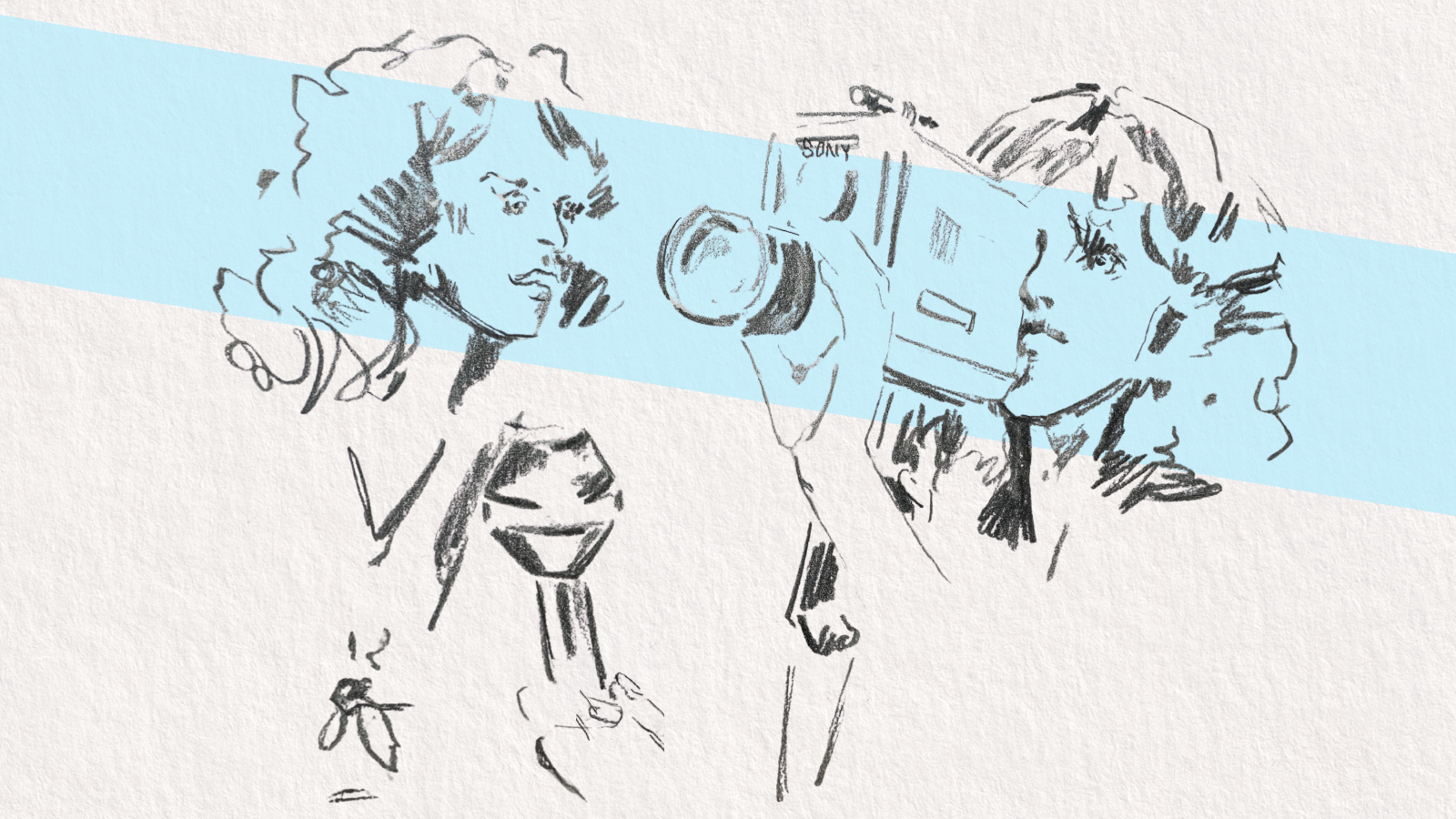
“Don’t take any notes. Just look at it. It’s a lot, but you’re going to get the opportunity to use it.” In New York’s Hell’s Kitchen in the 1970s, Susan Milano would hold a Sony Portapak video camera while teaching a video workshop at the Women’s Interart Center. Compared to film equipment her Portapak felt light as can be. On the back of the boxy plastic device, there was a microphone. “If you’re doing an interview or anything like that, you would not use this microphone,” she’d say, pointing at it, “because it’ll pick up noise from here to Hoboken.” The Portapak came in a leather case, with a shoulder strap, and the videomaker would casually sling it over her shoulder. After Milano finished her walkthrough, she would invite the women up to start putting it together themselves.
The Women’s Interart Center — a feminist arts Mecca which was around until 2016 — was regarded as the most developed women’s video production facility in New York. “At the time they brought me on, video was hot hot hot,” Milano recalled from her loft in Tribeca. “Not just among artists, but among filmmakers and activists.”
The Portapak was introduced by Sony in 1967. It was hot, and not just because it was a novelty. It was the first highly portable video recorder — easy to use, and, at a price of around $1500, far less expensive than big, fancy video gear produced for broadcast television. You couldn’t just sling a studio camera over your shoulder and look cool. You could carry the Portapak anywhere and shoot anything, and play the footage back instantly. “It could also frustrate you,” Milano said to me, “because it was not made to be roughed up — you had to really treat it with a certain delicacy.” With low-resolution black-and-white images and tinny sound, the Portapak was not intended for professional use. It was cherished by videographers who were more interested in freedom than technical precision, including creative outsiders experimenting in what would come to be called “guerilla video.”
In the 70s, more and more women turned to video. It was a medium that was still emerging, largely unbound by tradition, genre or aesthetic — unlike film and television, where men were the establishment. So when women picked up a Sony Portapak they could create a new way of looking at the world — their way.
Not that video didn’t come with its own set of challenges. It could be difficult to get your hands on equipment, to name one thing. In the beginning, Dougherty would borrow equipment from the Movie Club at the Henry Street Settlement on the Lower East Side. In Tucson, the Videoletters borrowed their cameras from other feminists at the public library. Women in the Bay area would swap video gear with other video collectives in the area, or get it through connections at the University of California. But once they had a camera in hand, their creative autonomy was total. And in 1975, that in and of itself was radical.
In the spring of 1975, videoletter emissaries all over the country got to work. Every collective had a unique culture. In San Francisco, Just Us Video Collective documented the Bay Area art scene. In Washington D.C., Spectra Feminist Media Project focused more on politics. The videoletters had variety. Videoletter creators recorded on subjects as varied as feminist newspapers, women’s health clinics, an all-women prison, women factory workers on strike, protests… “That was the beauty of it,” Carol Clement reflected. “They were all so different. It was like a slice of life, both what they were about and how they were presented.” Just having women on camera at all, for that long, showing their world, talking about their world, felt revolutionary.
The creators were mostly young, full of blazing ambition. And most, it bears mentioning, were white. The lack of racial diversity is a common critique of the women’s movement and that criticism also applies to International Videoletters. Women of color did participate here and there and some attended screenings, but they were a minority both behind the camera and in front of it.
At 8:00 p.m. on April 16, 1975, a group of women gathered at the Women’s Interart Center for the inaugural screening of International Videoletters in New York. Every second Saturday of the month, Susan Milano reserved the video room for International Videoletters’ screenings. The Center was its prime screening location. In the Bay Area, the women hosted screenings at feminist bookstores, coffeehouses, or in a room at the Berkeley Art Museum. In Tucson, things were more makeshift: the women gathered at one of the videomakers’ homes, and hooked the Portapak up to the TV. The screenings were cozy but still attracted an audience. Sometimes 20, other times 40 women, mostly other feminists. Whether they should reach more people who did not identify as feminists, or — imagine! — men, was a question the videomakers themselves didn’t quite have the answer to. All they knew was that they didn’t want to lose the intimacy they had fostered.
One session attendees huddled around the monitor to watch an interview with Yvonne Wanrow recorded by the Los Angeles Video Outlet. In 1972, Wanrow, a Native American woman from Spokane, Washington, had shot and killed a white man in an attempt to protect her nine-year-old son from assault. She was sentenced to twenty years in prison. When the videomakers interviewed her on camera, her case was under appeal. “You can’t take your children to prison, Wanrow said to the videomaker, “and this whole thing was brought about because of the need that I have to protect my children and the love that I have for them. I don’t know what justice means to you, but to me, it just doesn’t seem like it applies to me or any one of my people.” Wanrow spoke of her probation officer, how he had told her that he “knew all about Indians,” and that she should be taught a lesson. “This case, I feel, it could happen to any one of you,” Wanrow said. “It could happen to any person.”
At another screening, a young woman named Deborah Granger appeared on the monitor. She had been taped by the collective in Rochester for a video on office politics — the sneaky sexism that crept its way into workplaces across America. Granger sat down in front of the camera and explained, with a twinkle in her eye, that she was a switchboard operator at a law firm, although, at work she was just known as the office girl. She bantered some about the law firm practices, laughing with the videomakers. But the longer she talked about her place of work, the fainter her smile became. “No business office could run without the women that type, without the women who answer the phone, that listen to the Dictaphone, everything…” Granger felt unseen, unvalued. “All I have to do,” she said, “is just, at one moment, pull all the plugs out and they’re gonna realize how important I am in that firm.”
Many of the videoletters function as minidocumentaries of 1970s America, capturing not only the women’s movement but ordinary life. The intimacy of these recordings is a feature, not a bug. As Dougherty put it, “They don’t look like CBS News. We were not trying to be CBS News.” They were activists trying to foster community. After the screenings, the women would stick around to discuss what they had just watched, providing feedback while the camera was rolling. This tape would get sent back to the producers, to incorporate into their next round of videos. No movie theater, no television studio in America, allowed for this kind of dialogue between maker and audience.
It was thrilling. It could also be difficult. Amidst all the excitement, the women in Tucson reached out to Dougherty in despair. “We are all completely broke [and] involved in so many non-paying projects,” they had written, “that we’re afraid we can’t afford the 2 additional tapes without going into (more) debt.”
Money. It was often the problem. International Videoletters was unfunded, every one of these women participated out of passion. The entire endeavor depended on the unpaid labor of women. This is why, for example, Susan Mogul never made another videoletter after her initial involvement at the start. “You know,” she looked back, “nobody was getting paid for this shit.”
Those who kept at it paid the bills in other ways. Dougherty taught her filmmaking workshops. Carol Clement freelanced as an artist while pursuing her Ph.D. Leslie Carlson worked as a crew member in television — one of few women among many men. Deborah George had a job at a feminist radio network. One typed up dissertations for doctoral candidates. Another sold hot dogs at tourist traps. There was a substitute teacher. A journalist. A filmmaker. A photographer. A dominatrix. One woman was married and didn’t have to work. There was a side job here, a little gig there. Some were on food stamps and on welfare. All were committed to International Videoletters, with Dougherty tirelessly coordinating almost the entire effort.
The lack of funding did mean cracks began to appear in the foundation. The plan had been to make duplicate tapes and save the master copy, but in practice, it was financially unfeasible for many collectives to continuously buy new cassettes. Often they would simply recycle the tapes, including the master copies, by taping over the previous footage. Getting new videos out to women in other cities trumped preserving the previous content. They had set out in part to preserve the history of the women’s movement, but that very history was erased in the process of making it.
At first, the strain didn’t show from the outside. A couple of months into the project, the press got wind of International Videoletters. “One of the most useful applications of videotape technology I’ve heard of in a long time is run by feminists,” The Village Voice raved. The journalists — two men — had attended a screening in New York. “If every video freak in the country was made to watch a feedback tape of audience reaction,” they wrote, “I’ll bet most of their art would be a lot less boring.”
The summer of ’75 was a miserable one for Dougherty. At Women Make Movies, tensions between her and her co-founder, Sheila Page, had been rising for months. As the summer cooled into fall and fall into winter, they dissolved their partnership. It was painful. Meanwhile, International Videoletters grew. Word spread, and more and more cities around the country joined in on the network. They were slowly growing an audience too. Just after the one-year anniversary of International Videoletters, word crossed borders. Dougherty received letters from New Zealand and from Greece; there were eager collectives in London and in Paris… At times, a tape simply arrived at the Women’s Interart Center from abroad. That was how a tape from Toronto, Canada, slipped into the exchange: one day, it was just there. Who wouldn’t feel a sense of purpose from that kind of reach?
The project could also frustrate its members. Technology could fail them, audiences were difficult to build… Dougherty, too, felt deflated at times. “We don’t want to lose touch,” she wrote to George in Washington D.C., “That communication is so vital.”
On May 15, 1976, after months of frustration, tensions and reorganizations, Dougherty left Women Make Movies. Together with Clement, Dougherty packed her bags and left New York. After eleven years of living in Manhattan, she had had enough. They moved to Monticello, roughly two hours north of the city. From afar, she struggled to keep International Videoletters alive. “A lot of it rested on my shoulders,” she said to me. Still, she didn’t want that hard-won community to flicker out. Dougherty and Clement kept their apartment in New York and found some subletters, so they could always go back to the city and have a place to stay. “But it got to a point,” Dougherty looked back, “where schlepping back to New York on someone else’s schedule became difficult.”
Early in 1977, six women gathered at the Women’s Interart Center in New York, among them Susan Milano and Carol Anshien. They wanted International Videoletters to resume their New York screenings on their monthly schedule. The first was already scheduled for April 30. “At this point,” the women wrote, “we would like to know who is ready, willing, and able to participate.” One of the collectives ready to do so was based in London. The group of English women had obtained a grant and they would be able to join the exchange. At last, International Videoletters would fulfill the first part of its name.
There was no lack of energy. But before the end of 1977, the project ran out of fuel. The work, all done on a voluntary basis, became unsustainable on the level necessary to maintain this border-crossing exchange. There was no amount of sisterhood that could compete with the crushing logistics. “It just collapsed on itself,” Dougherty told me. All the time and energy that went into the coordination, the bookkeeping, the logistics, simply became unmaintainable. “You can’t sustain that kind of level of in-depth work,” Dougherty said, “you know, for no money.”
Many factors contributed to its ending. “I moved,” Dougherty looked back. “I had a different life all of a sudden. Who else had a different life?”
Many did. And so, after two years, International Videoletters died.
Each member went her own way. For some, those two boisterous years laid the groundwork for what was to come. “I think that was the beginning of my interest in documenting what was going on around me” George, of the Spectra Feminist Media Project in Washington D.C., said to me. She went on to spend over thirty years working for NPR.
Lydia Breen, who participated from Tucson, Arizona, went on to work for the United Nations in Geneva, where she focused on women’s issues. At the U.N., she made videos on sexual violence against women in warzones, and against women refugees. She told me she credits her work to what she did in Tucson in 1975.
Other members of International Videoletters went in all kinds of directions. Among them are professors. Journalists. Several women of Just Us Video Collective went on to work in film, and got their start in the sound department of Apolocalypse Now. Two of those women, Barbara McBane and Sue Fox, went on to work on films including Titanic, Dead Poets Society, and Forrest Gump.
Carol Clement and Ariel Dougherty split up, and Clement still lives in upstate New York, where she runs a farm. Ariel Dougherty spent decades working on films about and by women and continues to fight for gender equality in the media.
Archiving the tapes hadn’t really been on anyone’s mind until relatively recently. Today, the digital video archive Media Burn in Chicago is working to preserve the footage that could be found. Without the lab’s attentions, much of its archive would have fallen into oblivion. Its entire collection, over 10.000 videos collected over 20 years, is available to watch online for free. The tapes from International Videoletters have slowly been uploaded into the public archive as the women who made the videos dig up their long-lost work.
Yet Adam Hart, one of Media Lab’s archivists and curators, is acutely conscious of the clock. Video is a delicate medium; it starts to decay almost immediately upon taping. “There is no restoration process,” Hart said. “Once information is lost, it’s just lost.” The quality of any one tape will slowly deteriorate over the years. How long is the average tape’s shelf life? “Fity years is lucky” Hart said.
Well, it’s been over fifty years now since most of the tapes were made. If they were kept at all, most were stored in basements, attics, garages, and closets. For a long time, it seemed nearly all videoletters were lost. There were two in Dougherty’s collection, and a handful of others were scattered around archives around the country. The other tapes had never resurfaced, and given the practice of taping over many of the videos, there was no reason to think they could still be out there. When Dougherty learned that two videoletters, one from Rochester and one from Santa Cruz, were housed at Media Burn, she rolled up her sleeves.
Dougherty is now just as central to preserving the International Videoletters as she had been in organizing its creation. “It becomes political that it’s not available,” Dougherty said to me. “It’s basically a suppression of history.” She’s doing all she can to reach everyone who was ever part of International Videoletters, even if it’s been fifty years since they were last in touch. This time around, however, they have the convenience of email. “I want it to have a life beyond me,” she said. She nudged Anshien to send the tapes in her closet to Media Burn. Susan Milano sent Media Burn over 100 tapes. In the spring of 2025, Just Us Video Collective sent a whole box of tapes to Chicago. They arrived with significant age damage. “The very reason that this stuff needs to be digitized,” Hart said, “is that this work is made by people who did not have access to the industry — the materials of feature film, of broadcast and mainstream television. They were making videos about their own lives, about the things that were important to them. There are no other moving image archives of those communities, of those people, of those artists.”
Many may still be out there somewhere. Because these tapes were sent around the country, no one knows what videos still exist and where they could be. For decades, Dougherty had tapes stored in a friend’s basement in Long Island. The collection included a videoletter by Just Us Video Collective. A videoletter by Spectra Feminist Media Project is housed at the Getty Research Institute in Los Angeles, and it bears Deborah George’s name. She has no idea how it got there. Somewhere in her home, tapes are still stored.
Today, Dougherty operates from New Mexico, where she hardly slowed down as an activist. She continues to speak out on the lack of women’s progress. At home, she sometimes looks at the films shown at repertory cinemas in New York and will count how many of them are directed by women. “It’s terrible,” she bluntly stated. At times, however, she feels like this lonesome voice, just shouting into the wilderness. “Part of the problem is that sometimes I’m so out on a limb having the perception about it, let alone acting on it,” she told me, “that I feel like an oddball.” That doesn’t stop Dougherty, as she keeps up the fight for gender equality. “I think the cultural bias is still very, very strong against women’s stories,” she said.
Of course it is. In 2025, fifty years after International Videoletters was created on that February weekend, only 23% of Hollywood crew members were female, a figure that has barely climbed since the Center for the Study of Women in Television and Film started counting in 1998. 80% of creators of broadcast television is still male, although things are looking better in streaming services. In February 2025, the National Endowment for the Arts announced it would no longer fund applications promoting “gender ideology.” A federal court later ruled the NEA’s new restrictions to be unconstitutional. In March 2025, The New York Times published a list of words or phrases that government agencies have flagged to limit or avoid. Among them are ‘women,’ ‘feminism,’ ‘gender,’ ‘non-binary,’ ‘transgender,’ and ‘gender based violence.’
And in our culture, both online and offline, there is an odd yearning towards traditionalism. On TikTok and Instagram, female influencers record themselves exuding an ultra-feminine aesthetic, flaunting dangerously skinny physiques, or exemplifying “tradwife” values, promoting romantic depictions of financial dependence. All of these women are promoting their own preferred iteration of patriarchy. None could be further from the womanhood the activists of the 1970s were so desperate to cultivate.
From her kitchen in New Mexico, Ariel Dougherty was pondering what the legacy of International Videoletters could be. “We documented women’s concerns back then—many that are as significant, if not more so, today,” she said. “And for today’s women’s activists, to consumers, to people who are affected by women’s issues—which is all of us—it’s a model to look at.”
The feminists are out there. The prototype is there. And to pick up where they left off today, you don’t even need a Portapak.