
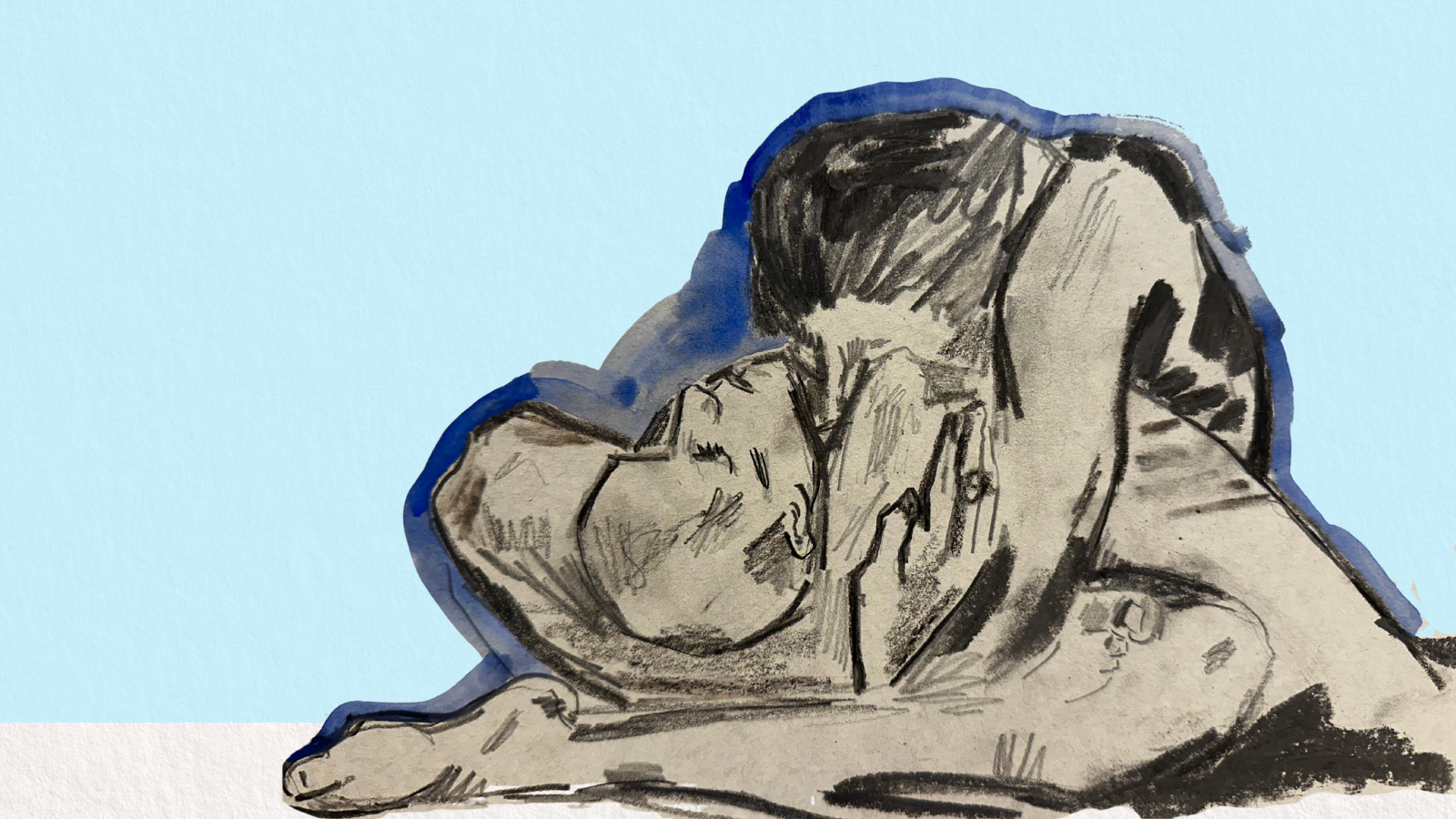
1.
In the late autumn of 1914, the German army waged all-out war against the small Flemish town of Diksmuide. Having failed to capture Paris before the arrival of British troops on the continent, the German High Command had set a new task: a mad rush to the North Sea, and the all-important ports of Dunkirk and Calais. To do this they would have to cross the Yser, a small river which winds north through the marshy Flemish flatlands. But Belgian troops had dug into the river’s west bank, and they repelled every attack. The fighting was ferocious, and between mid-October and their retreat in late November, the Germans suffered more than seventy-five thousand casualties. The fortifications outside Diksmuide are still known as De Dodengang, The Death Trench.
During the night straddling the twenty-second and twenty-third of October 1914 a young man stood up in a rifle pit and was shot. His name was Peter Kollwitz, he was ten days out of military training, and he was the first of his regiment to die. Peter’s friends dug him a quick grave, and then took cover in it. Eighteen years old and not yet a legal adult, he had persuaded his parents to permit him to volunteer. His father Karl, a doctor, had been completely opposed. Yet somehow he had convinced his mother, the artist Käthe Kollwitz, who then convinced her husband. At his graduation, she gave him a pocket chess set and a copy of Goethe’s Faust. Days later, she wrote him that her dread was lifting, and she no longer felt “so heavy as before.” She had drawn something, and relieved her anxiety through art. The envelope was returned, unopened, at the end of the month.
By December she had already begun a monument for him. Kollwitz’s work from before the war is densely detailed, and studied from life. A committed socialist, she made subjects of radical moments in German history — The Peasant’s War, the Revolt of the Weavers — as well as the working-class men and women who came to her husband’s clinic. She often used the child Peter as a model, especially for etchings in which grieving mothers grip tightly to their dead children — a coincidence with the cruel ring of prophecy.
Yet faced with Peter’s actual death, these forms became suddenly insufficient. “The abyss has not closed,” she wrote in a 1916 diary entry. “It has swallowed millions and is still gaping.” She would need art that could address the abyss. In her first attempt, Peter’s body rests on a slab, with his palms opened upward and his head tilted jaggedly back. He appears again in her War prints of the early 1920s, as a soldier gripped in the arms of death, and as a newborn, offered up as a sacrifice by his mother. Kollwitz experimented with line etchings and crayon lithographs, but their soft details refused to convey the ragged contours of her grief. Her stark, harsh woodcuts, marked by the grain of the printing block, express an ancient, almost apocalyptic grief – a Danse Macabre for our age of industrial slaughter.

It was only in 1932 that Kollwitz completed her monument, and erected it in Belgium near Peter’s grave. Two figures, two parents, kneel on separate pedestals. The father holds himself upright. The mother bows her head. By their winter clothes we know that they are in the land of death. They lack identifying characteristics — Karl’s mustache, Käthe’s hollow eyes — and have been reduced to basic shapes and smooth lines. The mother’s hands, her hair, her sorrowing face blend with her shawl; she seems more shroud than body. Their grief has isolated them from each other, and from themselves.
She would return to Peter for the rest of her life. There he is, laid out across her lap like the dead Christ at Berlin’s Neue Wache. And there again, a child peeking out from his mother’s sheltering arms, yearning for duty, for glory. There, there, there, snatched away always by the skeletal grip of death. But I have always been especially moved by those two parents, bent to the ground in their grief. Almost a century on, they kneel there, unconsoled.

2.
This grief, her grief, was braided with a deep and abiding guilt: that she had allowed her son to volunteer, that she had ever supported the crimson upheaval that would kill so many millions like him. Like many Europeans of her time, Kollwitz had initially supported the outbreak of war. Though a socialist, she felt swept up in what she called a feeling of “absolute community” with her fellow Germans. Thomas Mann celebrated it as a “great, fundamentally decent, and in fact stirring” conflict which would shake a decadent civilization out of its fin-de-siecle stupor. He predicted that “stronger, freer, happier German soul” would rise from the ashes. Even the Social Democrats voted unanimously to approve war funds. Massive crowds gathered in Berlin, in Paris, in Vienna, in London to cheer their young men off to the front. No one believed it would last long; perhaps six weeks.
It went on for more than four years. Sixty million men were mobilized, twenty-three million were wounded, and at least nine million died, along with at least six and as high as thirteen million civilians. Germany alone lost fifteen percent of its male population. The war, in other words, was a collective experience, and it shaped a generation of art and writing. Otto Dix fought in the Battle of the Somme opposite Jean Giono, who was one of only eleven members of his company to survive. Siegfried Sassoon became known as “Mad Jack” for his suicidal bravery. The physician Gottfried Benn served in field hospitals, and acted as medical witness at numerous executions. Ernst Ludwig Kirchner had a mental breakdown, as did the medical orderly Max Beckmann. Ernst Jünger was wounded seven times, and shot twice in the head. Gabriele D’Annunzio became a famous fighter pilot, and lost sight in one eye. August Macke died in September 1914, at Champagne; his good friend Franz Marc was killed two years later, during the Battle of Verdun. Wilfred Owen was shot on November 4, 1918, just one week before the Armistice.
The violence of the First World War was metastatic, and further waves of violence followed in its wake. The Kollwitzes joined a community of grief many millions strong. Grotesquely wounded veterans returned home, their faces shattered by bullets and shrapnel, many permanently blinded by poison gas, to nations which were often ashamed of them. Many seemingly unharmed soldiers suffered the psychosis then known as shell shock — an epidemic so pervasive it inspired Freud to formulate his notion of the death drive. The mutinous German units known as the Freikorps ravaged the newly-independent territories of the former Russian Empire, and then returned to kill socialists at home.
Those artists who survived had to reconceive of their own art, if they hoped to make sense of this unsettled reality. They would have work, to use the art historian Joseph Leo Koerner’s phase, in a “state of siege”: a context of prolonged danger and uncertainty which supercharges the artist and their art, both in their moment of creation, and in the moment of our reception. It is, he writes in his 2025 Art in a State of Siege, “a perspective on art” that arises in moments of prolonged danger. It causes us to reconsider past art, and reconceive how we should make our own. Such sieges can be literal, as in the trenches of the Yser. But they are just as often psychic, even metaphorical. Freud called on the language of siege warfare, for example, to describe the trauma response of PTSD victims.
Koerner locates such a siege in the paintings of Hieronymus Bosch, those frames overflowing with hybrid demons and wild animals and impish visions of eternal damnation. Thanks to their imaginative perversions of the natural order, all those monstrous fruits and gigantic tree-men and sadomasochistic end-times prophecies, Bosch’s paintings have tantalized and mystified viewers across the full spectrum of modernity. In his book Koerner links together Spanish king Phillip II, Nazi jurist Karl Schmitt, Jewish art historian Erwin Panofsky, and his own father via the Garden of Earthly Delights. But, he emphasizes, “what looks fantastical to our eyes would have been familiar” to anyone viewing the painting in the painter’s time. The flaming cities that backlight Bosch’s hellscapes were the order of his century — and thanks to the invention of devastatingly powerful Howitzer artillery and strategic air bombing, they became an emblem of ours. Observing the German military’s stalled progress across the Caucasus oil fields in December of 1942, Jünger compared the scene to “certain paintings by H. Bosch.” Besieged by a vista of unprecedented industrial-scale destruction, the writer returned to a painter who had died at the start of the sixteenth century. “Too bad,” he wrote in a letter to Schmitt, “that Bosch could not paint what I saw.”
This task was left to the artists of his own time. Dix created a series of fifty etchings he called simply Der Krieg. Like Goya’s Desastres de la Guerra, they reflect the totality of war’s horror, from the abstract to the naturalistic, the nightmarish to the surreal, in a disorienting array of styles. No-Man’s-Land is depicted as a forest of disturbed earth and scattered flesh. Cartoonish storm troopers advance through a haze of poison gas. The gaping corpse of a horse is flayed by jagged pen strokes. A field of shell craters like the bottom of the sea.
The Great War was many things, but it was never dignified, and Dix consistently rejects good taste in his depictions. He caricatures his subjects, and crowds his etchings with humiliating details: a rear officer’s bulging belly, the gushing wounds and animal fear of a maimed soldier. This is not the pious patriotism of a propagandist, the classical poise of genre painting, or the vitalistic realism adopted by Jünger in his Storm of Steel. Dix courts outrage and bad taste; he wants you to squirm, to look away. Kollwitz responded to her son’s death with a simplified, compacted style, reproducing formally the absence left in her own life. But Dix’s suffering suffuses the structure of reality, and it did not disappear with the Armistice.
Weighted down with war debts, its streets full of disabled veterans and right-wing paramilitaries, the Weimar Republic was a society of perpetual siege, and it produced an art of fragmentation, chaos, and excess. In the paintings of the Neue Sachlichkeit, or New Objectivity movement, we see a nation of rapid and seemingly unstoppable developments: motorcars, factory floors, short-haired women wearing ties. “The sudden,” Koerner says of the art of Max Beckmann, “intensifies the experience of the new and the now which defines modernity.” These are works executed with an extreme sense of the surface; their ‘objectivity’ arises from their focus on an external which is always screaming in your face. The group, wrote the contemporary curator Gustav Friedrich Hartlaub, was “incandescently contemporary in its lack of belief in art.” Past generations of German artists had turned inward towards expressionism’s mystical hues, or upward, to cubism and its heavenly abstractions. Kirchner left the city behind, and painted radiant landscapes of Alpine color. But the Neue Sachlichkeit looked directly at Weimar, in all its unflattering details.
They found a society desperately attempting to escape the wreckage of the war still everywhere among them. Among the works at the Neue Galerie’s recent Neue Sachlichkeit show was a 1930 painting by Georg Kinzer. Good upstanding Burghers make their way through the shopping district of a prosperous city. It is wintertime; they are bundled up in overcoats and furs. They gaze into lit-up shopwindows: armless mannequins, lingerie, a pig’s head with an apple in its mouth. In their indifference, they step right over a blind man, a beggar, selling matchboxes on the sidewalk. The burghers are fat, ugly; in their desire to avoid the veteran they too have gone blind. But this is not a simple social critique, and Kinzer does not erase the beggar’s warts, his rheumy red eye, the greasy hair which falls from his cap. Like in Dix’s prints, there is no dignity here, no idealism. Kinzer paints to expose the chaos of a nation still very much under siege.
These are paintings which retain the capacity to discomfort and disturb. They besiege you. There were no bold industrialists or noble peasants on display at the Neue Galerie, only proto-fascists and red-nosed peasants scattering seed over barren fields. Dix’s comfort with caricature makes it seem as if he is mocking his sitters, and he often is. His canvases’ composition, the way they bring together seemingly alien elements of the natural and industrial world, rhyme with the toxic scars of trench warfare which polluted great swathes of western Europe for decades.
The siege, in other words, has made the paintings possible, has given them not only subject matter but structure and style. Again and again, I watched as visitors stopped, awe-struck, before George Grosz’s monumental 1926 Eclipse of the Sun. In Grosz’s semi-cubist canvas, a conspiracy of industrialists, royalists, and headless bureaucrats collude to imprison the German people in a hell of perpetual warfare. The painting is not subtle; the Kaiser’s sword is stained with blood, and the sun is eclipsed by a great red dollar coin. Yet all along the periphery are images which contemporary viewers immediately recognize: air raids, machine guns, torched cities. There really were bodies moldering under Europe’s green and pleasant fields — just as there are now. Grosz just brings them to the light.
#/media/File:Eclipse_of_the_Sun_(Grosz).webp)
3.
In 1921 the young critic Benno Reifenberg saw a painting by Max Beckmann, and was moved. “Do you believe,” he would write, “you who ask, that you may already forget, that the war is over and done with? That it is history? War is.”
This painting, The Night, displays a hideous scene. By candlelight, two people are being murdered: the man hung, the woman with her hands bound above her head. Their limbs are bent at obscene angles, shoulders wrenched from sockets, legs flailing for purchase. The woman has been stripped half naked, and her legs are wrenched wide in a macabre near-split. Around them a crowd has gathered to gawk, to sneer, to take part: one person holds the hanging rope, another pulls down on the hanging man’s arm. There are remnants of army uniforms, but also circus clothes, the pipe and waistcoat of a respectable bourgeois. These murders implicate everyone.
#/media/File:Max_Beckmann,_1918-19,_The_Night_(Die_Nacht),_oil_on_canvas,_133_x_154_cm,_Kunstsammlung_Nordrhein-Westfalen,_D%C3%BCsseldorf.jpg)
Beckmann executed the painting over a full year, using himself and his wife as models. He had served as a paramedic at the Battle of Tannenberg, where a hundred thousand were killed, and later worked at an operating theater in Belgium. “I saw fantastical things,” he wrote in a letter to his wife. “In the half-lit shelter half-clothed men streaming with blood, being bandaged in white. Huge and painful in expression. New conception of the flagellation of Christ.” He aestheticized his experiences in order to defend himself. But it was no use: he had a nervous breakdown, and was discharged.
Before the war Beckmann had painted disasters, enormous canvases balanced between the impressionists and the old masters. But his experience of “real catastrophe,” writes Koerner, “changed everything.” The disaster was no longer distant; it was everywhere around him. He unveiled The Night in 1919, soon after demobilized soldiers, radical workers, and the newly-formed German Communist Party staged a revolt in the streets of Berlin. With their military weakened and demoralized, the newly-elected Social Democrats called in far-right Freikorps squadrons for support. The communists Rosa Luxemburg and Karl Liebknecht were kidnapped, tortured, and murdered — all with the SPD’s approval. Liebknecht was shot in the back, Luxemburg in the head. Her body was dumped in the Landwehr Canal.
Beckmann had not intended to portray these murders when he began on The Night. But in his psychologically upturned state, he had intuited what Reifenberg would later identify: that the war was not dead and gone, but had seeped into the fabric of Weimar society. Between 1919 and 1922 far-right assassins murdered numerous leading communists, important socialists, and the head of the moderate Center Party. In June of 1922 the Jewish foreign minister Walter Rathenau was shot while leaving his home. His assassins had previously served in a Freikorps unit involved in the suppression of the Bavarian Soviet Republic — with the explicit approval of Rathenau’s own SPD. Other extreme right veterans of the Munich conflict would join Hitler in his 1923 Beer Hall Putsch.
Freikorps units rampage across Beckmann’s work of the late teens and early twenties. In multiple prints from his 1919 Hell portfolio, they smash their way through cafés and street scenes, and collaborate with bespectacled passers-by to tear a Christ-like man to shreds. So too the mutilated bodies and faces of war veterans, whose sudden appearance tears a hole through the bourgeois desire to put such a destructive conflict in the past. “Once suffered.” Koerner writes, “the wounds [of war], too terrible to be remembered, instead are repeated.”
Because of his focus on the urban chaos of inter-war Germany, Beckmann is often classed with Dix and the Neue Sachlichkeit. But his work is far more unsettled, even unnerved. The NS concerned itself with the surface; in Beckmann the state of siege is primarily psychic. Koerner observes that the artist “publicly promoted the understanding of his art as a nervous symptom of war trauma,” an attack upon the inner world by malign outside forces, a threat which the interior can only repulse by reconstituting the attacker as a set of refracted symbols. Even when successful, this defense is ultimately self-defeating. As in the combat nightmares of shell-shocked veterans, it transforms the inner world into a deformed reflection of the attacker, and permanently upends the relationship between in- and exterior.
The psychic siege not only compels but commands a change in the self. In the middle of his breakdown, Kirchner painted himself in uniform, with a bleeding stump for a brush hand. The grief-stricken Kollwitz rejected her past style and subject matter, embracing stark forms and pacifism. Sassoon described shell-shocked survivors as men regressed by the war into adult children, “with eyes that hate you, broken and mad.”
Beckmann understood this; he had experienced it himself. His was an insight of scale: he understood that war had become deeply entwined with the conduct of ordinary life. He depicted unreal relations in real spaces, posing costumed figures — clowns, kings, gods — in anonymous domestic settings, all humming with violence. Like Goya, he defamiliarized contemporary signifiers, and charged mundane spaces with symbol and mystery. He transported the battlefield into the home. In 1921’s The Dream, a model with doll in hand is menaced by a fingerless fishmonger, a jester crawling on his severed legs, the bugle call of a blind organ grinder. Musical instruments are scattered about. The suspicious woman sits on a suitcase. Whether congregated in an attic, or a basement, or the hold of a ship, they seem to be headed somewhere — but where? Beckmann won’t say. We can only see that new interior fronts are still opening up, that even now, with the armistice and the peace, war still is.
4.
Ernst Jünger volunteered for military service on August 1, 1914. His service spanned nearly the entire war, and he received numerous medals, including the last Pour le Merite ever awarded. He fought alongside August Macke at Champagne; Macke died, and Jünger survived. He kept a detailed journal, and later wrote of his war experiences in numerous novels and essays, and became immensely popular among a generation of soldiers who longed for their time at the front, as well as young men who had missed their chance to join in the heroic fight for the nation.
The war had not been a catastrophe for Jünger, but a proving ground, a zone of mystical unity achieved only by those capable of withstanding unimaginable pain. Once a romantic Wandervogel, combat convinced Jünger of the necessary expression of masculine strength through industrial slaughter. Gazing out across the trenches in Storm of Steel, the narrator is “overcome by a feeling of invulnerability. We might be crushed, but surely we could not be conquered.” The crucible of war forged blood, race, nature, and machinery into a single continuous being. This unit, bonded together by mortal peril, would form the basis for a new political orientation he called “front socialism.”
Jünger’s “gripping spectacle” of invulnerable mechanized warfare mirrored F.T. Marinetti’s histrionic desire for “beautiful ideas that kill.” Writing in 1909, the aspiring Futurist cheered the slaughter to come: “We want to glorify war — the only cure for the world.” After the conflict there would be no stagnation, no utilitarianism, no feminism, no weakness. Only a manic industrial velocity that would plow relentlessly onward, grinding the weak under its wheels.
For Marinetti, the war was an unmissable opportunity, a “breeder of morals;” he agitated for Italian entry, and volunteered as a member of a bicycle patrol. Gabriele D’Annunzio used it as a launching pad, finding fame as a fighter pilot, and then a dictator. In 1919, the playwright and failed parliamentarian led a battalion of Italian mutineers into the Yugoslav city-state of Fiume, and established himself as ruler. For fifteen months, the man who called himself Il Duce gave speeches, designed outfits, and drew an international army of disgruntled soldiers under his sway. Where once he had written for a bourgeois audience, his aims had changed: “The word, addressed orally and directly to a multitude, must have as its only purpose action, violent action if necessary.” He was driven out after minimal fighting during Christmastime, 1920.
For all these men, the war had been a moment of possibility and promise, and that hope for transformation was foundering amidst the idealistic contradictions of post-war democracy. Jünger disdained pacifists like Erich Maria Remarque as “pests of civilization” who denied the life-giving masculine vitality of violent war. A generation of politicians had stabbed their militaries in the back, and now left-wing artists were presenting the people with a degraded image of their battlefield glories. Kollwitz’s memorials, Dix’s grotesqueries, and Beckmann’s mysteries: all expressions of the defeatism that had left Germany unable to complete the war it ought easily to have won.
This sense of an art so central to society it could have lost a war seems foreign to us now. But for the fascists, art was a key battleground, and one they aimed to win. Channeling D’Annunzio, Goebbels declared the führer “an artist,” a genius who shapes the people as a sculptor does stone, or a painter his colors. Alfred Rosenberg compared Nazi stormtroopers to works by Dürer. Upon seizing power in 1933, the Nazis established numerous Combat Leagues (Kampfbünden) for German Culture around the country to disseminate the new regime’s cultural theories. The national revolution, they believed, was “above all cultural.” If they hoped to uncover “long hidden sources of German folkways” and stop the destruction of the German race’s “vitals,” then the false, degenerate, international art would have to be uprooted and crushed. “There is no freedom,” declared the director of the Stuttgart Kampfbund, “for those who would weaken and destroy German art.”
Hitler himself declared an “unrelenting war of extermination against the last elements which have displaced our art.” For her pacifism and socialism, Kollwitz was purged from the Prussian Academy, as were Kirchner, Dix, and Academy president Max Liebermann. ‘Degenerate’ painters were forbidden even from purchasing art supplies. 16,000 works by Dix, Beckmann, Van Gogh, Picasso, Klee, Gauguin, Chagall, and Ensor, among others, were removed from public collections. Politically active artists were targeted from the start. On Goebbels’s direct order, the Berlin police arrested the cabaret performer and anarchist Erich Mühsam mere hours after the Reichstag fire. For more than a year he was tortured and beaten by his Nazi captors, and in July 1934 he was murdered by guards at the Oranienburg concentration camp.
In exchange, the Nazis proposed a theory of art grounded in theories of racial vitalism. The German people, they proclaimed, had had enough. No more would artistic elites, who only pretended to enjoy the work they consumed, force on the public those images of the crippled, the wounded, the disabled. Real culture, the Nazis believed, must flow from the authentic expression of a particular people, united by blood in their shared goal of expansion and reproduction. There would be no more confusion, discomfort, ambiguity. Aryan art would take its forms from nature, presenting classical ideals of beauty, strength, and belonging that valorized the family, the collective, the race. It would be immediately legible to any German of the day, and it would inculcate them with the proper values.
In theory, the goal was to banish confusion, to free the viewer from any danger of contradictory thinking. “Artworks that cannot be understood on their own,” Hitler declared, “[…]will as of now no longer find their way to the German Volk.” In practice, there was only mess. Cultural leaders found themselves trailing Hitler, whose hatred for “unfinished pictures” led to a near-total rejection of even the German impressionists — except, oddly, for certain landscapes by the Jewish Liebermann. Some works by degenerate artists were purged, while others were kept, often only due to the judgment of local officials. Even the Nazi theorists could not construct a consistent canon. Why, they wondered, had the Nordic master Rembrandt painted so many Jews? When in 1938 the government staged its first official German Art Exhibition, attendance was low. Visitors dubbed its purpose-built Munich venue the “Palazzo Kitschi.”
The year before, millions more had flocked to the Entartete “Kunst” (Degenerate “Art”) show, held at the nearby Institute of Archeology. The hundreds of deaccessioned works were hung roughly, without frames, and often accompanied by mocking text. One room announced “a representative selection from the endless supply of Jewish trash that no words can adequately describe.” Expressionist sculpture was charged with contributing to “the systematic eradication of every last trace of racial consciousness.” These labels enlisted visitors as participants in the atrocity exhibition: they were encouraged to point and laugh and loudly demand their money back. By attending and acting out, they played their part in the racial purification of German culture. They too became foot soldiers in this artworld which was now a battlefield.
The Nazis sold many of the most valuable deaccessioned works to foreign collectors for next to nothing; Beckmann’s Portrait went for a single Swiss Franc. For the embattled regime, foreign currency was far more valuable than any painting. What could not be sold was destroyed outright. On the night of March 20, 1939, nearly 5000 paintings, sculptures, watercolors and graphic works were burned outside the headquarters of the Berlin Fire Department.
Not all authoritarian regimes were so permanently antagonistic to their avant-garde. Japanese Marxists were allowed to publish again after making tenkō, a public repudiation of their proletarian views. Marinetti fused his Futurist Party with Mussolini’s fascists, and Futurist artists were often commissioned by the regime. D’Annunzio celebrated the second Il Duce’s brutal colonial invasion of Ethiopia, and the playwright Luigi Pirandello melted down his Nobel Prize medal to fund the war effort. Even foreigners like Ezra Pound were invited: the pathbreaking modernist celebrated slain fascist warriors in his Cantos, and recorded a number of English language propaganda broadcasts during World War II — an act of treason for which he was nearly executed. But all required art to serve the state, the people, the race, that unity of purpose which had excited Marinetti at the factory, and Jünger in the trenches.
The Nazis found collaborators of their own. The ranks of the Kampfbund swelled with middling painters and sculptors, eager for revenge against the gallerists and curators who had once spurned them. Major authors like Gerhart Hauptmann and Knut Hamsun endorsed the regime’s anti-modernism. Jünger had despised the Weimar Republic, and openly longed for a government of warrior-poets. Initially, he was feted among the Nazi elite, but the worm would eventually turn. Jünger would not join the party, and his 1939 novel On the Marble Cliffs was censored by the Gestapo. The painter Emil Nolde joined the Nazi party early, and throughout the 1930s and -40s he repeatedly tried and failed to argue that his expressionist canvases complied with Aryan standards. He had to buy back his own paintings to save them from destruction.
Even open sycophancy often failed. In October 1933, a group of 88 writers signed an open letter, pledging a “vow of faithful allegiance” to Hitler. The second signatory was the expressionist poet and playwright Gottfried Benn. In exchange for his loyalty, he was briefly made head of the Prussian Academy’s poetry section, and vice president of the Union of National Writers. But he was soon removed, and was repeatedly attacked by the SS. A 1936 printing of his selected poetry was censored, and in 1938, the Union prohibited him from writing at all. He spent the war at a military post in eastern Germany, writing poems and essays for no one.
5.
This is the essence of Koerner’s state of siege: some vision, some artistic insight, intrudes upon the course of everyday life, and alters how we perceive our own experience. In the hell of the Nazi war machine, Jünger pictured Bosch. Beckmann imagined combat surgery as a stage of the cross. Wandering the Prado in the summer of 1969, a young Seamus Heaney came upon Goya’s Black Paintings, and thought of Derry, “Where two beserks club each other to death / For honour’s sake, greaved in a bog, and sinking.”
And last Spring, I found myself at the New York’s Neue Galerie thinking about a siege all our own. That May, the National Endowment for the Arts canceled nearly 600 grants to arts organizations, non-profit publishing houses, local theaters, and public conservancies across the country. Nearly $1.2 million in funds were rescinded from fifty-one small publishers. The president had previously purged the John F. Kennedy Center for the Arts, installed loyalists on the board, and made himself head; last December, he ordered the name changed, to include his own.
His administration has been even more explicitly ideological in its attack on the Smithsonian Institution. In August, the White House ordered a review of eight separate museums, to ensure that they complied with a presidential directive to “celebrate American exceptionalism.” Later that month, it released a list of artists, artworks, and exhibitions which supposedly violate MAGA standards, including an Afrofuturist exhibition; a Hugo Crosthwaite portrait of Anthony Fauci; a papier-mache Statue of Liberty created by striking farmworkers; and a painting, submitted to the Outwin Boochever portrait competition, of a migrant family crossing the southern border. Official government social media accounts sneeringly posted images of these and other artworks, inviting rabid followers to join in the denigration — a ‘Degenerate Art’ exhibition for the digital age. It is not a stretch to imagine the deaccession and even the destruction of such works, all as part of President Trump’s crusade to exterminate what he calls “anti-American ideology.” In December he even threatened to cancel the Institution’s funding completely.
Some organizations, like New York’s Central Park Summerstage, have cowed before the assault. Others have been emboldened. Galeria Fiume, an art gallery named for D’Annunzio’s free state, opened in New York with the aim of promoting art “for the new regime.” (Their May launch featured, among other treats, “Dark Cabaret.”) In The New York Times, Ross Douthat gave a softball interview to the publisher of Passage, an independent press which has to date published race scientist Steve Sailer and “humane genocide” proponent Curtis Yarvin, as well as the Hardy Boys. He spoke, like Jünger, like the Kampfbund, of an erotic “vitality” now sapped by liberal modernity. In order for right wing agit-prop to become art, he argued, it would have to be provocative, and seek offense.
Yet since November 6, 2024, the American Right has only been able to offend and destroy – they do not create, they do not build. Mainstream pundits regularly call each other low IQ retards. Cable news guests make jokes about mailing explosive pagers to their enemies. New York City Councilmembers publicly threaten to kill their opponents. Everyone is regularly threatened with deportation and denaturalization —even birthright citizens— for the slightest offense to the nation, the president, the secret police.
But offense is a weak feeling; the moment passes, the thrill fades, and nothing is left but the bruise. There is nothing subterranean: it’s all surface, all image, all kitsch. Provocative art requires an audience to succeed, and when that audience turns away, you’re left with nothing but shit in your teeth. This explains the failure of the Daily Wire’s film production wing: even MAGA diehards need something beyond the sense that some lib, somewhere, has been triggered. The Neue Sachlichkeit were controversial in their day, but their work doesn’t provoke; it unsettles; it refuses a straight reading, because its form is not dictated by its intended audience.
Everything in our present age militates against this kind of complexity. Novels can’t confuse, films can’t challenge, music can’t distract us from the playlist’s endless flow. Artists today are squeezed between ideologues, corporations, elected officials, and the public’s great indifference. A provocation demands a response; but who can respond, if no one is paying attention? Who is there to offend, when we’re isolated and alone? “I thought people would come or at least write,” Kollwitz reflected after her expulsion from the academy. “But no. Such a silence all around us.”
So it makes sense that signs of life have emerged from a desire for community. At last May’s Cannes Film Festival, a group of Danish and Swedish filmmakers updated the groundbreaking Dogma 95 manifesto for an age of digital siege. “In a world where formulaic films based on algorithms and artificial visual expression are gaining traction,” they write, “it’s our mission to stand up for the flawed, distinct, and human imprint. We champion the uncompromising and unpredictable and we fight the forces working to reduce cinematic art to an ultra-processed consumer good.” In order to sign on to Dogma 25, filmmakers must write their scripts by hand, reject the internet, refuse make-up, and shoot on location. Filmmaking is to be small-scale, collaborative, bound to the communal and interpersonal. “Create the film,” they command, “as if it were your last.”
Literary readings have become their own social scene in New York, but for every downtown PR-boosted astroturf cokehead photo-op, there are three or four others drawing their small, earnest crowds in outer-borough backyards and dive bar courtyards. At their best, these events open up the typically isolated acts of writing and reading; they bring us together, and make the individual communal. But even at the sleepiest recital, attendees must share a space with one another, and listen to a reader, and be relieved, for a couple hours, from the purposeful alienation of their phones. And writers, in turn, have to observe how their words land in a room full of foreign consciousnesses, a mental universe removed from the hit-and-run ideology of social media, and the blinking void of a word processor. That there are so many new readings, and that they are so possible, should prove that we are sick of being atomized and placed apart from one another.
These developments are not necessarily political, and they certainly aren’t activism. But they are a rebellion of life against dominant ideologies of consolidation and scarcity, and they provide an alternative to the resurgence of a vapid, vitalistic atavism, which denies the generative possibilities available to us as equals, creating this world together. This past year, I’ve felt most myself at group events: readings, clubs, concerts. As at the 2020 Black Lives Matter protests, I feel the pull towards collectivity, towards that sharing of life in space with utter strangers that defines any true encounter. Back in the Spring, at the Bowery Ballroom, Tamara Lindemann of The Weather Station looked up towards the crowd and asked: What the fuck happened? Hundreds of us had gathered there to share in her distress, and so none of us was alone.
Sometimes I despair of that parade of opportunists and collaborators marching, unmasked, for their moment in the spotlight. But this crisis has only sharpened my self-belief. Actions, events, and words which a year ago would have passed without question now punch me in the chest. I have written more, and I have gone out more, and I have refused to be alone. The very form of my life is a victory I refuse to surrender.
Two summers ago I went to see the Welsh band Los Campesinos, and last May I saw them again. Both times I sang along with the crowd, but I truly hear them for the first time now: “When the black cloud comes, if one flame flickers / We will feast on the tongues of the last bootlickers.” Right there, at deafening volume: our perpetual state of siege. I screamed and screamed, until I was hoarse. I am still screaming with them. So are you.