
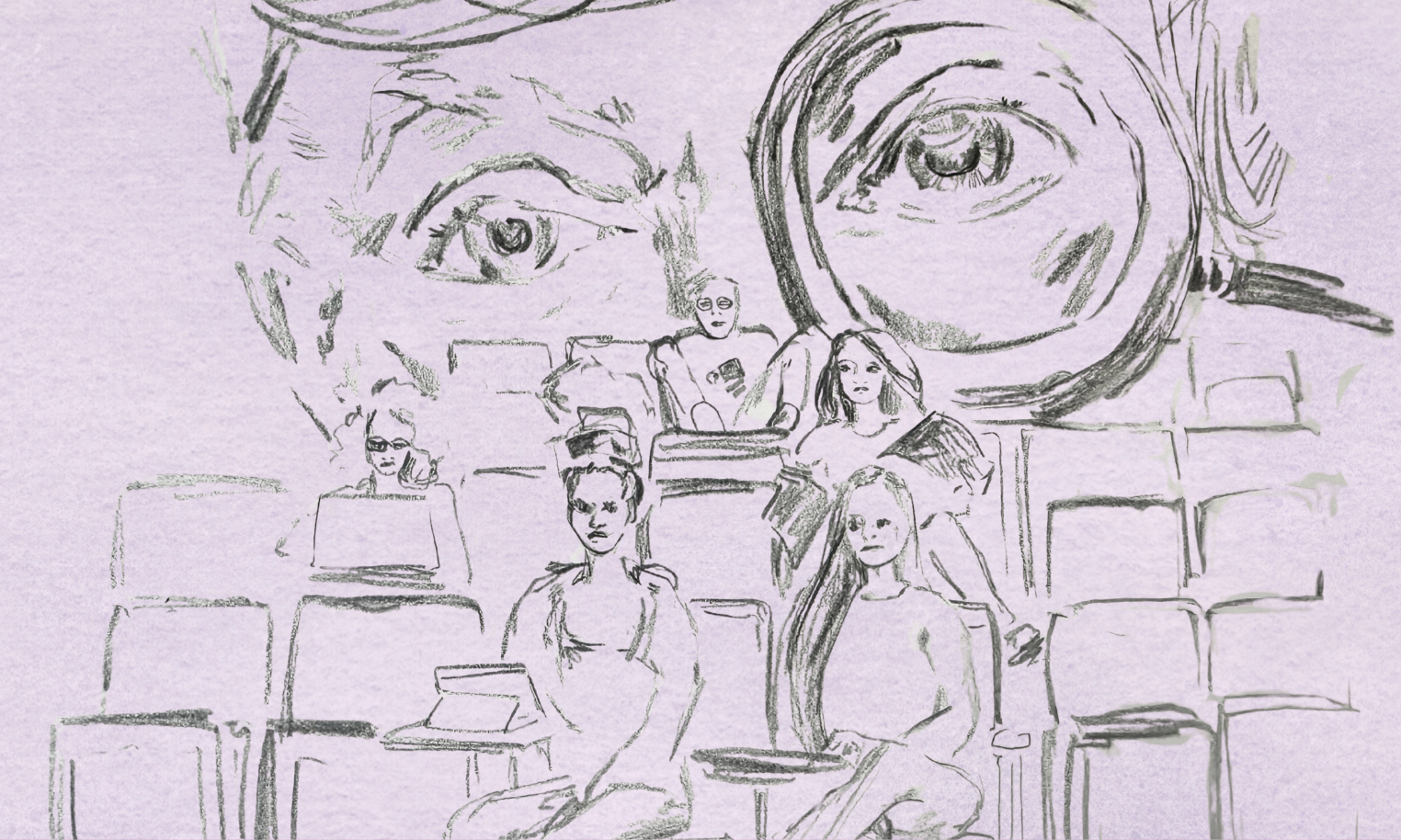
In March of last year, about six weeks after Donald Trump returned to the White House, I traveled to Washington for a meeting of American education scholars. The opening panel focused — appropriately enough — on Trump’s threats to university funding, free speech on campus, and more. Then it was time for questions, and I raised my hand. I said that I agreed with all the critiques of Trump, but I also wondered what those of us who work in higher education might have done — or not done — to bring about this awful moment. Could we use it to look in the mirror, I asked, and not just to circle the wagons?
Dead silence. Then another member of the audience spoke up. “I just wanted to say that I was deeply offended by Professor Zimmerman’s use of the term ‘circle the wagons,’ which connotes a hateful history of Native American displacement and genocide,” she said. More awkward silence. Finally the moderator of the panel interjected herself. “Thank you for reminding us that we need to be careful in the language that we use to describe others,” she said. So the panel began with a diatribe about Donald Trump’s assault on free speech and it concluded with a warning to watch our words.
That signifies a loss of faith in universities themselves. For the past seventy-five years, we have been telling a story about how we enhance democratic dialogue and understanding. Yet we don’t really believe it. If we did, the moderator would have asked the objecting scholar to say more about why she bridled at my phraseology. Then the moderator would have asked me to reply, and after that she would have solicited reactions from the audience. And eventually we might have gotten around to the substance of my question, which concerned the delicate matter of what degree of introspection, what sort of critical self-examination, might be required of professors and teachers amid the current crisis. None of that happened, of course. The moderator drew the panel to a moralistic and satisfyingly evasive close, and we all went out to lunch.
“Out to lunch” is where much of higher education is — oblivious about how we got here and how we might change course. Yes, Trump represents a dagger at our heart; and yes, we must join hands to resist him. But long before he came to power, growing numbers of Americans — and not just Republicans — were starting to see higher education as something of a scam. We charge ever-higher prices for degrees of dubious worth, even as we proclaim our commitment to the public good. To make good on that ideal, we cannot simply circle the wagons. We need to look in the mirror. What role have the universities themselves played in this disaster?
Harry Truman became president in April 1945, a few hours after Franklin Roosevelt succumbed to a stroke. Over the next two years Truman received a pair of high-profile reports that defined the contours of American higher education for the next half-century. The first, entitled Science: The Endless Frontier, called on the federal government to subsidize university research that would improve Americans’ health, national security, and standard of living. And the second, Higher Education for American Democracy, urged the government to help people attend college. That would create a more equal society, as well as a more virtuous one: bringing greater numbers of students into higher education, it would also foster the skills and the understanding that good citizenship demanded.
Universities would receive considerable autonomy in deciding how to use federal dollars. In exchange, they would provide the technical know-how and the democratic spirit to sustain the nation. Education scholars call this the “academic social contract,” and it certainly had a good run. We developed vaccines to prevent polio and other life-threatening diseases. We did the basic research that spawned the internet. And we brought millions of women and people of color into classrooms that were formerly reserved for white men. The federal government pumped research dollars into universities via the National Science Foundation, the National Institutes of Health, and other new agencies. It also provided aid to students under the Higher Education Act of 1965, which transformed our universities into truly mass institutions. Signing that measure, Lyndon Johnson declared that post-secondary education was “no longer a luxury, but a necessity.” States increased their subsidies to universities, too, which allowed still more people to attend.
When did the contract start to unravel? One common story dates it to the student demonstrations and social upheavals of the 1960s, which soured taxpayers — especially those on the right — against higher education. Ronald Reagan won the governorship of California in 1966 by pledging to “clean up the mess at Berkeley,” which had exploded in protest two years earlier. (He also railed against campus “hippies,” whom Reagan famously described as “someone who looks like Tarzan, walks like Jane, and smells like Cheetah.”) Yet tuition remained free for in-state students until 1970, when the state instituted a nominal $150 fee. The big tuition increases did not kick in until the 1980s, as state legislatures started to slash their higher education budgets to pay for other priorities, especially prisons. And after Reagan ascended to the White House, the federal government reduced student aid by twenty-five percent over five years. It also shifted student aid from grants to loans. Some people who received grants when they started college had to borrow money to complete it.
Yet the universities were backtracking on their side of the bargain, too. Despite the Truman-era promise to educate young people for democracy, universities eliminated core courses designed to introduce students to the liberal traditions of Western thought; in some quarters, indeed, the West itself was imagined as a source of oppression rather than liberation. Colleges also cut back on distribution requirements, which had forced students to take classes in a wide range of disciplines in what used to be described as “Gen Ed.” Now each student would choose their curricular adventure: they were paying their own way, so they also got to select their own courses.
Most of all, higher education created systems that rewarded faculty research and downgraded undergraduate instruction. Any professorial effort in the classroom meant less time in the laboratory or the library, where careers were won or lost. That was already apparent in 1947, when the Higher Education and Democracy report called on professors across the disciplines to teach and model the habits of democracy. “In the past our colleges have perhaps taken it for granted that education for democratic living could be left to courses in history and political science,” it declared. “It should become instead a primary aim of all classroom teaching and, more important still, of every phase of campus life.”
For this reason, the report also demanded that every professor receive rigorous training in how to teach. “The most conspicuous weakness of the current graduate programs is the failure to provide potential faculty members with the basic skills and the art necessary to impart knowledge to others,” it argued. “College teaching is the only major learned profession for which there does not exist a well-defined program of preparation directed towards developing the skills which it is essential for the practitioner to possess.” You can’t teach the art of democratic living if you don’t know how to lead a discussion, or to deliver a lecture, or to provide helpful feedback to students. But most professors still receive almost no formal preparation for these tasks. To get a Ph.D., you must spend six to eight years mastering a field and making an original contribution to it. But at the University of Pennsylvania, where I work, teaching assistants receive three days of training before they are thrown to the undergraduate wolves.
Professors cannot fulfill their obligations to their students — and to our democracy — if they are not deeply committed to educating them. That means exposing them to a wide range of ideas, which was once the heart of the liberal ideal. But no longer. In a recent study, the political scientist Jon Shields and two colleagues surveyed course syllabi to see if professors who assigned Edward Said’s Orientalism also asked students to read Ian Buruma’s and Avishai Margalit’s Occidentalism or any another critique of Said. They also looked to see whether teachers adopting The New Jim Crow, Michelle Alexander’s now-canonical account of racism in criminal justice, also assigned scholars who took issue with Alexander, such as the Yale law school professor James Forman, Jr. or the Princeton sociologist Patrick Sharkey. Shields’ conclusion was sad and altogether predictable: these kinds of pairings, these efforts at fairness and complication, are extremely rare. Despite our rhetorical commitment to “critical thinking,” we typically present one side of an issue — the left-wing side, almost always — and call it a day. Such a practice is not simply a reflection of political bias, although it is surely that. It is also a mark of bad teaching.
Professors generally refuse to admit any of this, which compounds the problem. We are like little children who close their eyes in the hopes that nobody can see them. That was apparent during the fateful testimony by three college presidents in December 2023 before a Congressional committee investigating antisemitism on campus, following the Hamas attack on Israel and the subsequent war in Gaza. Asked whether calls for genocide would be protected speech, the presidents answered — correctly — that it depends on the context: who is speaking, who is listening, and whether the speech posed a direct threat of physical harm. But here is what they did not say: the universities have not defended this principle consistently. At Harvard, for example, the eminent evolutionary biologist Carole Hooven was pushed out for saying that there are a multiplicity of genders but only two sexes: male and female. “In what world is a call for violence against Jews protected speech, but a belief that sex is biological and binary isn’t?” Harvard president Claudine Gay was asked. She replied that Harvard supports “constructive dialogue, even on the most complex and divisive issues.” The Hooven episode proved the opposite, of course. The meaning of sex is enormously complex and divisive, and the university did not back Hooven’s attempts to engage constructively about it.
And when Gay was asked whether Harvard prepared its professors to engage students in that dialogue, she dissembled still further. “We devote significant resources to training our faculty in that pedagogical skill and prioritizing that in our recruiting and hiring,” she said. Really? I have been a professor for three decades, and I have never seen a hiring decision or a tenure decision that hinged on teaching ability or accomplishments. Nor have I witnessed any required pedagogical training for faculty. We all have Centers on Teaching and Learning, which began in the 1960s in response to student protests about poor instruction. But the centers cannot force anyone to participate in their programming, and they certainly cannot reward good teachers or penalize bad ones. If we truly valued teaching, we wouldn’t need a separate unit of the university that was devoted to it. Designed to elevate instruction, the centers demonstrate our low estimation of it. Ditto for teaching awards, another legacy of the 1960s: everyone knows you can make more money by finishing your book — and getting promoted to the next salary rung — than you can via a one-off prize.
Claudine Gay resigned in the wake of her disastrous testimony; so did my own president at Penn, Liz Magill. “Two down,” crowed Representative Elise Stefanik, Republican of New York, who had spearheaded the Congressional investigation of antisemitism. Forgive me if I doubt that the party that is welcoming the Holocaust denier and virulent racist Nick Fuentes into its fold is deeply concerned about the safety and the well-being of Jews on our campuses. Antisemitism became a wedge for punishing universities that had failed to uphold their side of the academic social contract — and when Trump returned to power, he ripped up whole agreement. A fight against anti-Semitism became a fig leaf for a fight against higher education, against intellectualism itself. Researchers who explore the endless frontier of science — as the Truman Administration called it — saw their federal grants slashed. (My wife, an infectious-diseases physician, was one of them; her ten-year project to prevent neonatal infections in Botswana got the ax.)
And what about the second Truman-era commitment, to higher education and democracy? Under the original terms of the bargain, we received institutional autonomy in exchange for enhancing citizenship. But we turned our backs on that duty, and now Trump is trying to bring us to heel. Hence his proposed “compact” with universities, which would replace the old academic contract. Protect the “marketplace of ideas,” the compact declares. Stop “belittling conservatives.” Restore “grade integrity” instead of giving everyone an A. I share all these goals, deeply and fundamentally. But under the compact, the Trump Administration gets to decide who is meeting them. Donald Trump and his GOP minions will tell us whether we are discriminating against them — or against Jews! — and if we are grading too easily. And if they say that we are falling short, they cut off our federal dollars. That’s a formula for extortion, not education. The shakedown is perfectly clear in the absurd — and absurdly large — fines the Trump administration is imposing on universities that meet with its disapproval. Nice university you got there. Pity if something should happen to it.
Happily, most of the universities who were initially offered the Trump bargain — including Penn — rejected it. Others have sued the administration, arguing that its threats and penalties represent capricious efforts to squelch speech that it doesn’t like — a proposition so obviously true that I am almost embarrassed to repeat it. But my embarrassment does not end there. I am also mortified that our own institutions have done such a poor job in upholding the values that Trump is undermining. The big question is whether we can rediscover them, and how.
In Alcoholics Anonymous, the first step to recovery is admitting that you have a problem. Most of my colleagues aren’t there yet. The trauma of Trump is too fresh, too raw, too painful. When human beings are under attack, their initial impulse is to defend themselves. Thus, everything our team says is right and everything the other team says is wrong. Mocking the idea that universities are biased against conservatives, the American Association of University Professors — our most august academic organization — recently posted that “fascism generally doesn’t do great under peer review.” In other words: the reason we have so few Republican professors is because they are brownshirts in disguise, and really stupid ones at that. We do not have to engage or debate them; indeed, we must not engage or debate them. That would be “both-sides-ism,” which renders us “complicit” with Trump and his cult followers.
As an analysis of the views of people with whom liberals disagree, this is shameful. Our interlocutors may be wrong, but that does not make them evil. And this kind of condescending dismissal is also a terrific way to avoid the hard questions about our own complicity, our own responsibility, in the degradation of the university. After the attacks of September 11, 2001, people on my side of the political aisle urged Americans to ask why so many people around the world hated us. But that line of inquiry was anathema to conservatives such as William Bennett, the former secretary of education in the Reagan administration, who excoriated us for “moral equivalence.” America was attacked because it was good, Bennett insisted, and because its foes were evil. Period. If you questioned that narrative, you were playing into their hands. You were a traitor. You were as bad as they were.
Too much of higher education is still in the Bennett phase of mourning. We know that growing numbers of Americans have lost faith in us. And so we tell ourselves that they are racist, or anti-intellectual, or so blinded by the Trump cult that they cannot see how good we really are. And we imagine that anyone who doubts us must be on his side, just as Bennett claimed that critics of American foreign policy were empowering al-Qaeda. This is what conservatives mean when they talk about Trump Derangement Syndrome: it prevents us from thinking straight. It is a cognitive impairment nearly as obscene as Trump himself. But surely we can circle the wagons against him while continuing to look at ourselves in the mirror. Or maybe not so surely; but we must try.
The academic introspection must begin with a clear-eyed appraisal of our failures around democratic education. Trump went after our scientists for the same reason that Willie Sutton robbed banks: that’s where the money is. But the big problem in higher education is not our scientific research apparatus, which was the envy of the world before Trump took a sledgehammer to it. It is our abandonment of the ideal that propelled us to build up universities in the first place: the cultivation of citizens. Students come to college for all kinds of reasons: to have fun, to get a job, to find a mate. But they generally do not come here to become better citizens in a democracy, as the report to Truman envisioned they would.
What would it mean to reconstitute our universities around that goal? Several universities — including my own — are developing new core courses for first-year students that explore the history and the challenges of democratic government, alongside other fundamental themes in the humanities. Other schools have established programs around civic engagement and “dialogue across difference,” which has become something of a cliché at the Trump-era university. And sixty-one leaders of higher education — calling themselves College Presidents for Civic Preparedness — have partnered with the Institute for Citizens and Scholars (formerly the Woodrow Wilson Foundation) to create new classes and other campus initiatives to “prepare the next generation of well-informed, productively engaged, and committed citizens.” This is all fine and good — indeed, it is great — but it also feels a bit like our Centers for Teaching and Learning: if we embraced our civic purpose fully and honestly, we would not need to create special courses and initiatives to enhance it.
Nor would we need separate schools of civic thought and leadership, which have sprouted at thirteen public universities in eight different Republican-dominated states. They aren’t just new programs or classes; they are full-fledged degree programs, with faculty lines and student majors and the other hallmarks of academic expansion. The GOP lawmakers who endowed them were not at all wrong about the lack of civic knowledge and engagement among our students. And neither are they wrong about the left-wing groupthink of the academy. But so long as the civics schools are coded politically red, they are destined to fail. The Trump administration recently announced a set of grants to promote civic education around this year’s momentous anniversary of the Declaration of Independence; priority will go to universities that have established “independent academic units dedicated to civic thought, Constitutional studies, American history, leadership, and economic liberty.” Get the picture? These American principles are now imagined as “conservative,” which subverts the shared civic purpose that the new schools purport to uphold.
And we certainly will not revive that purpose by relying on artificial intelligence, the other shiny object of the modern academy. The nation’s largest university system, Cal State, recently inked a deal with Open A.I. to make it America’s “first and largest A.I.-empowered university.” It will embed AI tutors across the system’s twenty-two campuses and prepare its 460,000 students for “A.I.-driven careers,” whatever that means. The jury is very much out on whether AI can help students learn, instead of simply doing their homework for them. Yet it is safe to say, I think, that AI is unlikely to make them better citizens. Genuine citizenship requires people to deliberate their common fate with others. According to the report to Harry Truman in 1947, universities should teach “the practice as well as the theory of democracy.” Let us agree that the practice as well as the theory of democracy is more than a prompt to ChatGPT. Does anyone seriously think that a robot can enhance democratic citizenship? Shouldn’t we instead worry about it eroding our democratic capacities, by substituting a bot’s judgment for our own?
Gamely, some of our techno-futurists have imagined that AI will free up professors to do the real work of liberal education — debate, critique, analysis — while the robot takes care of the rote dimensions. But that, too, presumes a university that puts teaching front and center and that motivates professors to do the same. There is no organization called College Presidents for Teaching Preparedness, because we do not prepare people to teach in our colleges. That needs to change if we want to make good on our democratic charge. Every department that produces new faculty members should have a set of required courses devoted to the instruction of that discipline. And every professor’s teaching — like their research — should be judged by their peers. Student evaluations are important, but they are not enough. When I wrote a history of college teaching, I did not submit it to a group of eighteen-year-olds to see if I had something interesting or important to say; it was sent instead to experts in my field. They should review my instruction, too, to see if it tracks with what we know about effective teaching. I have taught at Penn for nine years, and nobody has ever observed me in the classroom. I could be doing anything. Or nothing.
We also need a set of institutional rankings around teaching, so that students and their families can make informed choices about where to go to college. When we survey Americans and ask them what makes for a good university, their most common response is “it has excellent teachers.” But there is no way for them to know which schools promote that kind of excellence in their classrooms. It is wonderful that many institutions are reviving their curricula to address citizenship and democracy, but without skilled and informed teachers, the curricula alone are unlikely to make much of a difference.
Effective teaching resembles a workable democracy in that it is premised on free and open exchange. And if you think we have protected and nourished that value at our colleges and universities, you haven’t been paying attention. After the panel at the education conference in Washington, where I was condemned for using an allegedly racist term, several scholars came up to me and said that they were both confused and troubled by the charge. Then they added that they were afraid to raise their voices during the panel discussion, because others might think that they were racist as well. I have nothing against the person who objected to my comment; indeed, I admire her for speaking her mind. My problem is with the culture of fear, of timidity, of conformity, which is inimical to both education and democracy. Trump has ramped up that fear, but he certainly did not create it. We created it. It is up to us, therefore, to undo it, by dedicating ourselves to the kind of instruction that makes people free instead of afraid.