
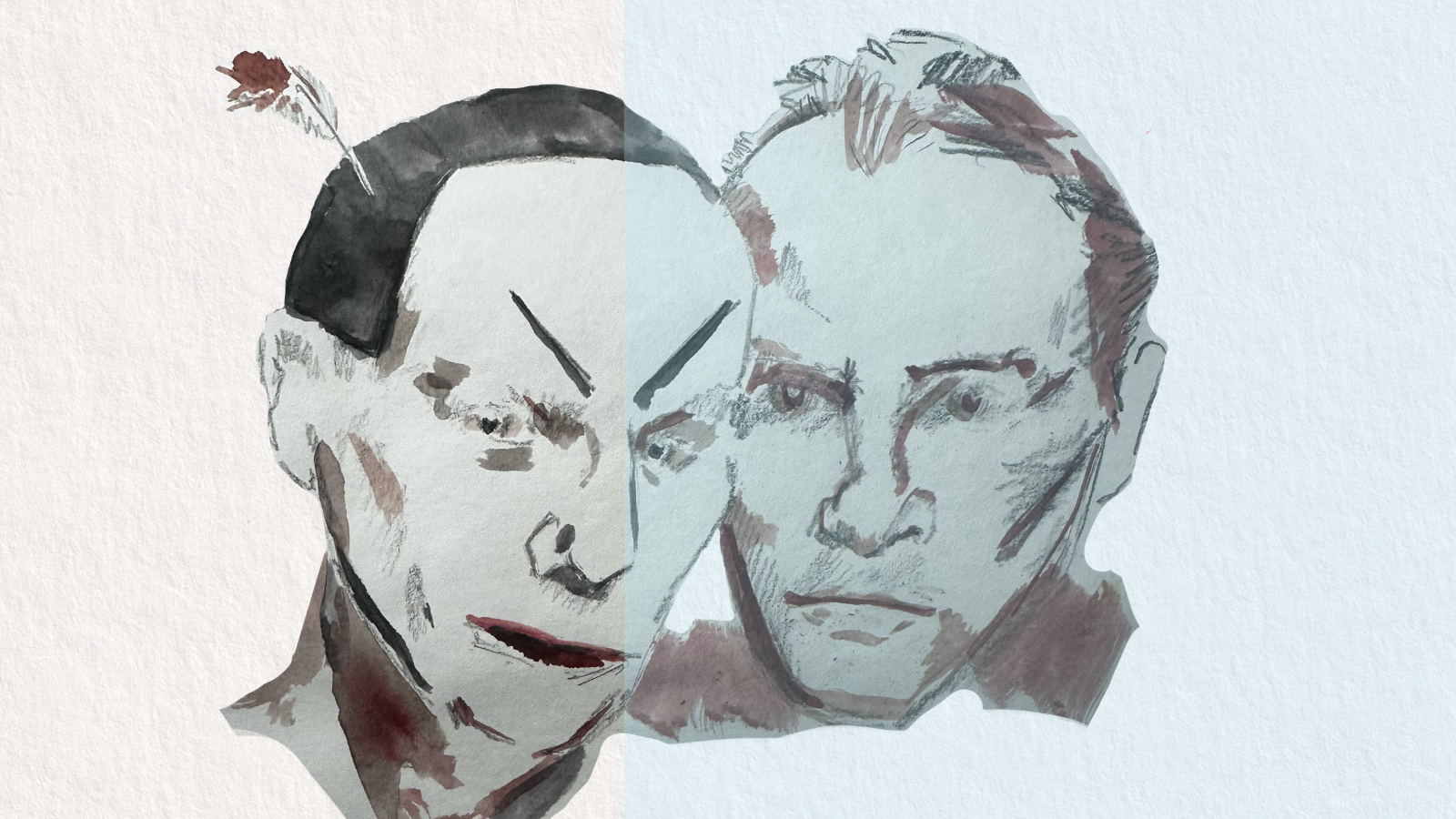
Before the author Klaus Mann was labeled a mongrel, a queer, a junkie, a communist, and in the curious judgment of the FBI, a “premature anti-Fascist,” he found himself tarred with perhaps the cruelest epithet of all: Dichterkind, they called him, the child of a poet. As with the celebrity offspring of our own era, the accident of his birth afforded the second of Thomas Mann’s six children — and the most keen to become a novelist himself — a measure of unearned fascination seasoned with resentment.
Despite a lifelong addiction to narcotics (especially heroin, dubbed tuna fish in his diaries), a mania for world travel, severe bouts of depression, and a highly active sex life, with a special fondness for “rough trade,” as a friend put it, Klaus was also a remarkably prolific writer, if not quite the artistic equal of the Nobel-winning heavyweight author of Death in Venice and The Magic Mountain, with whom he was doomed forever to be compared. “Having begun my career in his shadow, I wriggled and floundered and made myself rather conspicuous for fear of being totally overwhelmed,” he admitted in his autobiography. But literary reputations are not fixed, and these days, while Thomas’ oeuvre has acquired the musty aroma of the canon, respected if not widely read, Klaus’ most famous novel, Mephisto, a savage indictment of the German cultural elite and its footsie with fascism, has come to feel perfectly contemporary, even urgent, nearly nine decades after its publication.
Though Thomas confessed in his diary to developing an erotic fixation on his teenage son (“his naked bronzed body left me unsettled,” he wrote), he was somewhat cooler to the boy’s literary output. He described Klaus’s 1925 debut, the play Anja and Esther — a brazenly transgressive work produced when Klaus was still a teenager — as “indescribably sick and corrupt little piece” and even mused about having the production shut down.
Set in a mysterious co-ed institution, what its creator described as “half ballet school, half sanatorium (with a touch of jail, brothel, and monastery),” the play concerns a quartet of wayward adolescents, who were portrayed by Klaus himself and his sister, Erika, as well as tyro actor Gustaf Gründgens and Pamela Wedekind, the daughter of Spring’s Awakening playwright Frank Wedekind. Despite scathing reviews, the production was a sensation, due in large part to its cast of nepo babies performing an edgy erotic roundelay. Meanwhile, a version of these onstage shenanigans was playing out in real life: Klaus and Gustaf were lovers, as were Erika and Pamela; meanwhile Klaus was engaged to Pamela; and Gustaf and Erika would briefly marry.
Anja and Esther’s frank treatment of homosexuality no doubt played a role in Thomas’ disapproval. A closeted gay man himself, he had a lot to lose from the furor his son’s work had stirred up: even in the famously permissive Weimar era, same-sex relations were illegal. Thomas’s subsequent publication of an essay, “On Marriage,” denouncing homosexuality for its “sterile dissoluteness,” as opposed to “the fidelity and beauty of the ethically based and legally sanctioned bond between man and woman,” might therefore be read as a defensive maneuver, a way to put some distance between himself and his enfant terrible. But it did little to dampen the Oedipal conflict: Just months later, Klaus, not yet 20, published The Pious Dance, a frank, autobiographical coming-of-age tale widely seen as Germany’s first openly gay novel. “It never crossed his mind to lie to himself about it,” Klaus wrote of his protagonist’s sexuality, “to fight it as ‘degenerate’ or as ‘sickness.’”
If his father “despised, tormented and humiliated him” throughout his life, as Fredric Spotts put it in his biography Cursed Legacy: The Tragic Life of Klaus Mann, this might have been one reason: Klaus was always unashamedly himself in a way that Thomas, for all his genius and renown, never dared be. And within a few years, their contrasting approaches to life, art and politics — Klaus’ heedless truth-telling versus Thomas’ high bourgeois orthodoxy and scrupulous self-preservation — would meet a daunting test.

Klaus spotted the fascist threat long before it ripened — so early, in fact, that the FBI would later assume he was a communist. In a 1927 pamphlet, he identified an alarming strain of nationalism among members of his generation, and condemned an older cohort of cultural elites who during the Great War had either eschewed politics altogether or worse, “succumbed to triumphant madness instead of cursing it.” He implored the nation’s intellectuals to learn from their tragic mistake when fascism arose again, as he saw that it would. In part, the pamphlet may have represented another veiled shot at Thomas, who during the First World War had published a collection of essays, the imprecisely titled Reflections of a Nonpolitical Man, in support of German militarism. Failing to heed his son’s warning, the great man would equivocate for years as the Nazi threat gathered steam, ever mindful of his status, connections, and book sales (if seemingly less concerned about his ethnically Jewish wife and half-Jewish children). While Thomas Mann is now justifiably praised for denouncing the Nazi regime, recording a series of speeches from California as part of the Allied propaganda effort, his journey to the right side of history was marked by detours. On April 10, 1933, following the official proclamation of the Third Reich, Thomas acknowledged in his private diary some “secret, disquieting, persistent musings” — in particular, the thrilling possibility that “something deeply significant and revolutionary” might be underway in the Fatherland. As for the rule banning Jews from practicing law, issued days before, he concluded, in the equable tone employed by certain of our contemporary pundits, that there were “two sides” to the issue.
His son knew better, as he made clear with the 1936 publication of Mephisto, a terse, poisonous attack on his former lover, Gustaf Gründgens, and others whom he saw as betraying their values to curry favor with the Nazi regime. With its unsparing satire of the theater crowd, the novel is a worthy forerunner of Thomas Bernhard’s The Woodcutters, but the wartime setting raises the stakes considerably, especially given that Mann’s effort was nearly contemporaneous with Hitler’s rise. “Everything that exists will fall apart,” one character predicts. “When it comes down, it will bury us all.” Not a bad prognosis for a book was written nearly a decade before Germany’s surrender.
The novel traces the career of actor Hendrik Höfgen, a regional theater performer attached to a small company in Hamburg during the waning days of the Weimar Republic. That the character was based on Grüngens seemed to escape no one — nor was it meant to. (The book’s Wikipedia page includes a table confidently naming a real-life counterpart for virtually every character.)
Although Hendrik is a genuine talent, lighting up like a “glowworm,” as one character puts it, whenever he’s onstage, he is nonetheless deemed a lightweight and an artistic fraud by his more perceptive colleagues. In the words of the theater’s director, he is “basically a trivial creature. Everything about him is phony, from his literary taste to his so-called Communism.”
Indeed, he is a master of what today is called virtue signaling, instinctively aligning with then-fashionable leftist views as a kind of personal branding exercise. Endlessly postponing his plan to launch a politically oriented theater company sure to awaken the proletariat, for example, Hendrik explains “with fine eloquence that it was absolutely essential to humor the public and the press by putting on lighter and more popular shows before he could take the plunge.” Eventually, at the urging of his leftist colleague Otto Ulrichs (based on actor and underground resistance fighter Hans Otto), he finally assents, sort of: “At the last moment Hendrik had — for tactical reasons — decided on a war tragedy, which in three somber acts portrayed the misery of the winter of 1917.”
Despite his powerful onstage charisma, Hendrik is harboring a deep insecurity, as indicated by his penchant for “interesting nervous breakdowns,” as Mann wryly puts it. Another trick for managing his anxiety, “the means by which he atoned for his ambition and humbled his vanity,” involves a clandestine relationship with a biracial tap-dance coach and dominatrix who goes by the moniker Princess Tebab. “When the public likes me a little — when I have a success — I owe it all to you,” he professes during one session. “To see you, to touch you, Princess Tebab, acts on me like a miracle cure… refreshment like no other I’ve ever tasted.”
To which she replies, “You really are the weirdest little shit I’ve ever met.”
Hendrik’s chief antagonist is an impoverished young actor and avid Nazi Party member named Hans Miklas, who seethes at his arrogance, his success and his liberal politics. On one fateful occasion, overhearing Hendrik disparaging the actress Lotte Lindenthal, a middling talent who happens to be the companion of a powerful Luftwaffe officer (a character modeled on Hermann Göring), Miklas challenges Hendrik to a fight and is promptly fired. Eventually, however, he grows disillusioned with the Reich. “It’s all shit,” Miklas declares, bringing to mind the sullen resentment increasingly heard from the likes of Marjorie Taylor Greene and Tucker Carlson. “We’ve been betrayed. … Now [the rich] talk patriotic bilge while they make their deals — that’s the only difference.”
By chance, when Adolf Hitler (“the blustering lout whom [Hendrik’s] brilliant and progressive friends had so often ridiculed”) is named chancellor, the actor is in Spain, “playing an elegant confidence man in a detective movie.” Alone in his hotel room, he considers his options — whether to go into exile, like so many of his compatriots (including Klaus Mann, who relocated to Princeton, NJ, in 1936), or take his chances back in Germany. What follows are a jumble of rationalizations sure to strike a chord with contemporary readers. The German people will rise up, he tells himself. A Nazi dictatorship is still a long way off. Surely the left-wing parties will mount a counterattack. And even if the worst does come to pass, he can take comfort in the fact that he never officially joined the Communist Party. Perhaps most important, he reassures himself, he isn’t a Jew: “‘I am a blond Rhinelander,’ exulted Hendrik Höfgen, revived by champagne and his optimistic reflections on the political scene. It was in the best of spirits that he went to bed.”
Hendrik soon learns that he’s got a fan in high places, the actress he’d once insulted, Lotte Lindenthal. Assured of his safety due to her high-placed friends, he promptly returns to Berlin and downplays his former left-wing sympathies (“an artist’s folly”). His ascent under the new regime begins in earnest when, with Lindenthal’s affectionate patronage, he wins the role as Mephistopheles in a revival of Faust.
That Hendrik’s appeasement of fascist evil occurs in the context of Goethe’s classic play about a deal with the devil (based on the same legend later that became the basis for Thomas’s novella Doctor Faustus) might seem a little on-the-nose. But Mann was working with the facts at hand: Gustaf Gründgens’ really did perform as Mephistophiles, greatly impressing the Nazi leadership. To the author’s credit, he mostly lets this too-convenient accident of history speak for itself, only underlining the point in one passage that finds the Göring character, now the prime minister, raving about Hendrik’s interpretation. “Isn’t there a little of [Mephisto] in us all?” he remarks, declaring the devil “a German national hero.” Before long, Hendrik is the toast of Berlin, churning out tame, acceptably nationalistic productions as director of the State Theater, living in a grand villa, and having Princess Taleb deported when she threatens to expose him. That said, Hendrik does have a conscience, and so attempts to balance his moral ledger with the occasional gesture of good will (putting in a kind word for Otto Ulrichs, who is eventually executed anyway, and hiring a half-Jewish secretary). Nurturing this kind of political “insurance policy,” as Hendrik terms it, seems to have done the trick for his real-life counterpart: Even after the war, Gründgens would remain a beloved celebrity in Germany, starring in the 1960 film adaptation of Faust and using his considerable clout to block his former lover’s roman-à-clef from publication for years. (Mephisto eventually became available in West Germany in 1981; shortly thereafter, a film adaptation by director István Svabó won the Academy Award for best foreign language film.)
Mephisto is not an especially nuanced read; it was written at a time, not unlike our own, when nuance may have felt inadequate to the challenge at hand. Rather, just beneath its polished surface, it’s a howl of rage at a world going mad before the author’s eyes, and doing so with the meek and mercenary assent of his erstwhile friends and colleagues, not to mention his father.
It is also one of the most deliciously venomous novels one might ever encounter. One of the book’s great pleasures is the unalloyed malice of Mann’s physical descriptions. Much as we all enjoy a good Twitter ratio or diss track, rarely do they deliver the visceral satisfaction of Mann’s merciless caricature. He describes one character’s “bluish mouth working silently under his black mustache like some avidly sucking carnivorous plant.” The surrogates for Göring and Joseph Goebbels are identified as “the fat giant” and “the deformed propaganda dwarf.” And then there’s Adolf Hitler: “Power incarnate had an insignificant receding forehead,” Mann writes, “over which fell the legendary greasy strand of hair, and dead staring eyes. The face of Power was putty-white, bloated, porous…” (If only we could show him the visage of Stephen Miller and provoke Mann to put pen to paper…)
It’s tempting to outline the many parallels between Mann’s portrait of 1930s Germany staggering toward the abyss and our own lurch down a similar path — to compare, for instance, the virality afforded the AI power ballad “We Are Charlie Kirk,” with the obligatory singing of the “Horst-Wessel-Lied” at a fancy ball, or to note how closely a recent X post by Palantir cofounder Joe Lonsdale calling for public executions echoes the avid bloodlust of a futurist poet in Mephisto (“We are still too soft…. Where is the public torture?”), or to see in the nimble passage of Bari Weiss from college scold to CBS News editor-in-chief a tidy replay of Grundgens’ ascent. But reading the novel merely as a political guidebook, a sort of companion piece to Dorothy Thompson’s classic essay “Who Goes Nazi?” feels too cheap. Better to think of it as a Bildungsroman in reverse, in which the protagonist’s social ascent is a story not of moral development but of grubby compromise and spiritual corruption.
As with a more conventional coming-of-age tale, there is a lesson on offer here — though I’ll admit it didn’t strike me right away. I suppose I was too busy enjoying Mann’s exquisite takedowns of the opportunists, rationalizers, equivocators and other enablers in his social circle to spot my own faint reflection in those ghastly cameos. In time, though, the question began to nag at me: Am I really any better? As I write these words, the wealthiest, most powerful people in human history are openly musing about sunsetting democratic governance, culling the workforce, laying waste to our institutions and maybe supplanting human life altogether, just to see if it’s cool AF. A government-sanctioned criminal gang roams American streets, bundling citizens and noncitizens alike off to prison camps and brutalizing anyone brave enough to raise an objection. The most powerful, sorry, lethal, military in the world vaporizes drowning men at the press of a button. And so on.
Meanwhile, I quietly reassure myself that my own papers are in order, that my neighborhood is far from the front lines, that I sure was clever to scrub my Twitter feed and download Signal last year. True, I haven’t spent quite as much time at the barricades as I might wish to, but like the cultural elite of Weimar Germany, I’m artistic, well-informed and deeply troubled. I do my level best to navigate a bad situation, without of course jeopardizing my own modest influence. I pitch my essays to prestigious journals of opinion — bearing witness, as one does — ever hopeful that the right combination of words will nudge my readers toward political virtue. That said, Mann’s description of Hendrik’s self-delusion still stings just a bit; it is “nothing but a vulgar arabesque,” he writes, “at the edge of an enterprise doomed to collapse.”