
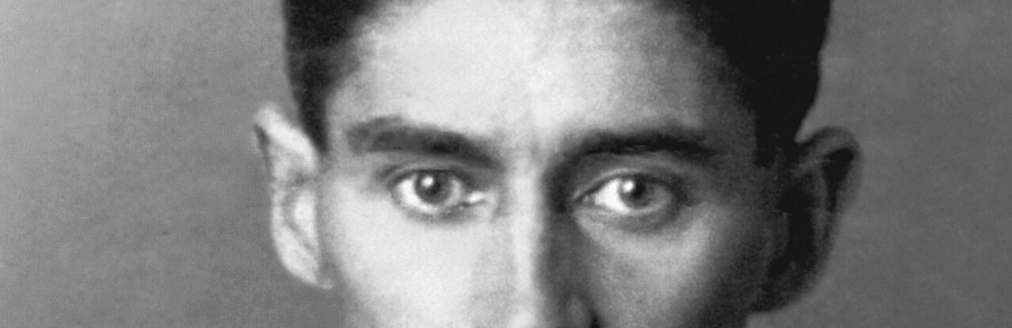
Dr. Franz Kafka, as he is officially listed, is buried in Prague’s New Jewish Cemetery, about a mile down the road from where I live in the neighborhood of Žižkov. The greater Olšany Cemetery, which it adjoins, is across the street from my apartment. I often go there for walks in the evening, meandering along its overgrown rows and flower-crowded graves. Kafka’s headstone looks like an expressionist prism, a long diamond slightly fattened at its top. The stone bed in front of it is frequently littered with candles, pens, scraps of paper, rocks painted with pictures of beetles. He is interred there along with his mother Julie and his father Hermann (whom he is unable to escape even in death). Max Brod, without whom we’d know nothing of Kafka, has a plaque on the opposite wall. Given that Kafka instructed Brod to burn all of his work “unread,” he almost certainly would not have welcomed people flocking to his grave, so whenever I stop by to say hello to him, I think to myself: “He would hate this.”
I’ve developed a habit of saying the same thing whenever I walk by any number of the businesses, monuments, museums, or attractions in Prague that bear Kafka’s name. The house that he was born in (demolished and rebuilt at the end of the nineteenth century) at the foot of Old Town Square, previously the Kafka Café, is now the location of a high-end shop that sells handcrafted timepieces, including a limited-edition Kafka watch for $2,500 USD. The author’s signature is scratched onto the dial-face, and the detail of its design, according to the website, “reflects the depth of his work.” Last time I passed by the store, I stopped inside and politely told the man working at the counter: “I don’t think he’d be very happy about that, you know.” After some initial confusion as to whom I was referring, he simply smiled and shrugged.
Today, one can find in Prague: the Kafka Museum, the Kafka House, the Franz Kafka Bookstore, the World of Franz Kafka exhibition, the Franz Kafka Apartment, the Kafka’s Head Apartment, the Hostel Franz Kafka, the Kafka Restaurant, the Kafka Hummus Café, the Kafkoff Bistro and the Kafka Ink tattoo parlor. His books are displayed on front tables in every bookstore; the letters to Felice and Milena are the most popular, often picked up by young women who see them as the love letters of a tortured romantic. There are also several statues, busts and monuments — the most famous being the Head of Franz Kafka, a giant kinetic sculpture composed of forty-two rotating stainless-steel plates, designed by Czech artist David Černý and located in the courtyard of the Quadrio shopping center in New Town, where tourists reliably gather to take selfies.
The list of works produced about, inspired by, or based on Kafka is far too long to enumerate here (the author’s Wikipedia page contains a selected list that tallies nearly fifty films, musicals, novels, video games, etc). Biographies number in the dozens (Reiner Stach’s three-volume biography, written in German and published in English between 2005 and 2016, was conceived to be an exhaustive, definitive work). There have been thirteen film adaptations of his novels, and in the last two years — coinciding with the 100th anniversary of his death — two productions about his life have been made: Kafka, a series which aired on German and Austrian television in 2024, and this year, Franz, a biopic directed by Agnieszka Holland. Foremost, the Kafka Industry afflicts the high culture of the literary-intellectual. Like Dante, Shakespeare, and Joyce, Kafka has kept scholars gainfully employed and well-fed for generations. He has become a department, a bureau unto himself. His work has been examined, excavated, and interpreted to the point that the ratio of words written by Kafka to words written about Kafka is now estimated to be about 1:10,000,000. A symbolic punishment for a man who himself claimed to be “made of literature.”
There are reminders of Kafka all around Prague, yet despite the city’s frozen-in-time, museum-like architecture, it is difficult to reinhabit the environment of what was likely his day-to-day life. He was born in 1883 on the edge of Josefstadt, the city’s Jewish Quarter, where Hermann, who grew up in a village in south Bohemia, had settled a decade earlier. The wall that had surrounded the ghetto for hundreds of years was torn down in the early nineteenth century, a few decades after the Edict of Tolerance in 1782. The quarter, which served as the inspiration for The Cabinet of Dr. Caligari — a labyrinth of narrow streets, shadowy passages, staircases, brothels, gas lamps, ramshackle flats — was already being cleared away at the time of Kafka’s birth. Between 1893 and 1913, the entire neighborhood was demolished in an act of slum clearance, modeled on the Haussmann renovations in Paris during the reign of Napoleon III. If one can believe Gustav Janouch’s Conversations with Kafka (1951) — a series of discussions the author supposedly had with his subject throughout 1920 but which were not written down until decades later — Kafka was haunted by the disappearance of the old ghetto and the life that disappeared with it: “With our eyes we walk through a dream: ourselves only a ghost of a vanished age.” Today, all that remains is the Old Cemetery, the Jewish Town Hall, and the Old New Synagogue, still the oldest active synagogue in Europe, a building that (in surely an apocryphal story) Hitler suggested leaving intact as a monument to an extinct race. The synagogue is situated on Pařížská street, which once served as the boundary of the ghetto. Today it is an outlet for high-end shopping, lined with designer brands, mannequined windows, sports cars, and security guards.
Kafka’s entire life was localized in the city center. He grew up in House at the Minute, a sgraffito building underneath the Astronomical Clock in Old Town Square. The grammar school he attended was at Kinský Palace on the opposite side, which also housed Hermann’s shop for textiles and odd items, and the insurance company where Kafka worked was about a ten-minute walk down the street. The farthest he managed to get away from the center, and the presence of his father, was a little house on the slopes of Prague Castle that his sister Ottla prepared for him. That reprieve was where he wrote “The Great Wall of China” and began work on The Castle. Outside of a trip to Weimar with Brod to visit Goethe’s house, two Viennese trysts with the writer Milena Jesenská, and a stay at Ottla’s country house in the village of Zürau, the only times Kafka left Prague were for stays in sanitariums to nurse the tuberculosis that would eventually kill him. He famously said of the city: “This little mother [mutterlein] has claws.”
The Prague that Kafka grew up in was also different from the one in which his father had learned to get along. Hermann had made his living in the second half of the nineteenth century, a time of mobility and more or less tolerable acceptance of Jews in many central European capitals. He owned and operated a successful business, and though he harbored a distrust of the Czechs who lived and worked among him (referring to them as “paid enemies”), he’d managed to assimilate and enjoyed the affluence of the new Jewish bourgeoisie. But by the time of Kafka’s birth, the Austrian imperium was cracking, Czech nationalism was on the rise, and attempts to nationalize the language and banish German influence were becoming more and more fervid. As German speakers, Prague’s Jews were a minority within a minority, and thus bore double the brunt. In 1897 anti-Jewish and anti-German violence broke out in the city in response to the government’s denial of Czech language rights, and shortly before Easter weekend, 1899, accusations of “blood libel” flared up after a 19-year-old Czech girl was found dead near the Bohemian village of Polná. The story became a national scandal and led to the wrongful imprisonment of a Jewish man named Leopold Hilsner. In 1920, just a few years before Kafka’s death, anti-Jewish riots again erupted in Prague; archives were destroyed and Torah scrolls were burned. Kafka recounted the event in a letter to Jesenská: “I have been spending every afternoon outside in the streets, bathing in anti-Semitic hatred. A ‘filthy brood’ [Prašivé plemeno] is what I heard them call the Jews. Isn’t it only natural, to leave a place where one is so hated? . . . The heroism of staying is nonetheless merely the heroism of cockroaches which cannot be exterminated, even from the bathroom.”
Attempts were made repeatedly to drive Kafka out of the society after the Czechoslovak Communist Party seized power in a coup in 1948. Kafka’s work, then only recently published, was banned for its “decadent anti-realism” under the imperative of Stalinist state aesthetics. In 1963, however, the Czechoslovak Academy of Sciences organized a conference in the town of Liblice to discuss Kafka’s work for the first time since its prohibition, an event that is often seen as the opening shot of the Prague Spring since the organizers and attendees were met with no retaliation. For the writers who attended, it was almost impossible not to identify their own condition with the author’s (Milan Kundera reports that the Polish scholar Roman Karst ended his talk by crying “Franz Kafka lived and suffered for us!”). Whether one liked it or not, under the communist regime, the cliché of the “Kafkaesque” seemed unavoidable. “They make you do it,” as Christopher Hitchens remarked, relaying an anecdote about a trip he made to Prague in the 1970s — determined not to invoke the name of Kafka — during which a meeting he had with dissident writers was broken up by the secret police (StB), who arrested everyone, and when asked “What for?” replied, “We’re not telling you.” Ivan Klíma’s 1986 novel, Love & Garbage, is partly an extended meditation on Kafka by a writer who takes up a job as a trash collector. And when Vaclav Havel was elected president in December 1989, Philip Roth described it as “K. meets Klamm at last.” Roth himself visited Czechoslovakia many times throughout the 1970s, by his own admission, in search of Kafka, trips that would later be dramatized in The Prague Orgy (1985) and The Professor of Desire (1977), in which the protagonist, David Kepesh, who is preparing to give a lecture on Kafka in Bruges, is taken around Prague by a Czech professor (possibly based on Klíma himself, who was Roth’s own “tour guide”) and shown a series of ghostly locations, including a meeting with a prostitute with whom Kafka supposedly slept.
For the better part of the twentieth century, most of what we thought we knew about Kafka’s life meant disentangling the man from the image Brod had created of him: the saint, the seer, the prophet, the prognosticator, the arch allegorist who knowingly left his work to be decoded by generations of energetic exegetes. The works of interpretation written by Brod after Kafka’s death say it all: The Faith and Teachings of Franz Kafka (1946), Franz Kafka, He Who Shows the Way (1951), Despair and Salvation in the Work of Franz Kafka (1959). And in Brod’s 1926 novel, The Enchanted Kingdom of Love, the character Garta, based on Kafka, is described as “a saint of our time,” and “saintly rational in the face of all mythologies” even though he was “a mythological figure himself.” The Kafka Industry, then, began with Brod, which means it began as soon as Kafka’s work met its audience. This image was further embroidered by Janouch’s untrustworthy and apocryphal Conversations, a work of shaky hagiography that presents Kafka as a kind of sage, his every utterance meditated and oracular.
Kundera, who spent decades trying to suppress his own biography and any efforts to interpret his work through it, unsurprisingly had spleen aplenty for what he called “Kafkology,” which tyrannizes over the author’s work by reading it “almost exclusively in the microcontext of biography.” Kafkology, Kundera contends, “produces and sustains its own image of Kafka, to the point where the author whom readers know by the name Kafka is no longer Kafka but the Kafkologized Kafka.” It is the huge edifice of the author’s own image that rises up and crushes him, and the critical apparatus becomes a monstrous instrument, a cannon to kill a cockroach. It is with Kafkology, therefore, not Kafka himself or his work, that anyone who dares make another film, write another biography, add another presumptive, heretofore undiscussed word, ultimately has to contend.
Anxiously conscious of this, Agnieszka Holland’s new film makes its modesty known in its title. It is not Kafka we’re dealing with here, but Franz: the tall, spindly, giggling vegetarian; the middle-office man at the Prague Workers’ Accident Insurance Company; the nocturnal son pacing the parlor of the family flat, unable to find the peace and tranquility needed to write. The film manages a restrained, earnest, often relievingly funny depiction of Kafka’s life in a way that makes no claims to him. As so often with biopics, the “life” consists of a series of notable moments: the booming, crude, mercurial, incurious Hermann placing little Franz out on the balcony in the middle of the night (as recounted in “Letter to His Father”); Franz and Max waxing Kierkegaardian while being undressed by brothel prostitutes; Herr Kafka having a laughing fit during an important meeting in which one of his superiors is being promoted; a visit to a nudist sanitarium shortly after his diagnosis; Kafka reading “The Penal Colony” to a disgusted audience, and later, cracking up while reading a scene from The Trial aloud to a circle of literary friends. Other than these two scenes, the film approaches Kafka’s writing elliptically, as an act that few witnessed and none had access to: mercifully, it avoids any frenzied montages of the author at his desk; there are no epiphanies, no sudden arrivals of great ideas, no moments when the writer steps back from his desk and realizes he’s “done it.”
There are flashes of the ghetto being torn down, of Wehrmacht columns marching across the bridges of Prague, of the gas chambers where Kafka’s three younger sisters (Elli, Valli, Ottla) would all perish, killed by an insecticide. There are also flashes to the present day, which show people engaging in both real and parodic tours of Kafka sites around Prague. A group of Chinese tourists are invited to buy an official Kafka towel and lie down on the grass next to the lake where Hermann chucked his son into the water during his first swimming lesson. Later, a group is taken for some veggie junk food at Kafka Burger (fortunately, not a real place). Holland knows that any film about Kafka’s life cannot be made in innocence. It must attempt to slip the shadow of the nachleben and reckon, whether it wants to or not, with the Kafka Industry. In doing so, the film tries to have it both ways: to present an unassuming, de-mythologized portrait of Kafka while also being unable to escape the fact that the entire production is yet another donation to Kafka Inc.
This is, perhaps, the only approach one can take now. Who would presume to say anything new about Kafka? How much more is there to say? We rightly feel like Josephine, the operatic mouse in the last story Kafka ever wrote (after the tuberculosis spread to his larynx and took away his voice): How can she sing? She can barely squeak! The most it seems anyone can do is add and disclaim. Holland’s film, innocuous enough, does both. All the ink Kundera contemptuously spilled trying to rescue Kafka from the Kafkologists was itself a kind of adding. Stach’s biography, the comprehensive heft of which is unquestionable, is an effort to ward off further adders, at least for a while. And this essay, of course, is another on the pile.
When the first edition of The Metamorphosis was published, Kafka insisted that there be no image on the book’s cover. It was crucial, he said, that readers not see what Gregor is turned into. From the very beginning, he was trying to shun easy readings, but also disarm the interpretive instinct. Critical explication, he sensed, would smother the work. But to deny is also to invite. And so we find ourselves faced with a version of the same dilemma Kafka described as long looming within himself: “the impossibility of writing” and “the impossibility of not writing” about him.