
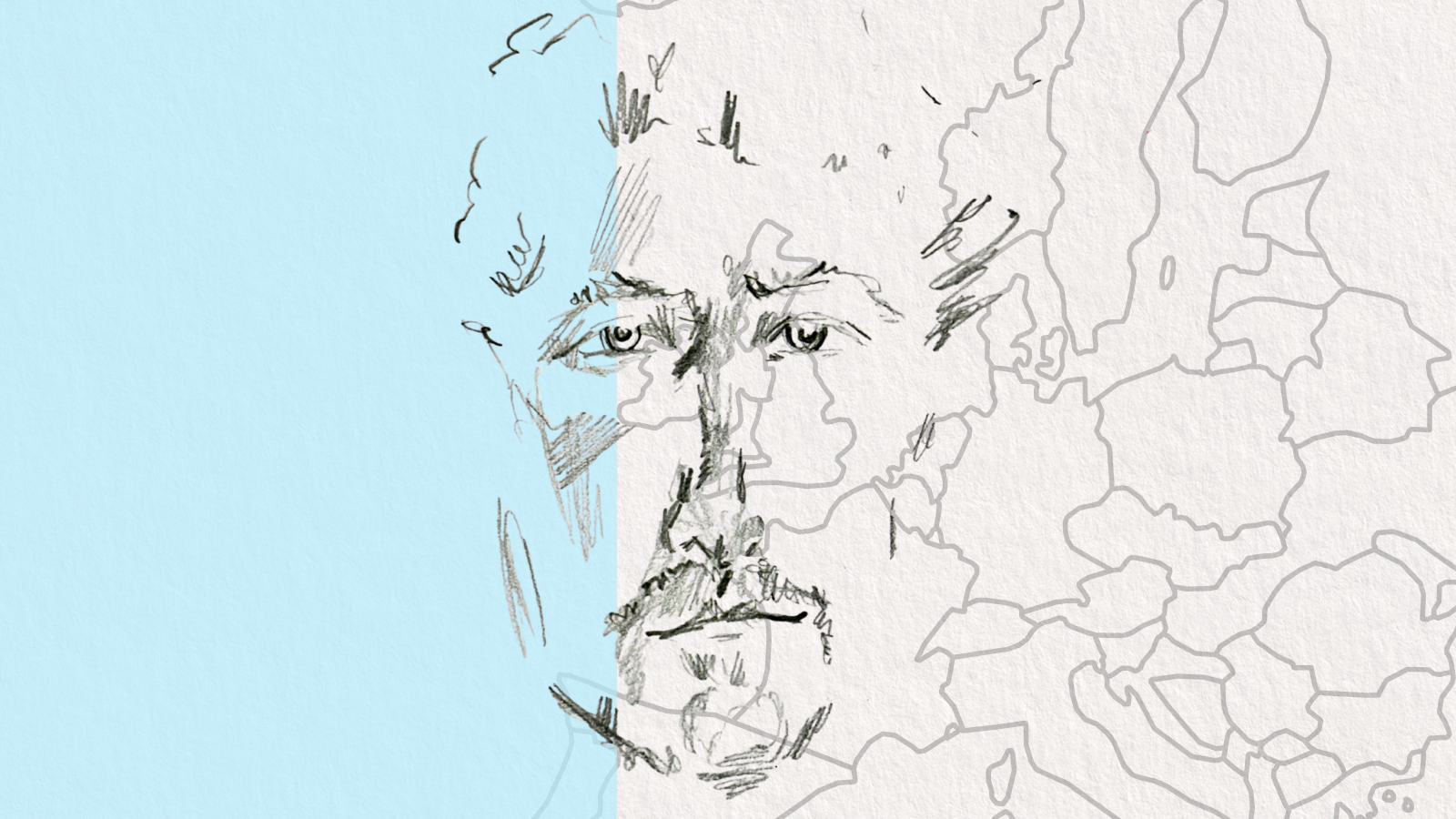
The name Giuliano Da Empoli might not mean much to American readers, but in Europe the Swiss-Italian writer has established himself as one of the continent’s most fêted political and intellectual commentators. The Wizard of the Kremlin, his 2022 novel about the rise of Putinism, was an instant bestseller and has been adapted into a lavish feature film directed by Olivier Assayas with a screenplay by Emmanuel Carrère (and starring, a little improbably, the boyishly expressive Jude Law in the role of Putin). Last year, The Hour of the Predator, Da Empoli’s book-length essay on the new world disorder, sold 200,000 copies in France in its first two months of publication. It was instantly translated into most European languages and has, along with The Wizard of the Kremlin, become a ubiquitous presence in bookstores and airports across the continent. When I bought my copy of The Hour of the Predator in central Copenhagen last summer, the woman at the checkout counter told me she’d read it in one sitting, it was “just that good.” When did a political essay last cast such a spell?
Yet what is most unusual about Da Empoli is his proximity to power. These days, most writers are too low on the cultural Dow Jones to be taken seriously by politicians, let alone get invited to lunch with the president of France, as Da Empoli sometimes is. (He and Macron are on a first-name basis). But then Da Empoli was born into politics: his father, Antonio Da Empoli, was an economic advisor to Italy’s socialist prime minister Bettino Craxi, and was even shot and wounded in a 1986 assassination attempt by the Red Brigades. Da Empoli himself has served as deputy mayor of culture in Florence and was, from 2014 to 2016, a senior advisor to Italian Prime Minister Matteo Renzi. Today, he teaches at Sciences Po in Paris and is a founder of the Milan and Brussels-based think-tank Volta, whose advisory board includes David Miliband, a former advisor to Tony Blair and Foreign Secretary under prime minister Gordon Brown; Matthieu Pigasse, a French investment banker and the co-owner of Le Monde; and Helle Thorning-Schmidt, Danish prime minister between 2011 and 2015.
Da Empoli first emerged as a political commentator in Italy in the early 2000s with a slew of books on meritocracy, information overload, and Barack Obama’s 2008 presidential campaign. In 2019, he settled permanently in Paris, attracted by the city’s “intimate connection between literature and politics.” During the Covid lockdown he began writing what would be his major international breakthrough: The Wizard of the Kremlin, first published by France’s Gallimard just a few months after the Russian invasion of Ukraine in 2022. Offering an imagined, behind-the-scenes look at the rise of Vladimir Putin, the novel follows an unnamed narrator to the home of Vadim Baranov, a retired Kremlin advisor based on Vladislav Surkov, the political strategist once described in The Atlantic as “the hidden author of Putinism.” Over tumblers of whisky in a library “fit for a Benedictine monastery,” Baranov assumes control of the novel’s narrative, treating his guest — and the reader — to the story of his career as a close advisor to the Russian president from the late 1990s to the beginning of the war in Ukraine.
Yet rather than a political insider’s portrait of the mechanics of Putin’s regime, The Wizard of the Kremlin is a highlights reel of recent Russian history. Baranov’s narrative makes its dutiful stops at all the familiar sights — the 1999 Russian apartment bombings, the Second Chechen War, the Kursk submarine disaster, the exile of Mikhail Khodorkovsky, the intimidation of Merkel with Putin’s dog, the Winter Olympics — episodes that Baranov threads together with a litany of armchair maxims (“People were tired and wanted order again”), pithy banalities (“Boris was a very intelligent man. But intelligence doesn’t protect you from anything, not even stupidity”), and vague cultural mystification: “The unexpected has always been one of the great qualities of Russian life”; “Russians aren’t like Americans, and they never will be”; “I understood that, as is often the case in Russia, reality had once again surpassed all fiction.” It’s not hard to see why it has sold so well in Europe. For a continent of readers already in the grip of Russophobia, The Wizard of the Kremlin is a Baedeker of Russian otherness.
“The challenge of the book is to take the devil’s point of view,” Da Empoli has said of the novel. It’s a challenge The Wizard of the Kremlin fails. Beyond bristling a few liberal European pieties, Baranov offers no real insight into the Kremlin’s worldview that cannot be got from journalistic or historical sources like Peter Pomerantsev’s Nothing is True and Everything is Possible or Mikhail Zygar’s All the Kremlin’s Men. Which therefore begs the question: why is this a novel? I’ll grant that it’s intriguingly structured and propulsively written; I like a good leathery monologue as much as any reader of le Carré or Conrad, but as the latter once put it: “What is a novel if not a conviction of our fellow-men’s existence strong enough to take upon itself a form of imagined life clearer than reality and whose accumulated verisimilitude of selected episodes puts to shame the pride of documentary history?”
Because it never dares put documentary history to shame, or enter into that special realm of possibility, speculation, and meddling with events that is the privilege of the novelist, The Wizard of the Kremlin finally amounts to little more than a specious contribution to the by-now bloated mythology of Vladimir Putin. For all its Dostoevskyan pretensions (“take the devil’s point of view”), the novel displays no sign of the Russian writer’s dialogical imagination; indeed, Baranov is never really questioned or confronted by the narrator. At length, the repetition of already familiar talking points, from accusations of Western decadence to sweeping generalizations about human nature, makes Baranov sound less like Satan and more like an opinionated dinner guest after one too many vodkas.

In The Hour of the Predator: Encounters with the Autocrats and Tech Billionaires Taking over the World, Da Empoli returns to his more natural role as an up-close observer of politics and power. And I do mean up-close: Da Empoli attends the inaugural dinner of the Obama Foundation, goes to a lunch meeting in Montreal with Justin Trudeau, and appears on stage at a private Bilderberg event in Lisbon to discuss artificial intelligence with Sam Altman and Demis Hassabis in front of an audience that includes Henry Kissinger and Jens Stoltenberg. The Hour of the Predator even opens with an account of the United Nations General Assembly in September 2024 from inside the UN’s headquarters in Manhattan’s Turtle Bay. At one point, I began wondering what a former political advisor turned novelist was doing attending a high-level meeting of the UN’s main policy-making body, especially as the book offers no explanation for Da Empoli’s presence. A quick online search eventually supplied the missing context: Da Empoli was at the United Nations General Assembly because President Macron had brought him there.
From these and other encounters with the world’s destiny molders and heavy-water brains, Da Empoli is persuaded that we are living through a “Machiavellian” moment, in which political norms are being cast aside and the chaos of war and destruction is becoming more profitable than maintaining peace. As in the fifteenth and sixteenth centuries, he argues, old institutions are being swept away as new technology ushers in an epoch of violence and brute force. “All the guardrails of the old world have no value now that the hour of the predator is upon us,” Da Empoli writes. But beyond providing him with the occasional anecdote, it is never really clear why he felt he needed to get up close and personal to deduce for himself what is so obvious to the rest of us.
In one chapter, Da Empoli journeys to Riyadh to examine Mohammed bin Salman’s Saudi Arabia and its embrace of bizarre, tech-utopian fantasies like a projected linear smart city with no cars or carbon emissions. He notes that bin Salman hosts the annual conference of the Future Investment Initiative, also known as Davos in the Desert, during which attending business leaders and heads of state usually stay at the Ritz-Carlton in Riyadh, a luxurious hotel with a sordid history. On November 4, 2017, it was abruptly closed to guests for three months, during which bin Salman used the hotel’s luxurious surroundings to cement his grip on power by detaining, interrogating, and in some cases torturing roughly 300 of the kingdom’s most powerful men. Da Empoli compares bin Salman’s purge to Cesare Borgia’s Senigallia massacre in 1502. “Like the Renaissance duke, who nurtured a grandiose ambition of unifying Italy under his rule, MBS has outlined a strategic vision of transforming Saudi Arabia into a powerful modern nation, freed from the grip of religious fundamentalism, with power concentrated in his hands.”
This is interesting enough as far as it goes, but it still isn’t clear to me why Da Empoli felt he needed to go to the Ritz-Carlton in Riyadh to arrive at these insights. At the beginning of the chapter, it appears he is about to meet bin Salman in person, yet the encounter is never described. Did he, in fact, meet him? If so, why? Was Da Empoli invited to attend the Future Investment Initiative? Or did he merely have Ritz-Carlton loyalty points he wanted to redeem? Here as elsewhere, Da Empoli’s unwillingness to be more forthcoming about his presence seems like a dubious evasion.
Da Empoli is more persuasive when examining the noxious influence of technology on politics. He rightly faults the Democratic Party in the United States for failing to impose any meaningful regulatory control on tech companies, especially in the case of AI, which now is “in the hands of private companies that have elevated themselves to the ranks of nation states.” He gives as an example of this failure Google CEO Eric Schmidt’s role in orchestrating Project Narwhal, the wildly successful computer program used by President Obama’s 2012 reelection campaign to gather information about voters. “Two weeks after Obama’s re-election, the anti-trust committee, which had started legal action against Google, closed the case,” Da Empoli observes. Again and again, he finds, politicians have bowed down before their new tech masters. “Even now that the sky has come crashing down, most of them still don’t understand what has happened,” he says.
There is plenty to agree with in Da Empoli’s diagnosis of the present and its historical precedents, even if it is neither very original nor, at 136 pages, particularly weighty in any sense of the word. The Hour of the Predator is a brisk and mostly agreeable essay undermined by the odd misjudgment, like Da Empoli’s apparently genuine belief that television shows like Veep, House of Cards and Squid Games are “useful” for understanding contemporary politics; or his all-too-typical supplication before the wisdom and intelligence of Henry Kissinger. “He was driven by curiosity, by a desire to understand — a desire so sadly lacking in the current generation of powerful men,” Da Empoli writes of the former board member of Theranos whose curiosity and understanding did not extend to the hundreds of thousands of lives he sacrificed to the calculus of realpolitik in Vietnam, Cambodia, East Timor, Chile, and East Pakistan.
Yet the most serious problem with The Hour of the Predator is not what Da Empoli says but what he leaves out. Except as a setting, and aside from a few scattered nods to Macron, Ursula van der Leyen, and Keir Starmer (“He reminds me of Louis Philippe I, the Citizen King, who famously carried his own umbrella”), the continent of Europe is almost entirely missing from Da Empoli’s map of our disorderly present. I wonder why that is. Cynically, one suspects European readers have flocked to this book because, with its criticism of American politicians and American tech companies, not to mention the usual rogue’s gallery of Putin, Bukele, bin Salman and other non-Europeans, it caters to European cultural vanity. Seen in this light, it’s hardly surprising to discover that “Europe’s political class can’t stop reading Giuliano da Empoli,” as Politico put it last year. By omitting their political leaders from his analysis of the present, he rolls the European reader in a blanket of complacency.
Exasperatingly, Da Empoli has nothing to say about the EU’s financing and support of Israel’s genocide in Gaza; the ongoing “rightward lurch” (in Anton Jäger’s phrase) of most European countries; the growth of an EU deportation regime that sends migrants to countries they have never visited, and where they may not be safe; the failure to take leadership of negotiations to end the war in Ukraine; or, as has been the case time and time again in the last year, the perverse need of Europe’s political elites to debase themselves before Trump. Even in Davos, where Trump was the runaway clown, Europe’s leaders looked confused and fragmented. The lack of a clear, coordinated response to the United States’ threatened tariffs and imperialist rhetoric about seizing Greenland revealed the truth of the late Hans-Magnus Enzensberger’s characterization of the EU as “a toothless monster in Brussels.”
While writing this essay, I happened to follow the Danish and Greenlandic prime ministers’ trip to Paris on January 27, where they met with President Macron to discuss the recent stand-off between the United States and Denmark over Greenland. Interestingly, Mette Frederiksen and Jens-Frederik Nielsen also participated in a discussion at Sciences Po with—who else?—Giuliano Da Empoli, whose unwillingness to challenge Frederiksen as she repeated the new European gospel of rearmament, combined with the fact that it fell to a Sciences Po student to ask Frederiksen how Denmark’s purchase of F-35 fighter jets from the United States fits in with European strategic autonomy, made Da Empoli look like what he is: an intellectual-for-hire for Europe’s political elites.
Over the past year, as Europe’s politicians have staggered from one humiliating debacle to another, the continent’s elites have found comfort in Da Empoli’s two bestselling books. In his telling, Europe is beleaguered not by its own political incompetence but by a “motley procession of autocrats, tech conquistadors, reactionaries and conspiracy theorists,” as it says in The Hour of the Predator. I’ll grant that they make for more exciting villains than the alphabet soup of the EU’s various directorates, but it’s a bit gauche for a man accustomed to appearing at closed-door meetings with Sam Altman and Henry Kissinger, or to being introduced to bin Salman at the Ritz-Carlton in Riyadh, to complain about conspiracy theorists and tech conquistadors. But what’s really deplorable is the suspicion that Da Empoli knows better. As he puts it himself in The Hour of the Predator, “the defenders of freedom seem singularly unprepared for the battle to come.” But why that is, and what can be done about it, are questions Da Empoli declines to ask. He might start by subjecting Europe’s political leaders to serious scrutiny. For that to happen, he may also have to turn down a few lunch invitations.