For days, the last tweet my Twitter feed displayed was about the fallout from a U.S. immigration officer shooting an unarmed white woman. Beneath it, two consecutive tweets from Al Jazeera English reported that Iran’s internet was facing severe disruptions. At first, the timestamp of the tweets shifted; the next day, the hour changed to January 8, even as the calendar date itself moved from the 8th to the 10th, then the 13th, the 16th, the 17th, and finally the 20th. The feed refused to update. The internet was still down.
It wasn’t the first time. It had happened before during the 12-day Israel war against Iran in the summer of 2025, earlier during the protests of 2021, and before that in the 2019, 2017, and 2009 demonstrations. Of course, it had never been this severe. Never this long, never so “impossible to bypass.” Even the domestic intranet that had worked during the 2021 protests was useless this time.
On Saturday, three days after the internet went down, I was switching phone numbers, trying to find out whether any media offices still had internet access. During the protests of 2021, ’2019, and ’2017, they had. A friend at a newspaper office said there was no internet anywhere. “Bring the pages on a flash drive,” they said, “paginate them, our newspaper doesn’t have internet either.” They said the paper was publishing eight pages these days, half of what it typically printed. Yet they still wanted to know whether I had anything ready to publish. I asked what others were writing. Most reports were based on “observations,” interviews with ordinary people.
The first two days of the blackout coincided with the height of the weekend’s street clashes. After that, I hadn’t left the house to buy a newspaper. Not just newspapers, nothing at all. Two weeks after the protests began, four days after the nationwide internet shutdown, I had a pre-scheduled surgery.
Just a few hours before the scheduled surgery, I woke reluctantly. Fearing that, as on the past two nights, the phones might be down, and that no internet taxis would be working, I had already asked a friend to drive me to the clinic. Looking at myself in the mirror, I knew that if my friend hadn’t been waiting with the engine running in the three- or four-degree cold, I might have shirked the surgery altogether. But now there was no turning back.
I put my silent phone into a bag and stepped out. We arrived at the surgical center before six in the morning. My friend insisted on waiting for me. I begged her to go back. The day before, when I was returning from a three o’clock appointment with my doctor, the streets had been filled with people anxiously trying to find their way home. I had heard that another street demonstration had been called for five o’clock, forcing all offices, shops, and even clinics to let their employees leave early so they could reach home before the gathering. Traffic throughout the city had come to a standstill.
The journey home, a route that usually takes about two hours during rush hour and costs roughly two dollars, had taken over six hours and cost twelve dollars, around one-third of a minimum wage in Iran. With these same worries in mind, I persuaded my friend that I would contact her after recovering from the surgery and urged her to go back.
As I signed the admission forms, the nurse looked at my face and asked, “Wasn’t there any time better than now for this surgery?” I didn’t know how to answer. I hadn’t scheduled the surgery myself, but neither had I resisted it. The worry, if not now, then when? and the thought that if I postponed it while things were still under control, I might never get another chance under worse circumstances, only added to my anxiety. She wrote the clinic’s account number on a slip of paper and said, “The payment terminals are down. Before admission, you’ll need to go to the bank and pay with a transfer form.”
After admission, as per protocol, I handed over my phone, which, without internet, felt like a child’s toy, and hoped there would be no televisions in the wards. There weren’t. I half-listened to the scattered remarks of nurses and other patients’ companions about the traffic and street conditions over the past few days. I gathered that that same morning, Trump had posted on social media that he would militarily intervene in support of the people in Iran on the streets. I heard this among the passing comments and thought, maybe I should run from the clinic! If anything happened, the worst way to witness it would be to be immobilized after surgery. But what could a lone person on two feet do in the face of war? Nothing. There was nothing I could do.
I tried to spend the hours before surgery comforting others. To a patient who said there might be a war, I said, “Even if there is, we’re already admitted; no one will expect anything of us.” My attempt at humor had no effect on their anxiety. In the operating room, before I could stop watching the trail of cold liquid entering my body, I smiled at the anesthesiologist’s joke that I might awaken in a new world order, and asked, “So, what should we wear for this new order?”
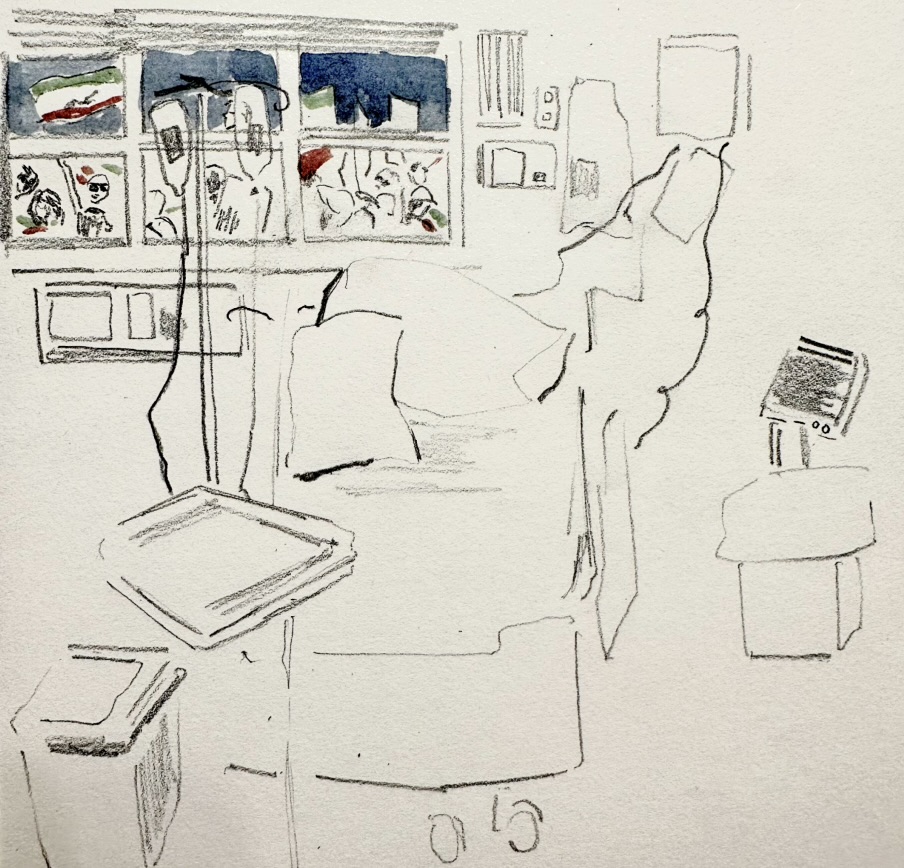
When I woke, there was no war. Still, the recovery room’s darkness dominated. Although the schedule had said the surgery would be “outpatient,” the nurses informed me I would have to stay at the clinic overnight partly because the surgeon was worried that, if the phones were cut off like the nights before, I might be unable to report or manage an emergency, or that he might be unable to reach me partly because the police had again instructed all establishments to close their doors by five in the evening and release nonessential staff. This was in part to fear of repeated attacks on buildings and potential harm to their occupants, and in part out of necessity to clear the streets before dusk. The police had requested that, aside from hospital emergencies, all businesses shorten their working hours. Rumors warned of armed individuals in the cities and amid the protests. The memory of yesterday’s traffic cast a shadow over everything.
I messaged my friend before the phones went down, “I won’t be discharged tonight; I’ll call tomorrow.” Twenty-four hours after Trump’s tweet I kept hearing, “He’ll strike tonight,” the people moving around me whispered in fear and mockery. Moving in and out of half-sleep, the only thing I could discern was that, unlike last Thursday and Friday, there was no sound from outside. The city center was quiet, or perhaps the windows were soundproof, and if something had happened outside, no sound of it penetrated the hospital. It was impossible to say for sure which. What could be said with certainty was that, late in the day, someone had entered the clinic noisily. The nurses said it might have been a seriously ill patient, or perhaps someone from the staff of this building or nearby buildings, forcing them to violate the order to keep the doors closed. Some people now wanted to leave the clinic at all costs, against the doctor’s orders, taking personal responsibility. There was a great deal of noise which ended only when it became clear there was no car for fleeing patients to use to leave the clinic.
The diminishing effect of the drugs mingled with growing anxiety over Trump’s claim. There was no way to contact anyone, to search for news, to read analysis that might calm us, or to see the following Trump tweet, in which he had walked back his words and said he would intervene if Iran carried out mass executions; none of it was accessible. I learned any of this only through whispers in the clinic. There were no televisions in the patients’ rooms, but there were screens elsewhere, in staff areas, where nurses and others gathered. Both Iranian state television and Persian-language channels broadcasting from outside Iran were covering the news, and satellite reception was still working, giving some people access to live reports. Outgoing calls from outside the country were cut off throughout those twenty days. Calls from inside Iran abroad were still possible, though expensive.
When I finally got my phone that night, I was startled by the sheer number of missed calls from unknown numbers. Before the phone went down again, I began calling them back one by one, primarily students, mostly friends of friends, anxious as January 15 approached, the deadline for many Canadian universities’ applications for the following year. They were knocking on every door, trying to find internet access so they could submit their applications.
Reports that had circulated for weeks about journalists’ partial and private access to the internet had led them to believe I had a connection and could do something for them, which I did not, and could not. All I could do was comfort a few whom I personally know, and tell them that after these days passed, we would email the universities, requesting that, given Iran’s exceptional circumstances, they extend the application deadlines for Iranian students.
Even as I assured the students that this was possible, I knew that many of them had already wasted time and money preparing their applications, and were now burdening themselves with needless anxiety. University admissions from Iran had always been difficult, even before domestic upheaval and the disruption of Iran’s relations with the world under Trump’s policies and the recent war. Now, with chaos, tension, and the looming possibility of another conflict, many countries would already consider Iranians as war refugees, and gaining university admission would be so out of reach that perhaps it was better not to think about it at all. I kept these concerns to myself. These students had enough to worry about already.
When I finished assuring them, the thoughts of war hit me again. What if he really struck, and war broke out? Six months had passed since this violent summer. In the previous war, the only thing I could do was make a halfhearted attempt to document events, and that depended on the internet. No media outlets can publish anything without their journalists. If a strike came, even if I were on my feet, there would still be nothing I could accomplish. I kept telling myself and others: at most, it would be “another limited illegal operation.” Thank God we had seen the Venezuela episode before the internet was cut; now we could reassure those worried about an Iraq-like strike that a full-scale war was unlikely. Yet, of course, such reassurances did little to ease the prevailing anxiety.
By fortune, no surgical complications arose. The next day, in the opposite direction of the usual traffic toward the city center, I returned home. They said the night before had been calm and that the chaos of the previous Thursday and Friday had not repeated. I thought the situation had really settled, and the internet would soon reconnect. During the war, complete internet shutdowns lasted only two days; now it was the sixth day of total blackout. Part of me wanted it reconnected quickly, to know what was happening around me; another part wanted the delay to persist, giving me a reason not to work. But for hours sliding into days, as the medication ran its course through my body, the internet did not return.
A week after the blackout, while foreign Persian-language TVs were reporting their dream-like fall of Iran’s government and Trump was about to appear beneath the Arc de Triomphe, inside Iranian broadcasts, everything felt as inert as a holiday evening. The first news program I could watch was CNN’s coverage of the UN Security Council meeting on Iran, in which the Russian representative called it a “circus.” [wait when were you able to watch this? Had the internet come back on? No. I watched it from satellite reception, I had CNN, a bunch of Persian-language channels broadcasting from outside and of course Iran’s state TV but I really didn’t have the stomach to fallow their coverage] That alone was enough to show that, with information flow to and from Iran halted, not only had the fever of the streets subsided, but the fever of rhetoric had cooled as well. Of course, Trump was expected to tweet more, threatening Iran, its government, and its leader again. Anyone who had covered his first presidential term, and I was one of them, knew that these words would continue, and that they did not necessarily signal the start of war, nor its end.
The curve of tension had flattened to a horizontal line, and finally, one could think of other things. About what kind of bleeding from surgery was abnormal, and what to do if a dose of medicine was forgotten. Was a strange physical symptom a hallucination, or was it something to be taken seriously? At any other time, Dr. Google could have helped; recently, even Dr. GPT had been added as an assistant, ready to advise. On the ninth day of the internet blackout, none of this was available.
Life only gives the illusion of resilience in solitude when social networks feel present. Stripped of them, I was conscious of how thin the company of books suddenly felt. I had André Malraux’s “Hope” by my side, but not Malraux’s hope, nor his courage.
Ten days after the internet shutdown, my editor at the newspaper called to ask if I had anything ready to publish. I said it was unlikely I could produce anything, but even if I did, how could I get the file to the paper? It became clear that we would continue working in a manner reminiscent of post-earthquake zones: journalists calling their editors, reading their pieces aloud over the phone so someone on the other end could type them up and prepare them for publication.
Hearing this glimpse of my colleagues’ work made me realize that staying grounded on the eve of potential war had not been such a wise decision. At least the other journalists were out in the city, watching people. I, like so many others, was trapped within the walls of my home with the distorted news seeping in from outside. All I could write about was the plight of those confined: that books were not enough, that television was neither a source of comfort nor information nor even a distraction, and that the incomprehensible sounds from outside, whether from Trump’s social media across two oceans or from the local cats’ meows, were equally anxiety-inducing.
Eleven days after the internet was cut, and eight days after surgery, I returned to the same city-center clinic to have the remaining stitches removed. The city had regained some order, and I was promised that a week of rest would restore me to working condition. I reminded the surgeon of the anesthesiologist’s joke, and we laughed, grateful that one could now move about the city after five o’clock without fear. The surgeon, half in jest, half serious, said, “The timing was bad for you; it’s the peak chaos of your work,” referring to the usual flood of sound from others shouting outside. In this moment, however, the situation allowed me to see the overlooked amid the chaos.
The anxiety of observers, navigating through a cacophony of politically tainted voices while anticipating the worst at every turn, leaves no disaster final enough; it drives them to layer rumor upon news, constantly speculating about what might happen next. I told him, half-joking, half-serious, that I had used the internet blackout and the excuse it provided for not working, to do nothing else; at least now, I could prepare for what lay ahead.
The internet blackout lasted 20 days. In four or five days after those first twenty, traffic and access [traffic and access – do you mean street traffic and access to the internet? Internet traffic I mean, By “network traffic and access,” I mean the reopening of the network to internet users, the gradual restoration of access.] gradually resumed. When images of what had occurred during the first two days of the shutdown were finally released, many observers were in shock. Others fell into denial. And then images of Iranian streets were buried beneath a wave of news about U.S. naval movements and air squadrons in the Middle East.
Over the grave of a slain friend the Iranian writer Houshang Golshiri had once said, “So much mourning has been poured upon us that we have no time to grieve.” When the internet was restored, many wrote that they wished such a day had never come. While still mourning what had happened in the streets of our cities we were restored to a world threatening war, apparently eager for the violence in the streets and from the skies to continue.