
“Our most sincere film can seem phony.” When François Truffaut wrote that in 1975 he could have been describing Hollywood’s long and largely sorry history of prestige pictures that, at least in the minds of the studios that greenlighted them, took a brave stand on important social issues. Occasionally, when the material had scope or the filmmaker was more concerned with urgency and truth-telling than with lofty ideals and we-the-people speechifying, a movie really did seem to capture a new reality and new attitudes that couldn’t be washed away by a studio’s quest for prestige and awards. And audiences responded to those movies with excitement rather than with the dutiful sense of praising something because it was good for them. I’m thinking about pictures like The Best Years of Our Lives, From Here to Eternity, On the Waterfront, The Godfather, All the President’s Men, Spotlight.
But those are exceptions. In American cinema, it’s always been easier to find real meat in B movies and Westerns and noirs and war movies and melodramas than in their high budget counterparts. Those movies, often made on the cheap for a quick profit, couldn’t avail themselves of the production values that, when it came to thorny topics, too often shellacked the life out of their subjects. High Noon, with its too-obvious parallel to McCarthyism, is the sort of Western that got praised as adult and worthwhile. It got the accolades that would never go to Delmer Daves’ 1950 Broken Arrow, in which a Pony Express scout trying to convince the Apaches to let the mail pass through their territory falls in love with a young Apache woman. And yet Broken Arrow, a movie that doesn’t include any brotherhood pontificating, in which Daves concentrates on telling a good, exciting, emotionally involving adventure story, is one of the most effective antiracist movies ever made in America, even interrogating the racism of its own genre.
We are hungry for art that speaks to the danger of this moment, and this hunger is the reason for the wild overpraise given to One Battle After Another, a puffed-up Spy vs. Spy strip. But even if Hollywood as it is currently constituted showed the will to break away from the endless franchise installments of superhero movies and fantasy movies and family animation and address America’s current white nationalist persecution of immigrants, the job has already been done for them, and better. 1955’s Bad Day at Black Rock and 1982’s The Border, both of them tough, uncompromised pictures. One was a hit, the other passed almost unnoticed through theaters at a time — the 1970s — when the audience for gritty adult moviemaking had dissolved.
Bad Day at Black Rock isn’t exactly a B movie. It was made at MGM towards the end of the tenure of Dore Schary, the production head whose taste for movies with substance won out over Louis B. Mayer’s wish to keep making the kind of glossy, colorful family entertainment that was increasingly out of step with the mood of Americans after World War II. At eighty-two minutes Bad Day at Black Rock has the no-nonsense drive of the Southwest Pacific streamliner hurtling through the desert in the credit sequence. The movie is directed by John Sturges, who proved his mettle in both modest pictures (Jeopardy, Escape from Fort Bravo) and big ones (The Magnificent Seven, The Great Escape). Sturges’ best movies are direct, whittled down to get rid of the extraneous, and they’re not just involving but stirring. Bad Day at Black Rock is one of his finest.
The movie takes place at the end of 1945 and the title destination is a dust-pile town in the California desert, a place where the train hasn’t stopped in four years. The lone departing passenger (Spencer Tracy), a one-armed man in a black suit and brown fedora, has barely stepped onto the platform before he’s roused the suspicion of the inhabitants. Especially when he tells the stationmaster he’s looking for a place called Adobe Flat. When the man, whose name is Macreedy, attempts to register at the local hotel, he’s stopped at the entrance by Coley (Ernest Borgnine), one of the two local goons who will be a threat through the rest of the picture (the other is Lee Marvin’s Hector). Coley asks Macreedy if there’s anything he can do for him. When Macreedy asks him if this is his hotel and Coley says no, Macreedy says, “then there’s nothing you can do for me” and brushes past him without another thought. That brief exchange sets the stage for every escalating one that follows. Macreedy won’t be intimidated, won’t acknowledge the weight the local brutes expect their very presence to impress on him, but he won’t fight back, which makes his adversaries, determined to push him to the point when he lashes out, even madder.
The most menacing of these is Smith (Robert Ryan), a local rancher whom Coley and Hector and pretty much the entire town answer to. When Smith, trying to find out what Macreedy is up to, apologizes to Macreedy for the unwelcoming behavior of the locals, there’s an even greater threat implied. This town doesn’t like strangers and, as Macreedy both guesses and has the temerity to say out loud, they’re hiding something. Macreedy, it turns out, is in Black Rock to present the Silver Star to a Japanese farmer named Komoko whose son died saving Macreedy during combat in Italy, the combat that cost him his left arm. When Macreedy manages to get to Adobe Flat and finds a burned-out farmhouse, a covered-up well, and, most ominously, wildflowers growing from a patch in the ground. Smith tells Macreedy that Komoko, like the other Japanese residents of the state, was interned and he doesn’t know anything about what happened to him after that. But he does.
What comes to light bit by bit is that Smith, turned down by the draft board the day after Pearl Harbor, got drunk with his cronies, headed out to Komoko’s farm, and burned it down with Komoko inside. This is the hold Smith has over his flunkies, and they’re so cowed that it never occurs to them that it’s also the hold they have over him. This is the lever Macreedy tries to use in his confrontations with Smith which, until the final one, are conducted as a sort of sparring mutual interrogation.
As defined as their positions are, Macreedy, the stranger who just wants to be left alone to do his errand, and Smith, a homegrown fascist who believes he controls everyone in Black Rock by natural right, are both, in their way, enigmatic figures. Macreedy’s name, John J., is like Smith’s surname, so American-common as to be anonymous. When Smith wires a Los Angeles detective for information on Macreedy, the shamus can’t find any record of his existence. Macreedy tells Smith he’s retired but he doesn’t say from what. And when he tells Smith that he got off the train full of self-pity, ready to do this one errand and slip off to the ends of the earth, or maybe slip off the planet altogether, you don’t believe him. The Macreedy who makes his way through Black Rock, even with one-arm and this group of podunk heavies squeezing him, is too animated by disgust, too annoyed by the alternating evasions and strong-arm tactics the locals resort to. And he’s played by Spencer Tracy, the least self-pitying of actors.
It’s always been a bit too easy for the cool kids to dismiss Tracy as a clod of boring normal stolidity. He could be, but there was also, especially in his best pairings with Katharine Hepburn (the pinnacle being Pat and Mike, which Gavin Lambert called a casual masterpiece) a marvelous lightness of timing and delivery that belied his salt-of-the-earth bulk. In Bad Day at Black Rock, Tracy, older and heavier, transforms his talent for light comedy into mental agility. Tracy trudges through the movie, keeping his pugnacious dignity even as the black suit he wears like a uniform gets dust-strained and creased. Mentally, he’s operating not just steps ahead of these punks but a few yards above them. He smiles at their pathetic attempts to intimidate him as if they were backward, obstreperous children whom his good manners command him to tolerate. Macreedy’s mental speed is on full display in a scene where Smith inadvertently demonstrates the limits of his own. Macreedy observes that Komoko made Smith mad. Smith admits it, sneering at the very idea of “loyal Japanese-Americans.” “They’re all mad dogs,” he tells Macreedy. Look at Corregidor, the Death March. What, says Macreedy, did Komoko have to do with Corregidor? And Smith answers, “He was a Jap, wasn’t he?” And then Smith goes on to decry not just Japs but historians and businessmen, everyone who wants to come poking around in the American West. “They say we’re all poor and backward and I guess we are. We don’t even have enough water. But I wish they’d leave us alone.” And when Macreedy fires back, “Leave you alone to do what?” Smith can’t answer. He has no reason to give, no faculty of reason to use, just his gut hatred and his fear and suspicion of anything outside this graveyard of a town waiting for the corpses of everyone who lives there, including his.
It’s easy enough to make an audience fear the danger that a man with Smith’s ignorance represents. But it takes real talent to give him enough brains to suggest that in such a man there can exist a wiliness that’s an equal danger. And Robert Ryan can do that because he remains the most convincing portrayer of psychopaths the movies have ever seen. Ryan didn’t slobber or giggle or wheedle or resort to all the other cliches actors usually do when playing psychos. Ryan, who was a slim 6’4”, had a build that used to be called rangy, a physical type that, especially in Westerns, we associate with the upright, laconic hero. Most of the time Ryan was laconic. Even when his characters flew into a rage, Ryan didn’t yell. His speech became rapid and viperous but he didn’t lose control of himself. As a racist bank robber in Robert Wise’s pitiless noir Odds Against Tomorrow, there’s a moment where Ryan scoops up a little black girl playing hopscotch with her friends in front of a Manhattan apartment building. Holding her by her shoulders he smiles and says, “now don’t you hurt yourself, you little pickaninny,” and you feel like he just wants to crush the child with his bare hands. The terror that watching Ryan inspires is the deep dissonance between seeing someone who, in build and bearing, seems so much the traditional hero but who slowly reveals something gone irretrievably wrong underneath. In movie after movie — as the Howard Hughes figure in Max Ophuls’ coruscating melodrama Caught, as the scheming killer being tracked by a bounty hunter in Anthony Mann’s The Naked Spur, as the Yankee gangster setting up in post-war Tokyo in Sam Fuller’s House of Bamboo — Ryan manages to make it seem like what’s gone wrong is America itself. Ryan’s Smith talks about the Japanese as mad dogs (which Macreedy ironically turns back on him when he tells Smith the wildflowers he finds at Adobe Flat mean something is buried there, but he figures it can’t be anything human because a human grave would be marked). The screenwriter, Millard Kaufman, cunningly provides Smith with dialogue in which the character reveals his equation of physical difference with disease. “I know those maimed guys,” he says of Macreedy, “their minds get twisted. They put on hairshirts and act like martyrs. All of ‘em are freaks, do-gooders, troublemakers.” And he goes on, “This guy is like a carrier of smallpox. Since he arrived this town has a fever, an infection, and it’s spreading.”
Like every would-be fascist leader America has seen, Smith sends others to do his bidding. Through most of Bad Day at Black Rock, the violence is implied, a possibility pressing down like the pressure in the minutes before a thunderstorm. But the physical confrontation we feel has to come arrives about fifty minutes into the picture, and Sturges does something very complex — he gives us what we think we want and then makes us disgusted for wanting it.
Macreedy discusses his war experience sparingly. He alludes to the carnage he saw in Europe only by comparing the wildflowers he saw over the continent to the ones growing at Adobe Flat. Smith conveys the gravity of a man who has witnessed the unspeakable and never wants to be part of anything like that again. But he exists in the context of a genre movie in which he’s the good guy bullied by the bad guys. We want to see them get it. And we do. When Macreedy goes to the diner for a meal, the usual goons are hanging out inside. Coley, who’s previously tried to run Macreedy off the road on his way back from Adobe Flat, does everything he can to needle him, complaining Macreedy has taken his seat at the counter, dumping ketchup into his bowl of chili. When Macreedy tries to walk out, Coley grabs him by the arm and spins him around. Macreedy’s immediate impulse is to deliver Coley a vicious chop to the neck. And suddenly Coley is no longer a threat, he’s a fat, out-of-condition thug gasping for breath. He can’t believe that an old, one-armed man has bested him, and so, newly enraged, he keeps coming. Macreedy lands a punch that sends him reeling into the street, taking the screen door with him. Finally, Macreedy mashes Coley’s fist in his, flipping him over and leaving him in a heap on the diner floor. This is what we’ve wanted to see for the whole picture. And it leaves us empty, it leaves us feeling the way Macreedy must have felt fighting the war: that he’s engaged in something necessary to maintain civilization, and yet, in service to that end, has participated in civilization’s antithesis. Macreedy does not kill in this movie, but what he has to do seems bad enough.
It’s crucial to the movie that the justice Macreedy secures is done on behalf of a man that many Americans did not want to accept as an American, that many Americans did not even accept as human. Bad Day at Black Rock can’t help but remind us of those Americans who served, as Smith was desperate to, but didn’t think of Jews, or even the Black Americans fighting with them, as human, and who didn’t bother to hide their feelings.
Bad Day at Black Rock is the classic melodrama of a small-town’s shameful secret coming out. But Sturges and his ace cinematographer William C. Mellor have shot the film so that, visually, everything is right out in the open. The movie is in CinemaScope and almost all of it is set during the daytime in the unforgiving desert sun. Which is the point. Though Smith and his flunkies don’t want it out that they committed murder, they do nothing to hide the racism that drove them to it. As Black Rock appears in long shot, the town is a street long, the buildings so flimsy it looks like one good storm could blow them away. But this, and nothing beyond this, is the America Smith is fighting for, nothing that includes anyone else, certainly no one any different from him. He’s fighting for a place where nothing can grow, where the doctor (the inevitable Walter Brennan) is more often called to serve in his role as coroner. This is a town where there’s no school, no children, and thus no future. The irony of Smith desperate to fight in a world war is that for him the world doesn’t exist. Kaufman includes a couple of “it’s time to rouse ourselves” lines from the few decent townspeople battered into silence, Brennan’s doctor and Dean Jagger’s drunken sheriff. And a few lines at the end about how maybe the town can come back. But when Macreedy, after a scant twenty-four hours, steps back on the streamliner, this man who wanted to hide out from the world seems as if he can’t wait to get back to civilization. As if he’s just escaped being another casualty of a town that’s taken the side of the people America was supposed to be fighting against. And you wonder, just how many other Black Rocks there are, and how many in places with the resources to flourish.

Over the credits of Tony Richardson’s 1982 The Border, Freddy Fender sings “Across the Borderline,” a song written for the film by Ry Cooder, John Hiatt, and Jim Dickinson. The lyrics tell an old story:
There’s a land
So I’ve been told
Every street is paved with gold
And it’s just across the borderline …
And when you reach the broken promised land
Every dream slips through your hand
You’ll lose much more than you ever hoped to find
Fender (née Baldemar Huerta) was forty-five and six years past his last Top 40 hit when he sang that song. He had lived a version of it: years of
playing the Tex-Mex circuit and a stretch in prison before a brief taste of mainstream success in the ’70s. But you don’t need to know that because the story of dreams that persist despite being dashed again and again is all there in Fender’s beautiful high vibrato. Only the worst kind of cynic would think that the dream he envisions in this song is a lie. The streets of gold exist for Fender because he’s seen them, walked on them. He knows what it costs to even imagine seeing them again (“You pay the price to come this far/Just to wind up where you are”), and yet he won’t give up that hope.
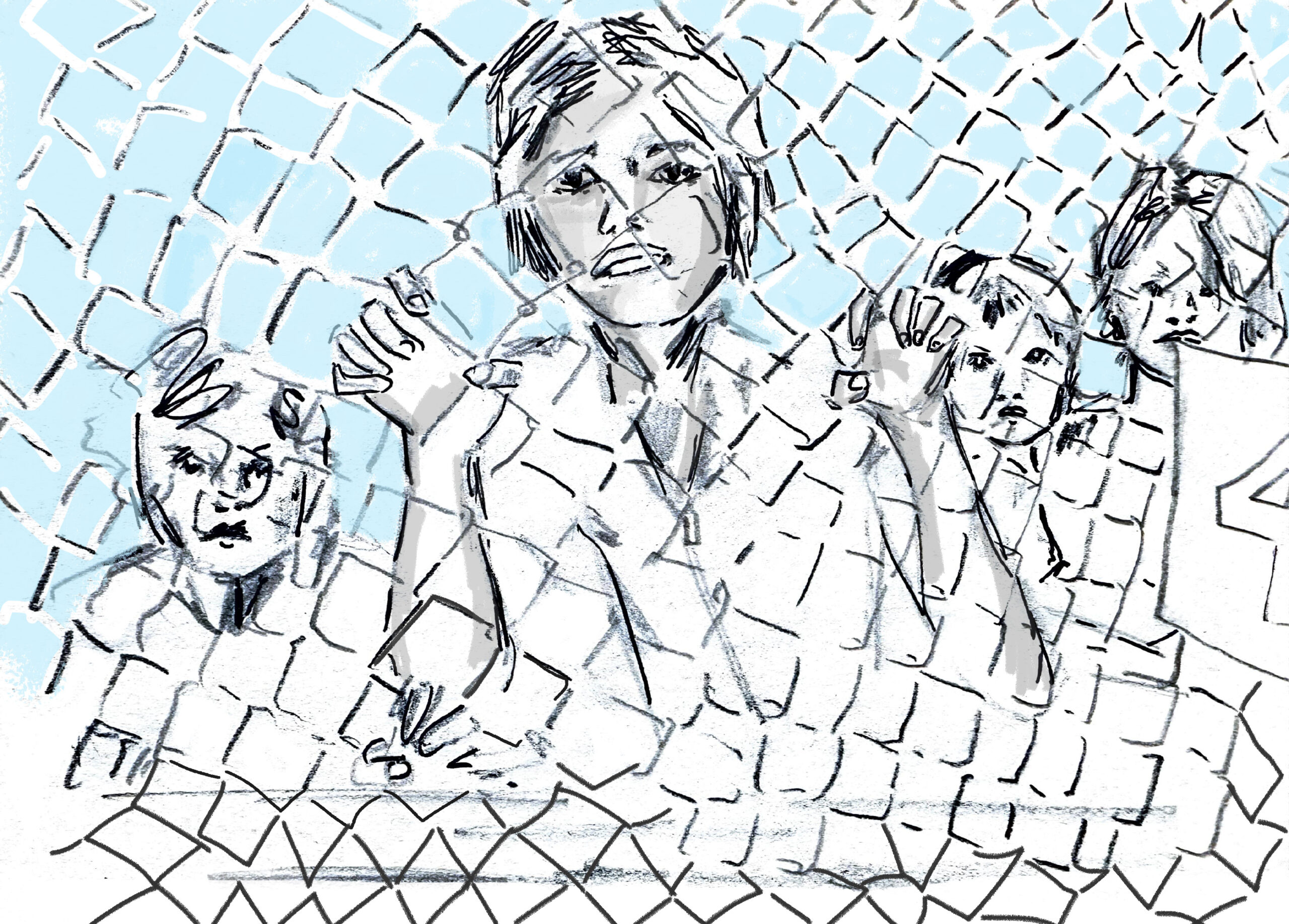
The American Dream is so familiar a notion to us that we’re ready to dismiss it entirely as propaganda. We act as if the phrase means “the American reality.” In The Border, it’s dreamed by immigrants and citizens alike. Maria (Elpidia Carrillo) is a young Mexican woman who tries again and again to cross the Rio Grande into Texas with her infant son and her twelve-year-old brother. Maria and others like her live in a vicious circle, picked up by the border patrol, processed, and sent back across the river to await their next chance. The movie is also the story of another dreamer, Charlie Smith — another generic American name — who’s played by Jack Nicholson in his least-known great performance. Charlie is living his own version of that vicious circle, working as an INS agent in Los Angeles, rounding up factory workers whom he’ll likely see again after their next border crossing. When Charlie makes an arrest at the beginning of the movie, the factory owner tells the two young men being arrested that they’re good workers and there will be jobs waiting for them when they get their status straightened out. But he’s paying them $6 a day and he tells Charlie he couldn’t survive if the unions force him to pay $2.50 an hour. And so, right at the start of The Border the screenwriters, Deric Washburn, Walon Green, and David Freeman lay out the hypocrisy of American immigration policy which targets the workers upon whom American industry relies.
The job is not getting Charlie very far either. He lives with his wife Marcy (Valerie Perrine) in a battered trailer on the outskirts of an industrial park. This or something like this, the movie is saying, is the American reality even for citizens who can’t dream of being middle class, let alone wealthy. So when a girlfriend of Marcy’s in Austin writes and tells her she and Charlie can buy the prefab home right next to her, and that Charlie can get a job on the Border Patrol along with her husband Cat (Harvey Keitel), Marcy and Charlie pack up and head for Texas. What he finds there is an even more virulent hypocrisy.
The misery Charlie sees in Austin is much worse than what he saw in LA. Mexicans desperate to cross the river pay “coyotes,” guides who, for a price, will take them to crossing points where there’s a good chance they’ll be discovered by the Border Patrol. One of Charlie’s coworkers explains to him that the most humane thing he can do is wait until the Mexican crossers get out of the river and onto American soil before arresting them. If you wade into the water, he explains, they’ll just hunker down to hide and catch pneumonia. The corrupt agents won’t even do that. They make money ferrying the undocumented over the border and delivering them into the hands of a hood, Manuel (Mike Gomez), who sells them to farms in need of cheap labor. When Cat offers Charlie a cut of these illegal profits, Charlie refuses. He knows he’s in a dirty, hypocritical job but he still has some sense of honesty. But with Marcy blowing through his salary to furnish her dream home, he can’t refuse Cat’s offer for long. And so he sinks lower into the muck.
Maria comes into Charlie’s life when Manuel arranges for her baby to be kidnapped. There’s good money to be made supplying infants to white couples who want a baby without the expense and hassle of adoption. And when one of Manuel’s competitors shows up with his throat cut, Charlie’s had enough.
Even when he has to resort to violence, Charlie is motivated by simple decency. In Nicholson’s best scene, Charlie seeks out Maria in the border shanty town where she’s living to give her enough money to pay the coyote to get her and her brother across. Maria sends her brother out of the shack and begins unbuttoning her blouse. “No es necesario,” Charlie hastily tells her, and when she asks why, he says, “I wanna feel good about something sometime.” Charlie’s need to act like a human being is as believable as it is devastating.
By the time he made The Border, Nicholson had already begun to fall into self-parody. In this movie when a scene gives him an opportunity for a fireworks display of anger, it’s Charlie we see explode, not Crazy Jack. The tension in this performance is the conflict in a man who’s bone weary, sick of everything around him — the corruption of his job, the treatment of people as commodities, the tackiness of the life Marcy is building for them and her inability to imagine anything else — and the nagging, persistent need to do good. It’s the type of performance especially appealing from an actor who had exploded in movies as a young hotshot. Nicholson plays Charlie as a man who has reached an understanding of how the years and the compromises they entail weigh down on you. Charlie is not just the hero but the movie’s moral center.
Tony Richardson, who made his name with sterling film adaptations of some of the great English kitchen-sink dramas of the ‘50s and ‘60s (Look Back in Anger, A Taste of Honey, The Entertainer) and had his biggest success with a gimmicky adaptation of Tom Jones, is not the director you’d naturally think of for a drama set in Texas about the innate corruption of American immigration policy. But it’s an almost ruthlessly controlled piece of direction. He doesn’t shy away from the violence — he makes it as physically ugly as it is morally ugly, but he doesn’t wipe our nose in it. And he manages to get the shabbiness of the border agents’ home lives, the cheap furniture and tacky barbecues, without being snobbish. Richardson wants to contrast the life the border crossers are desperate to make for themselves, really just a chance to survive, with the spiritually paltry life the people who live on the American side of the border have made for themselves. If you can reduce happiness to commodities, a new couch or a swimming pool, Richardson seems to be saying, it becomes easier to think of human beings as commodities that will allow you to buy more happiness. By contrast, there’s an unsentimental poignance in the battered belongings the border crossers clutch to themselves, the shacks they are doing their best to keep from looking squalid. The Border is a movie made by a director who knows details matter and knows how to convey the meaning of those details without resorting to speechifying.
If anything unites the characters in The Border it’s that each acts as if the American Dream is there for the taking. What they do to realize it becomes the movie’s moral litmus test. For Cat, it’s providing a (materially) better life for his family. He never makes the connection between the son he’s providing for and the children he’s stealing or selling into economic slavery. For Charlie, the Dream is the simple chance to “feel good about something sometime.” The movie’s final shot — Maria and Charlie standing together in the middle of the Rio Grande as he returns her infant, her in Mexico and him in America — has the deep, becalmed beauty of a Pietà. Only the American flag waving in the background, as elusive and high as the catch in Freddy Fender’s voice, tells you that nothing is settled. It may look like a dream, but it’s no mirage.
In both The Border and Bad Day at Black Rock, America exists only as a dream, a place the characters have fought for or dream of getting to but too big an idea to be defined by their pitiful surroundings. And while immigrants in Bad Day at Black Rock are a pestilence that need to be wiped out, in The Border they are reduced to tools to be used for the enrichment of the real Americans. The awfulness of this moment in America is that both of those ideas are alive in our ether, and the aliens are us.