 The preface to the first volume of Capital ends with a motto about intellectual autonomy, or rather, about intellectual autonomy and the attitude toward reception that serves it best. Altering a line from Dante’s Divine Comedy, Karl Marx pledges to live by the words: “Go on your own way, and let the people talk.” He certainly managed to act in accord with the first clause, nowhere more so than in Capital itself. In this genre-transcending work, Marx aspires to the strictest conceptual rigor and documents his claims comprehensively, yet he also cracks wise, operates in a declamatory key, and gives free reign to his imaginative powers, telling readers, for example, what commodities would say if they could speak. As for letting the people talk, that proved to be a greater challenge.
Capital was published in 1867; and the afterword that Marx produced for the second edition of his book in 1872 makes it clear that he studied as many responses to the first edition as he could find, not just the “systematic” ones, and that he was easily annoyed by slights and grateful for validations, even when it came from sources he disliked, such as the Saturday Review. Style, broadly speaking, figures prominently here. Marx brings up his “mode of presentation” more than a few times, famously asserting that it had to differ from the “mode of investigation” and faulting commentators for failing to see how he built off the latter when he developed the former. In a footnote, the last of thousands, some of which fill up multiple pages, he strikes back at “the mealy-mouthed scatterbrains of vulgar German political economy” who “have criticized the way my book is written and also the way its analysis is presented.” “Vulgar” in this context means tendentious and superficial, and Marx avows that he himself judges the “literary defects” of his magnum opus much more harshly than these lightweight naysayers, or in fact than anyone. He doesn’t say, however, which flaws he has in mind. Instead he adduces two favorable accounts of his style. One lauds it for injecting “charm” into “even the driest problems of political economy.” The other appreciates its “unusual liveliness.”
Thus began a discussion that has played a small yet vibrant role in Marx studies ever since, a discussion in which the literary features of Capital have been prized, sometimes explicitly defended, and generally treated as non-incidental, non-ornamental aspects of the text. This line of commentary stretches from statements by Marx and his collaborator Friedrich Engels to Sianne Ngai’s and William Clare Roberts’s recent contributions, running through writings by Wilhelm Liebknecht, Edmund Wilson, Marshall Berman, Ludovica Silva, Robert Paul Wolff, and Jacques Derrida. It has addressed a variety of topics, including some of the mimetic techniques that Marx employs in Capital, such as his parodying of classical political economy and his freewheeling style of literary citation. What has been overlooked, to the best of my knowledge, is perhaps the most innovative of those techniques — Marx’s use of free indirect discourse. For while certain occurrences of free indirect discourse in Capital anticipate later developments in literary modernism, they are not especially conspicuous, in contrast to Marx’s much-quoted vampire and werewolf tropes and his reworkings of Faust (“a sensuous-supersensuous thing,” and so on). Tellingly, the original English translation, done by Samuel Moore and Edward Aveling (who was for fourteen years the companion and collaborator of Marx’s daughter Eleanor) in 1887, more or less dropped these stylistic distinctions, and the same goes for Ben Fowkes’s version in 1976, which generations of Anglophone readers have depended on for access to Marx’s text.
What is Marx achieving when, rather than having a hypothetical capitalist speak directly, he engages in a kind of third-person imitation, reporting thoughts and utterances in a way that allows him to slide in and out of the hypothetical capitalist’s standpoint? How do we make sense of this investment of creative energy? We can of course bring different approaches to these questions. The one I want to pursue belongs to another conversation that has gone on at the margins of Marx studies but attracted participants of decidedly nonmarginal importance, for example, Hannah Arendt, Isaac Deutscher, and Isaiah Berlin. I am referring to the conversation about Marx as a Jewish writer.
Born in 1818 to parents whose fathers were, respectively, a rabbi and a cantor, Marx was converted to Protestantism when he was a small child — this in predominantly Catholic Trier, a city where Jews accounted for less than one percent of the population. His own father Heinrich had taken the step of baptism in order to practice law, and young Karl and the rest of the family followed him in that a few years later. Not much is known about Marx’s experience of Judaism — or anti-Semitism — in restoration Prussia. How much did he interact with his uncle Samuel, Trier’s rabbi? Is there anything to the speculation that his mother Henrietta occasionally spoke Yiddish around her children? Marx’s biographers have had little to say about such matters. But the fact of his Jewish heritage has at times been seized upon by rivals and skeptics (Mikhail Bakunin, Eugen Düring) and put allies (Friedrich Engels, Franz Mehring) on the defensive. Because Marx penned a number of lines that rather furiously disparaged Jews and Judaism, most notably in his essay “On the Jewish Question” in 1844, the obscure situation has also made for accusations of Jewish self-hatred.
On the other hand, the same fact has inspired many critics to frame Marx as being in some profound and productive way a Jewish writer. This framing has tended to rely on the power of suggestion — that is, to occur without much drilling down into the relevant sources. With a minimum of analysis, it is often said that Marx and his works stand in the prophetic tradition. Erich Fromm, for example, called Marx’s version of socialism “essentially prophetic Messianism in the language of the nineteenth century.” Or a critic such as George Bernard Shaw, and there were others, briskly ascribes to Marx “particularly Jewish literary gifts” — the idea being that his irony and his deconstructive brilliance self-evidently issue from his Jewish background. Or his commitment to social progress is sketched as a Jewish response to modernity: Arendt once maintained that, “In the country which made Disraeli its prime minister, the Jew Karl Marx wrote Das Kapital, a book which in its fanatical zeal for justice, carried on a Jewish tradition more efficaciously than the ‘chosen man of the chosen race.’” Or the following paradox is wagered: Marx’s universalist mode of disidentification with regard to his “Jewish stock,” which he almost never mentioned, exists alongside — and can amount to — a form of unconscious identification. This is what Deutscher meant when he described Marx as a “non-Jewish Jew,” and also what George Steiner wanted to convey when he said that Marx was “most profoundly a Jew,” when, driven by his “radical humanism,” he pushed for the “dissolution of Jewish identity.” There is a lot of loose and stereotypical thinking in all these characterizations.
Of the writers listed above, Isaiah Berlin provides the most thorough and most thoughtful reckoning, not only tracing the differences between Marx and Disraeli and their “searches for identity,” but also finding various affinities amid all the contrasts. Yet the characterization given of the group applies to Berlin, too. As he works his way to his main points, he holds largely to general historical framing and psychological observations having to do with Marx’s life circumstances — that he rejected his father’s bourgeois path of assimilation, for example.Toward the end of his account, Berlin writes, “When Marx speaks of the proletariat, in particular when he alters the history of socialism (and mankind) by asserting that there is no common interest between the proletarians and the capitalists, and therefore no possibility of reconciliation . . . it is difficult not to think that the voice is not that of a proud Jewish pariah, not so much of the friend of the proletariat as of a member of a long-humiliated race.” Like Berlin, I want to build a case for overdetermination in Marx’s critical voice. I suggest that sensitivities related to (or around) certain aspects of Jewish assimilation lurk, to use a Marx word, in the creative forms of imitation that he unveils in Capital. But I will try to balance historical framing and textual analysis, locating those sensitivities in Marx’s correspondence and then reading key passages in Capital against that background. The part of Marx’s correspondence I will focus on are his letters about Ferdinand Lassalle, which are especially revealing in this regard.

Seven years Marx’s junior, Ferdinand Johann Gottlieb Lassal was born in 1825 the son of a Jewish silk merchant and grew up in Breslau, which belonged to Prussia at the time and is now part of Poland. Like Marx, he studied philosophy at the University of Berlin, forming a lifelong attachment to Hegel, and, once again like Marx, he was drawn to ancient Greek thought. (At university he changed his name to Lassalle to cover his Jewishness.) Marx wrote a dissertation comparing Democritus and Epicurus; Lassalle’s well-received first book was The Philosophy of Heraclitus. At an even younger age than Marx, whose commitment to communism dates to his mid-twenties, Lassalle began to devote himself to the socialist cause: he was a member of the Communist League when Marx and Engels composed its manifesto in February 1848. As a teenager Lassalle dreamed of becoming the savior of the Jews: “It has always been my favorite idea to stand at the head of the Jews, with arms in my hand, to make them independent.” But as an adult, Lassalle, too, seldom said a kind word about them, once quipping, “I despise above all two kinds of people: Jews and journalists. Unfortunately, I am both.”
Lassalle spent six months in prison for promoting insurrectionary activities during the revolution of 1848. Afterward, he managed to remain in Germany, whereas Marx and Engels had emigrated, and in the early 1850s they saw him as a junior partner there, expecting, or at least hoping, that he would faithfully represent their views — at the time they often used the term “Bursche” (“lad,” more or less) when they referred to him. This was a blueprint for trouble, given that Lassalle aspired to be a major thinker in his own right. And when, in the mid-1850s, his Heraclitus book established his reputation as a writer, and he became wealthy thanks to a favorable ruling in his aristocratic companion’s lawsuit against her ex-husband, tensions began to make themselves felt. Describing Lassalle in 1856 in a letter to Engels, Marx notes with distress that he seems “completely transformed” — and not in a good way. In the late 1850s and early 1860s, serious disagreements arose over political questions, such as what Prussia should do about the growing hostility between Austria and France and whether the Prussian state could be a vehicle for real social progress if universal male suffrage were instituted.
Isaiah Berlin went so far as to treat Lassalle, who revered Bismarck and was prepared to support Prussian militarism in exchange for domestic policy concessions, as a “precursor of the Fascists,” as the Marx biographer Jonathan Sperber has put it. Lassalle was, in truth, more like a forerunner of Walther Rathenau: dandyish, not shy about likening his gifts to those of, say, Socrates, wide-ranging in his literary activities, which included a play that he said a mysterious force had made him write, leading a personal life that invited salacious speculation, Lassalle also worked indefatigably to advance the workers’ cause. He possessed the political charisma and talent for oratory that Marx lacked, and in 1863 he launched the very first mass working-class party, the General German Workers’ Association, which later merged with another party to form the ur-version of the Social Democratic Party. Marx was not the only person who found Lassalle alternately admirable and off-putting: Engels did as well. But of their responses to Lassalle, Marx’s was by far the more vehement and extensive one. And if some of the slur-filled nomenclature they came up with for Lassalle originated with Engels — “Jud Braun” (“Yid Brown”), “Isidor Berlinerblau” (“Isidor Berlin-Bluedye”), “Herr Wieseltier” (“Mr. Wiesel”), “Ephraim Gescheit” (“Clever Ephraim”), and “Ephraim der Tiefe” (“Ephraim the Profound”), it was Marx who actually engaged with the topic of Lassalle as a Jewish writer.
It didn’t help Marx’s relationship with Lassalle that during the peak years of interaction, in the early 1860s, his financial situation was dire. When the American Civil War began, Marx lost his job as a European columnist for The New York Tribune, and there was Lassalle, eating him out of house and home during an extended visit to London in 1862, humblebragging about how much cash he had squandered on fancy cigars and London cabs, and laughing off considerable investment losses in front of his friend who was drowning in debt. Worst of all, when Marx asked to borrow money, Lassalle struck an officious tone: he insisted that the loan be formally guaranteed by Engels. Marx bristled with resentment — his whole family did, in fact. But it isn’t resentment alone that breathes out of Marx’s accounts of Lassalle in his letters to Engels.
The writing also has an obsessive quality. In the Marx-Engels Edition volume of correspondence covering the years 1860 to 1864, Lassalle’s name is the one that comes up the most, more even than that of Marx’s wife Jenny. Marx often says something about Lassalle, changes the subject, and then comes back to him, evoking a recursive effect, or a sense or fixation. Then there is the near constant marking of Lassalle as a Jew, and also the preoccupation with how Lassalle’s work aligns with — and is deformed by — his style of assimilation. These features of the correspondence took shape slowly. They begin with Marx depicting Lassalle as a parvenu “sybarite,” who, with his outsized desire for “fame,” “struts around like a peacock.” Marx therefore had his doubts about Lassalle’s Heraclitus book, which Lassalle evidently sent to him. Although they “have been given this horse,” he tells Engels in December 1857, they should “look deep into its mouth — on the express condition, of course, that this Heraclitus doesn’t smell of garlic.”
A few months later Marx followed up with an appraisal of the book. His suspicions had been confirmed. Returning to the motif of parvenu vanity, he writes to Engels that there is “an enormous exhibition of learning” but “every informed reader will know how cheap it is to bring forth such a collection of quotations” when an author “has time and money and, like Lassalle, can have as much of the Bonn University library as he wants sent directly to his house.” Marx does seem intrigued by what he takes to be Lassalle’s methodological conceit, namely, to pursue philology with the conceptual self-consciousness of a Hegelian, but he thinks that Lassalle exhibits precisely the wrong kind of self-consciousness: “You can see how ridiculous he looks to himself in this garish philological outfit, and how he moves with all the grace of someone wearing fashionable clothes for the first time in his life.” In the end Lassalle delivers a “silly work,” characterized by the “legalistic mode” he knows so well rather than real philosophical thinking. Or as Marx puts it in his letter, “How strange it would be if some German-speaker learned Greek and thereby became a philosopher in Greek without being one in German.”
There was a rift in 1859, but the intimacy between Marx and Lassalle was soon restored and reached its highpoint. Marx stayed with Lassalle in Berlin for a month in the spring of 1861, with the two men spending most of that time in each other’s presence. They worked on getting Marx repatriated as a Prussian citizen under the new amnesty (he had been stateless since 1845), they discussed coediting a newspaper that would be financed by Lassalle’s companion Sophie von Hatzfeldt, and they socialized together, too, going to the ballet and the theater. For Marx, it was an uncomfortable intimacy. The more he got to know Lassalle, the less comfortable it became, and the censorious references to Lassalle’s parvenu characteristics burgeoned in Marx’s letters to Engels. He began to routinely call Lassalle “Itzig,” perhaps after the scurrilous Jewish character Feitel Itzig in Gustav Freytag’s novel Debit and Credit (1855). Sometimes he diversified the mockery with the epithets “Baron Itzig,” (Marx uses the English term “Baron”), “Grosser Itzig” (“Big Itzig”), “Lazarus-Lassalle,” and the adjectival form “Itzigsche” (“Iztigian”). Generally polite when writing directly to Lassalle, and reluctant to damage an important ally by attacking him publicly, Marx now displayed a bottomless appetite for taking him down in this private context.
Marx knew something about the history of German Jews attempting to distinguish themselves from other German Jews with whom they tended to be grouped together. For example, he had read Heinrich Heine’s famous, futile attempt to distance himself from the brilliant and caustic writer Ludwig Börne, whose name at birth, in 1786, was Loeb Baruch — futile, because people kept seeing them as connected by genre (early German feuilletonism), cultural-ethnic-religious identity (Jewish converts to Christianity), political orientation (progressive), wit (biting), and exile (Parisian). With its intrusions into Börne’s personal life (his mistress’s face is compared to an “old piece of matzo”), and its questionable timing (Börne died in 1837, just a few years before it was published), Heine’s book Ludwig Börne: A Memorial elicited much scorn when it appeared in 1840. Engels declared that it was “the most execrable thing ever written in German.” But Marx sent Heine a supportive note, telling him in 1845 that “the treatment this work has received from German-Christian jackasses is unrivaled in its stupidity — no other period of literature has seen anything like it.” The long review he promised to write went the way of the newspaper he and Lassalle were to co-edit: it never materialized. Still, Ludwig Börne seems to have made a lasting impression on him.
In setting himself apart from Börne, who was older by a decade and had once tried to mentor him, Heine — who opportunistically converted to Christianity in 1825 as his “entry ticket to European culture” but never stopped writing about the plight of the Jews and late in his life published a particularly affecting series of poems under the heading “Hebrew Melodies” — puts Jewishness at the center of things. But he did so with a twist. Jewishness is a matter of “temperament” for Heine, and it is coextensive with Christianness. Hence Heine places Jews and Christians together under the category “Nazarene,” to which Börne belonged — not because he was born a Jew, but rather because he was born with an “ascetic” disposition that manifested itself in the “narrowness” of his aesthetic judgments and the dreariness of his populism. Non-Jews can thus be Jews, which is what Heine says about one of his main antisemitic antagonists, the conservative poet Wolfgang Menzel. Employing vocabulary that Richard Wagner would appropriate in his notorious essay on “Jewry in Music” in 1850, Menzel had charged that Heine “aped” the art of others instead of creating truly original works. (When Wagner argued that Heine used special Jewish mimetic capacities to copy his way to a position of prominence in German culture, he wielded the same term, “nachäffen” or “ape.”) Not only that, Menzel made Heine out to be too dandified and depleted — he was rumored to have contracted syphilis in Paris — to create real art: “The physiognomy of Young Germany [a literary movement with which Heine was associated] was that of a dissolute Jew boy, just back from Paris, stinking of musk and garlic and dressed according to the latest trends, but wrung out and enervated because of his lascivious ways.”
So Heine effects a reversal in Ludwig Börne. Menzel is the Jew, and, he, Heine, belongs to the counter-category, that of “Hellene,” which means that his innate temperament makes him well-suited for authentic artistic production and the “cheerful” free creativity that it requires. Heine admits that he is conflicted about his own categories: he finds the Bible deeply engaging, and he sees Shakespeare, the greatest of all artists in his view, as a synthesis of Hellene and Nazarene. Moreover, Heine was a liberal, and cared deeply about political progress; but in the end he did not wish to be merely a political writer. That may have worked for Börne, the “little drummer” and native speaker of Yiddish who had to climb his way to proficiency in German, but it wasn’t right for Heine, the “big drummer,” whose aesthetic equipment is far more powerful. It is striking, then, that Ludwig Börne dedicates so much space to elevating prose forms that in terms of their cultural connotations stood closer to the lowly mimesis of interlopers than to Olympian aesthetic forms. Introducing a technique that Jeffrey Sammons has dubbed “double-voicing,” Heine in quite a few places ventriloquizes Börne: he has Börne say things that he might have said but didn’t, as well as some things he probably would not have said. And he also lets Börne speak directly — that is, he artfully quotes Börne, quotes him at his best, at uncommonly great length, which perplexed readers but also helped bring about the sense that whatever its ethical flaws and formal oddness, Ludwig Börne was in fact an aesthetic triumph. Thomas Mann spoke of it as “containing the most brilliant German prose before Nietzsche.” Heine himself defended the book with the line, “But isn’t it beautifully written?”
By the time Heine produced Ludwig Börne, the dichotomy between Athens and Jerusalem, Hellenism and Hebraism, had been established in German letters by Herder, Winckelmann, and Goethe, but to borrow Berlin’s expression, it is hard not to think of Heine when Marx describes Lassalle as “this most un-Hellenic of the Water Polack-Jews.” Actually, it is impossible not to think of Heine, because Marx mentions him and his baptism two sentences before he gives that portrayal of Lassalle. What thickens the connection is that Marx applies to Lassalle not only Heine’s vocabulary but also tropes that were insistently applied to Heine. We are already familiar with this, or with Marx casting Lassalle as a preening dandy who overreaches intellectually and lacks the psychological grounding needed to pull off a great work. In the letter to Engels in which he uses the term “un-Hellenic,” Marx also underscores Lassalle’s “plasticity,” by which he means not a Hellene’s affinity for images and the plastic arts but rather Lassalle’s problematic tendency to try to be all things as a writer. This assimilationist plasticity amounts to an anti-plasticity.
Again and again, Marx brings together Lassalle’s intellectual shortcomings and his assimilationism. Lassalle is the assimilationist striver par excellence: he wants to be — he has to be — nothing less than a “universal genius,” which, Marx speculates in a letter to Engels, is in part what “impressed” Sophie von Hatzfeldt, drawing her to Lassalle. Yet this very “parvenu” ambition goes along with an “‘objective’ vanity” and “sensitivity” that seem to preclude a successful outcome. Rather than getting a universal genius, “the countess” has through her contact with Lassalle taken on Jewish characteristics. According to Marx, she sometimes talks with his “Jewishy tone.” In another letter, Marx refers to Lassalle as the “Jewish Baron or Baronized Jew,” then speaks of how he aspires to be not only “the greatest scholar, deepest thinker, most brilliant researcher, and so on, but also Don Juan and a revolutionary Cardinal Richelieu.” Yet Lassalle’s conversation undermines him in this aspiration, since so much of it is “sentimentality” and “empty talk” carried on with “a grating voice that hits the wrong notes” and accompanied by “unaesthetic gesticulations” as well. Plus there is his wearying didactic “tone” (that word again).
In a further paradox, Lassalle’s freighted drive for intellectual originality leads to heavy citation, and to citational problems. Writing to Engels in June 1863, Marx skewers Lassalle’s speech on indirect taxes as “pushy” (“zudringlich,” a quality he explicitly associates with Lassalle’s “Judentum”) and “empty” (“schwatzhaft”), proceeding from there to some psychological analysis. The speech is, Marx says, the work of “student” who wants to “yell in the marketplace” that he is a “’solidly learned’ man and independent researcher.” In the end Lassalle winds up showing himself to be only an “arch student,” because he has recourse to quoting other political economists “up and down” and is unaware that Adam Smith “plagiarized” from the Physiocrats everything that he wrote about indirect taxes. For Marx, then, plagiarism is not peculiar to Jews — but it can be done with particular inflections, with Jewish ones. A year later, in June 1864, we find Marx complaining that Lassalle has copied from his work in an “Itzigian way,” dandifying it as he went along.
Also revealing are certain juxtapositions in the letters in which Marx deals with Lassalle’s Jewish assimilationist tendencies. Marx uses the derisive term “Jud” (“Yid’) whenever he refers to the journalist and newspaper owner Bernhard Wolff, a move he employs rather sparingly elsewhere and refrains from in his other discussions of Wolff. It is in this context that Marx gives his infamous account of the writer Ludmilla Assing that presents her “nastily Jewish physiognomy” as a singularly hideous phenomenon — she is, Marx comments, the “ugliest creature” he has “ever seen.” And the case of Lassalle prompted Marx to offer rare speculations on the deep origins of Jewishness and its potential cultural consequences. In one of his reports on his visit to Berlin in 1861, he enlists a scholarly text about the ancient world to shed light on Lassalle. “Apropos of Lassalle-Lazarus,” he writes to Engels,
Lepsius’s major study of Egypt has shown that the exodus of the Jews from Egypt is nothing but the story that Manetho tells of the expulsion of the ‘leper folk,’ who were led by an Egyptian priest named Moses. Lazarus the leper is thus the Ur-type of the Jew and Lazarus-Lassalle, except that with our Lassalle, the leprosy got into his brain. His illness was originally secondary syphilis that wasn’t properly cured.
It is not clear, at least not to me, how exactly Marx means to link Jewish history and Lassalle’s brain. A voracious reader of nineteenth-century scientific theory, Marx goes back and forth between the different senses of the German word “Aussätzige” — “leper” and “outsider.” The Jews were not a leper folk in the first sense, but the biblical Lazarus has the disease, and Lassalle was known to have had syphilis. Nor does Marx’s other statement about ancient Egypt and Lassalle clarify the situation. Writing to Engels about Lassalle’s visit to London in 1862, Marx, having just dwelled on Lassalle’s debilitating “impudence” and combination of insecurity and self-aggrandizement, hazards that his guest descends from the progeny of Jews who procreated with the black people who accompanied them on their way out of Egypt. The “shape of his head” and the texture of his hair indicate this, as does his “pushiness,” which for Marx is characteristic of Jews and black people alike: here we might note that Marx’s own skin was swarthy enough to earn him the lifelong nickname “Moor.”
However he wanted Engels to receive these crude genealogical thoughts (mock science?), they betray an obsession with Lassalle’s mode of Jewishness, which manifestly weighed on Marx. Consider his response to Lassalle’s death at the young age of thirty-nine in August 1864, from injuries suffered in a duel. Whereas Engels took the conventional high road, eulogizing Lassalle as a difficult but remarkable person and ally who would be missed, Marx breathed an unceremonious sigh of relief. How astonishing, he exclaims in his note to Engels, that this “noisy” and “pushing” (he uses the English word and may mean “pushy”) person is “dead as a mouse” (“maustod”) and will now “have to shut his trap altogether” (“altogether das Maul halten muss” — here again Marx mixes English and German). In sum, Lassalle set Marx off, bringing to the surface volatile sensitivities around Jewish assimilation and Jewish mimetic activities, and Marx himself invites us to see his sensitivity to Lassalle and his dubious copying as crossing over from his private correspondence into Capital.
On the very first page of the preface to Capital, Marx flags Lassalle’s copying as a concern, prominently alerting readers to how it has created the appearance of similarity between himself and Lassalle precisely where they are, in Marx’s view, quite different. He says about the “general theoretical propositions” in Lassalle’s “economic writings” that they have been “taken from my work,” taken from it “nearly word for word, down to the terminology I invented, and without attribution.” Of course, there was another way for Marx to deal with his sensitivity to mimetic practices that he associated, whether consciously or not, with a mode of Jewish assimilation that troubled him, appearing to him as something like a distorted image of his own assimilation — Marx’s version of being a hugely ambitious cosmopolitan socialist-journalist-theoretician versus Lassalle’s version, Marx’s marriage to an older aristocratic woman without means versus Lassalle’s relationship with a much older aristocratic woman with lots of means, and so on. Marx could cultivate his own alternative mimetic practices, but they were creative ones. As we know, in Capital he does that, too.
What remains to be seen is how these practices work. Let us turn to Marx’s style, key aspects of which can be profitably read against the background of his correspondence about Lassalle, or as being animated in part by the specific sensitivities around and anxieties about Jewish assimilation that we encounter in that correspondence. What Marx sees there as a failed project of mimesis on the part of an assimilating Jew, one that involves failures of mimetic writing, is in Capital countered by, and even transmogrified into, the literary mimesis of a modernizing writer. This is most excitingly illustrated by Marx’s use of the modern technique known as free indirect imitation. A notable example of the technique occurs in his discussion of the labor process and the valorization process. Here Marx takes up a point that he stresses in the previous chapter, where he reveals the secret of how surplus-value is produced: neither capitalists nor political economists understand how surplus-value comes about — hence “secret.” The previous chapter evokes at length the political economists’ way of misunderstanding its production; the chapter on the labor process and the valorization process represents the capitalists’ wrongheaded perspective, doing so by describing capitalist consciousness in the free indirect mode.
Marx invents a fictional character — a hypothetical capitalist who fails to produce surplus-value, even though he successfully makes yarn for which there is a market. In other words, the capitalist fails to produce surplus-value even though he does all the things required for doing so: puts money into means of production, hires a worker, and produces a commodity that can be sold at its value. This leaves him confused. According to Marx, the capitalist is ignorant of the valorization process, the non-natural capitalist process whereby surplus-value is generated, which is not the same as the labor process, a natural process common to all human societies. Thus the capitalist cannot know that the former process begins only when a worker works longer than his own worker did, and starts to perform unpaid labor, or only after the part of the workday when the worker brings about value equivalent to that of his labor-power. “Our capitalist can’t believe it. The product’s value merely equals the value of the capital he advanced. The value he advanced hasn’t valorized itself. It hasn’t created surplus-value; hence it hasn’t transformed money into capital.” What is he to think?
Our capitalist might have found solace in the idea that virtue is its own reward, but instead he starts to raise his voice. The yarn is of no use to him — he made it in order to sell it. Thus he should sell it, or better yet, he should produce only things that satisfy his own wants and needs, a trusted therapy that [John Ramsay] MacCulloch, his personal doctor, has prescribed to help against the epidemic of overproduction. Our capitalist now becomes defiant and defensive, rearing up on his hindquarters. He asks: Can a worker make commodities out of thin air simply by using his arms and legs? Didn’t he supply his worker with the material the worker needed to embody his labor and in which his labor is thus embodied? Given that penniless persons make up the vast majority of society, hasn’t our capitalist rendered an immeasurable service to society by providing the means of production — namely, the cotton and the spindle? Hasn’t he done the worker a great service, too, by giving him his means of subsistence? And shouldn’t he get something in return for this service?
This is not what narratologists would call classic free indirect discourse, which they tend to define as occurring where a character’s thoughts are related by a narrator in the third person but in the character’s language, or in a mix of the character’s language and the narrator’s, so that it can be hard to tell whose perspective readers are getting. In the passage quoted above, the perspective is sometimes marked more clearly than it is in classic free indirect discourse (“he asks”), and it is sometimes stressed that the capitalist is speaking rather than silently reflecting (“he begins to raise his voice”). Yet the basic features of modernist free indirect discourse are present, more so than otherwise in German letters before 1900. The fragmentary first instance of free indirect discourse in German literature is thought to have come in Georg Büchner’s drama Lenz in 1839, which was followed by some not very successful experiments around 1850 by the critic and novelist Otto Ludwig.
What we find in Capital is stylistically much more developed. There is a sliding from the capitalist’s perspective — “thus he should produce only things that satisfy his own wants and needs” into Marx’s — “a trusted therapy” prescribed by MacCulloch. At the same time, the capitalist’s language — “can a worker make commodities out of thin air simply by using his arms and legs?” — slides into Marx’s — “in which his labor is embodied,” thereby evoking an instability or lack of firm footing that corresponds to the weak intellectual agency that Marx ascribes to capitalists in the capitalist system. Never truly in control of his discourse, since it is narrated monologue rather than direct monologue, the capitalist loses control of it outright. There is also a proto-Kafkaesque combination of mockery and empathy — the émigré scholars Leo Spitzer and Dorrit Cohn suggested that free indirect discourse invites both. The capitalist has an economic “personal doctor” whom Marx liked to ridicule (MacColluch), yet the capitalist’s voice is not always clearly set off from Marx’s. Both the mockery and the empathy make sense. The capitalist offers up the shibboleths of “vulgar political economy” in which he is “well versed,” such as, hasn’t he “done an immeasurable service to society?” But his consternation is understandable: the system in which he operates is fundamentally opaque, which is in fact the theoretical point that Marx is emphasizing here, and also a plight with which Kafka’s characters are very familiar.
In addition, both Marx and Kafka play off the formal air that free indirect discourse can have. Its compositional and cognitive demands are such that it isn’t used in casual conversation in German, and sometimes it works, as it does in Capital, with a subjunctive form that has elevated associations. The formality creates a context in which the madcap moments feel all the whackier for feeling a little out of place: “rearing up on his hindquarters,” and so on.
Elsewhere in Capital, a work notorious for its expanses of dense prose, Marx carries out a spry imitation upward, telling readers how the political economist Nassau Senior “would have to continue” if he were more clearsighted about the production of surplus-value, and doing so to some extent in an enhanced version of Senior’s own style. It is a mode of literary mimesis that simultaneously recalls the “double-voicing” that Heine pioneered in his Börne book and anticipates the humiliating, annihilating techniques for breaking down and showing up employed by a later German-Jewish critic who analyzed the paradoxes of Jewish assimilationism while challenging the Wagnerian ideal of pure originality, namely, Karl Kraus. Walter Benjamin was being only semi-hyperbolic when he remarked about Kraus that after he imitates someone he emerges with “blood dripping from his lips.”
I would argue that the mimetic practices in Capital have still more functions. As with other moments of creative writing in the book, they serve as a vehicle for Marx to model the kind of multi-sided work that the book treats as essential to human flourishing. Marx certainly believed in the power of deep expertise, but he also thought that the narrowing of work, intellectual and otherwise, mutilated people:
Whereas simple cooperation does little to change the way an individual worker works, the manufacturing system revolutionizes his mode of labor from the bottom up, seizing the individual bearer of labor-power by the roots. It stunts the worker, turning him into a freak. For it acts as a hothouse for developing a particular skill by forcing him to suppress a whole world of drives and proclivities, just as in the states of La Plata whole animals are slaughtered merely for their hides or their fat.
So when Marx refuses to abide by the norms of scholarly writing and to suppress his literary inclinations — his first career plan was to become a poet — he is acting on his theoretical commitments. With certain moments of literary experimentation, such as the one that portrays the benighted capitalist’s mindset, Marx may also be trying to set himself apart from another form of intellectual-existential diminishment, albeit less self-consciously. This would be the assimilationism he keeps talking about in his epistolary reflections on Lassalle — keeps talking about in a way that lets us see the most sophisticated literariness in Capital as connected to the Jewish background Marx seldom spoke of directly.
One way to describe Capital is to say that it is a book about doubling, about how under capitalism the things that we make — and the labor with which we make them — become dual entities. Marx argues that capitalist societies are societies dominated by commodity production, and the commodities that they produce are use-values and values, or two opposing and complementary things. As use-values, they are diverse things whose different physical properties satisfy different human wants or needs. But as immaterial, homogenous, fungible “value-things,” they differ only with respect to how much value they represent. Similarly, there is the particular concrete labor that goes into the use-value component of a commodity, and there is the undifferentiated abstract labor that constitutes the substance of value and thus of a commodity’s “value-thing” component. Given how well the central motifs themes here align with some of the main preoccupations of late nineteenth-century anti-semitic discourse — the stripping away of particularity, the idea of a hidden insatiable force controlling basically everything, and so on — one could go much further in trying to link the book to the Jewish part of Marx’s biography. That is, one could argue that Marx was attempting to work though concerns about anti-semitism as he developed his theory of value. But it would be difficult to ground such an argument in sources because we simply do not have directly relevant source material.
What we do have is ample material that invites us to link Marx’s two sets of mimetic activity. On the one side, there is the mimesis of Lassalle’s Jewish assimilationism and the mimetic writing by Lassalle that, in Marx’s view, went with his assimilationism. On the other side, there is the radical mimesis in Capital that reads like a brittle, brilliant, innovative response to Lassalle’s mimeses. Marx wanted to be able to just “let the people talk,” but doing so was evidently out of reach, and the thought that “the people” would associate his work with Lassalle’s elicited in him a particularly strong reaction, which we have reason to be thankful for. He put the energy it generated to good use, investing it in mimetic forms that would continue their ascent in German-Jewish culture for decades to come.


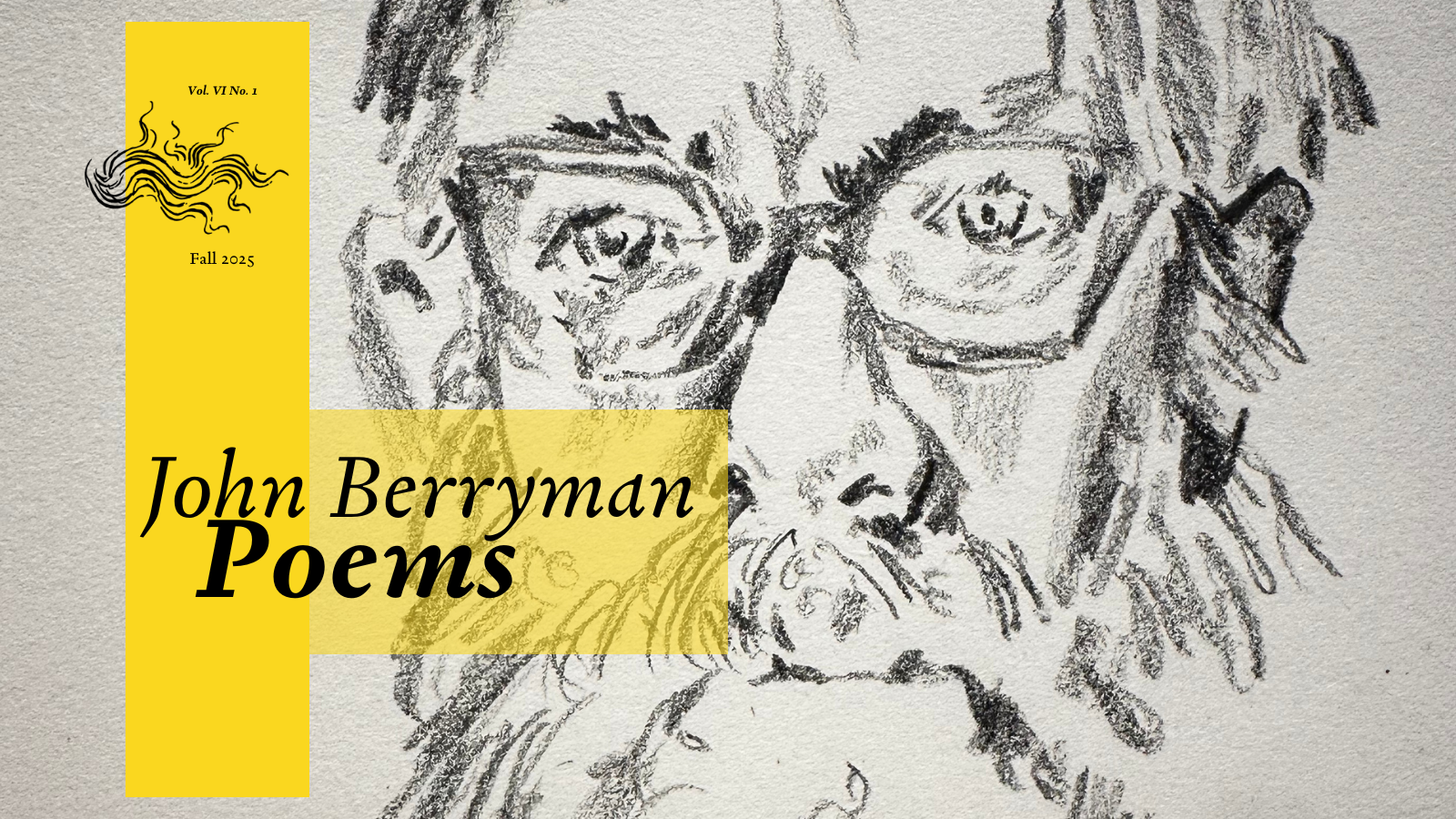 When, later, our adventure has bogged down,
 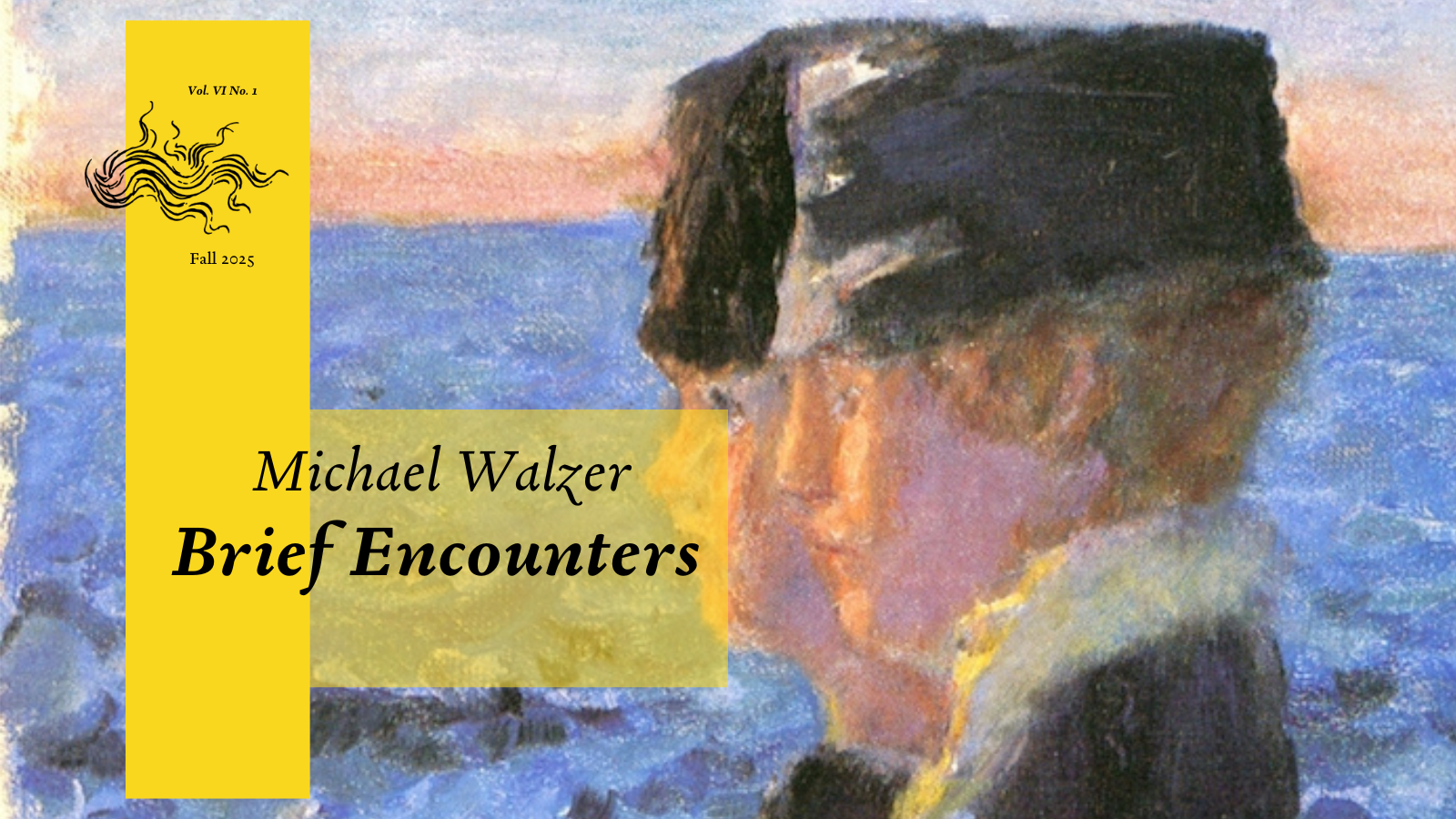 I have not lived among famous people. My comrades were lovely men and women rarely celebrated or even mentioned in the mass or mainstream media. But I did meet briefly with people like those described below. If they were called back from the dead, they probably wouldn’t remember the meeting, but it is still vivid to me. Think of these encounters as a circumstantial but still useful introduction to my politics, a quick glimpse in preparation for the more extended memories that come after.
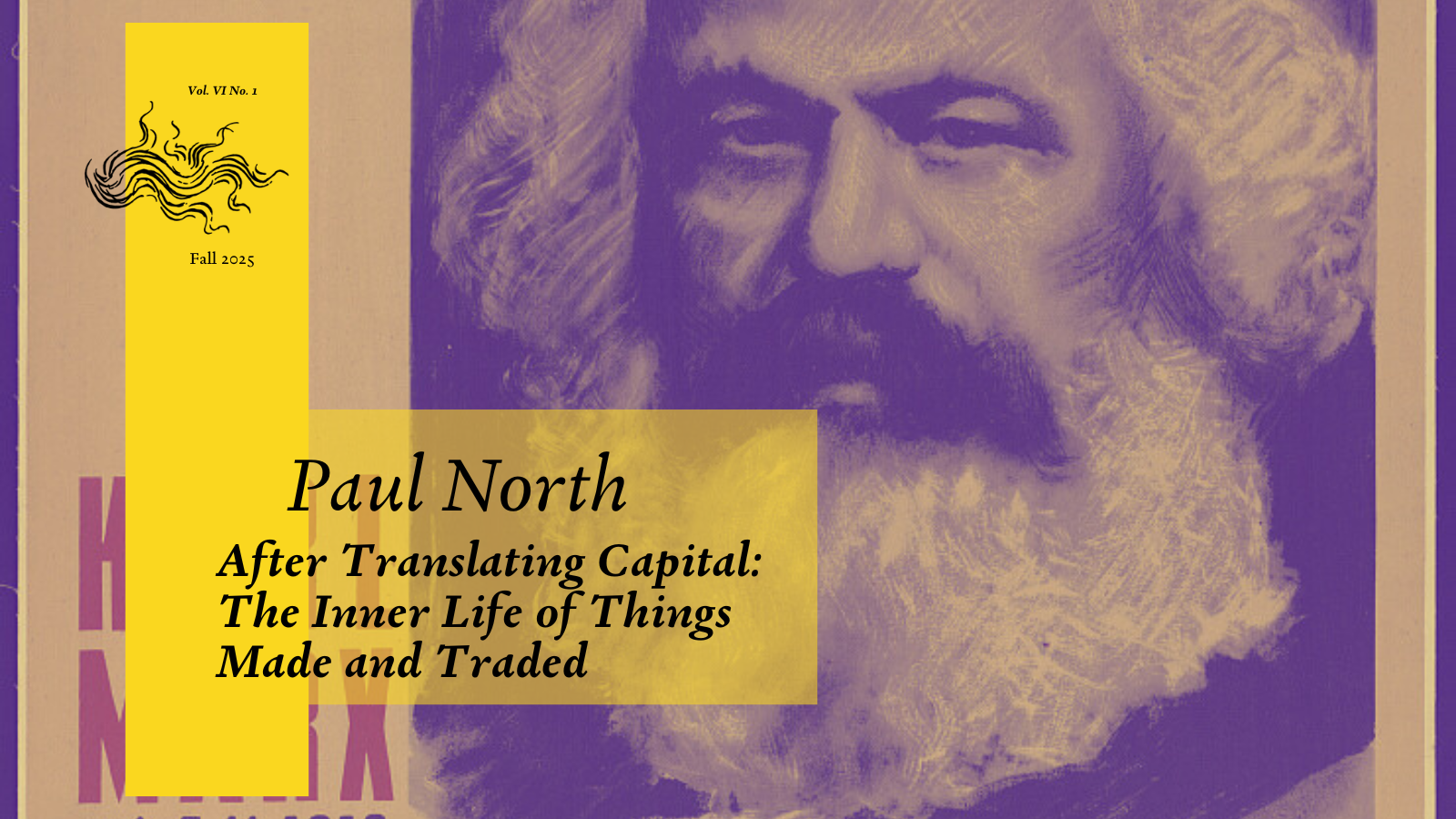 Marx was a great ape: he could do Goethe, he could do the Bible, he could do capitalists as well as workers, he could certainly do Hegel — better, he thought, than the legions of Hegel’s other apes. In a sense, he was, at any one moment, Marx-Goethe or Marx-Hegel or Marx-Ricardo. It is true, too, that Jews in German-speaking lands after emancipation — which started around 1750 — were granted, or were condemned to, this kind of mimicry. They observed German law, dressed in culturally appropriate ways, took on modern surnames, spoke the local language. They could be a good German, though always threatening to degrade into the bad Jew. They asserted rights as assimilated Jews while remembering their past as traditional Jews. Freed through the state, they were then beholden to the state. Marx describes this split in “On the Jewish Question” in stark terms. He dubs it “the decomposition of man into Jew and citizen.”
 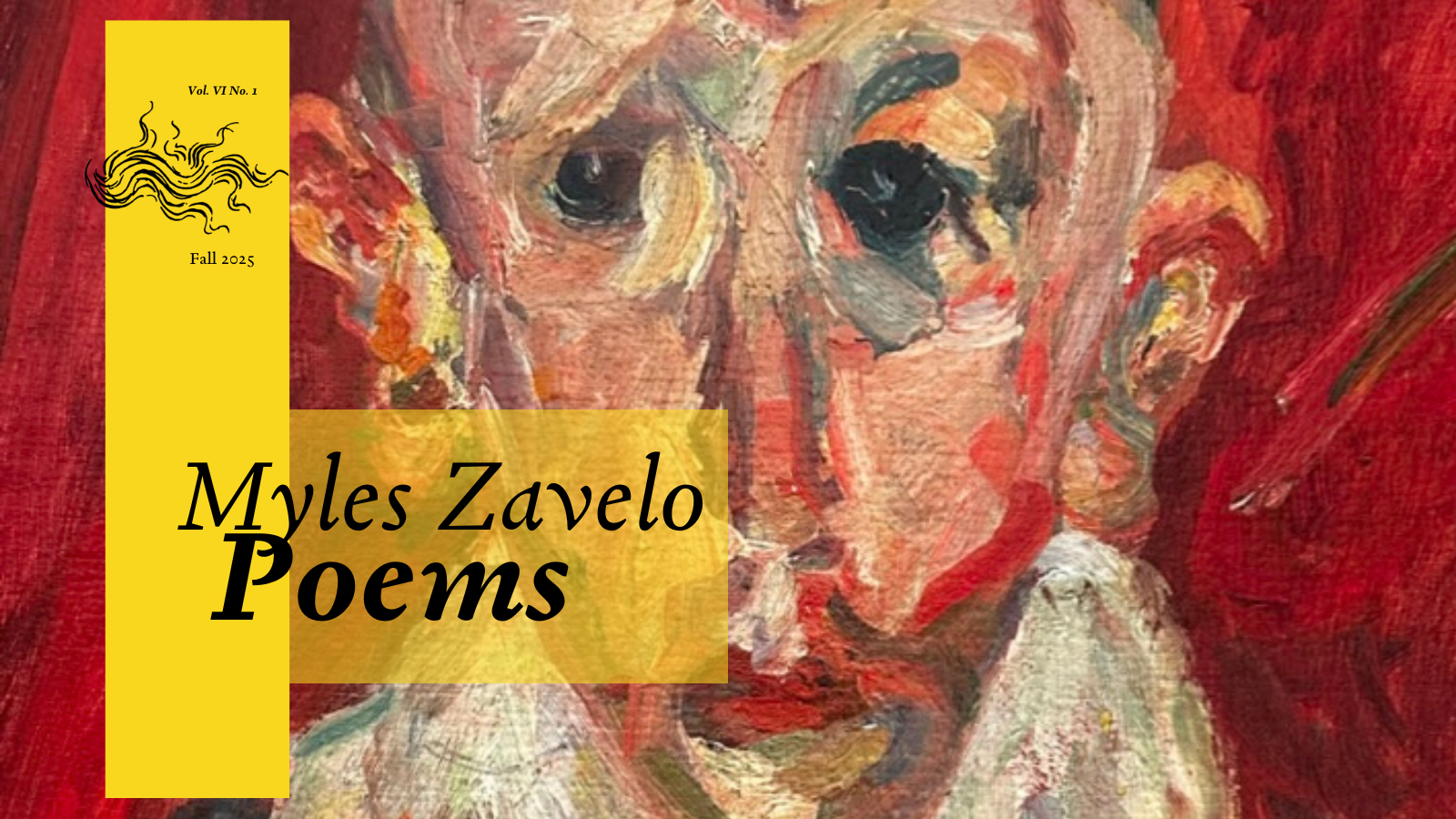 Everybody knows I have them. My problems were bad then. I have value now. I actually love chugging green juice. Dialectical Behavioral Therapy is the name of the holy game. They give me homework over there. They put ice in my hands. They take the sunglasses off my face.
  Charlotte Brontë and George Eliot had a similar quirk to their literary careers: after penning their respective masterpieces —