
The Revolutionary Synagogue: Notes of a Grateful American
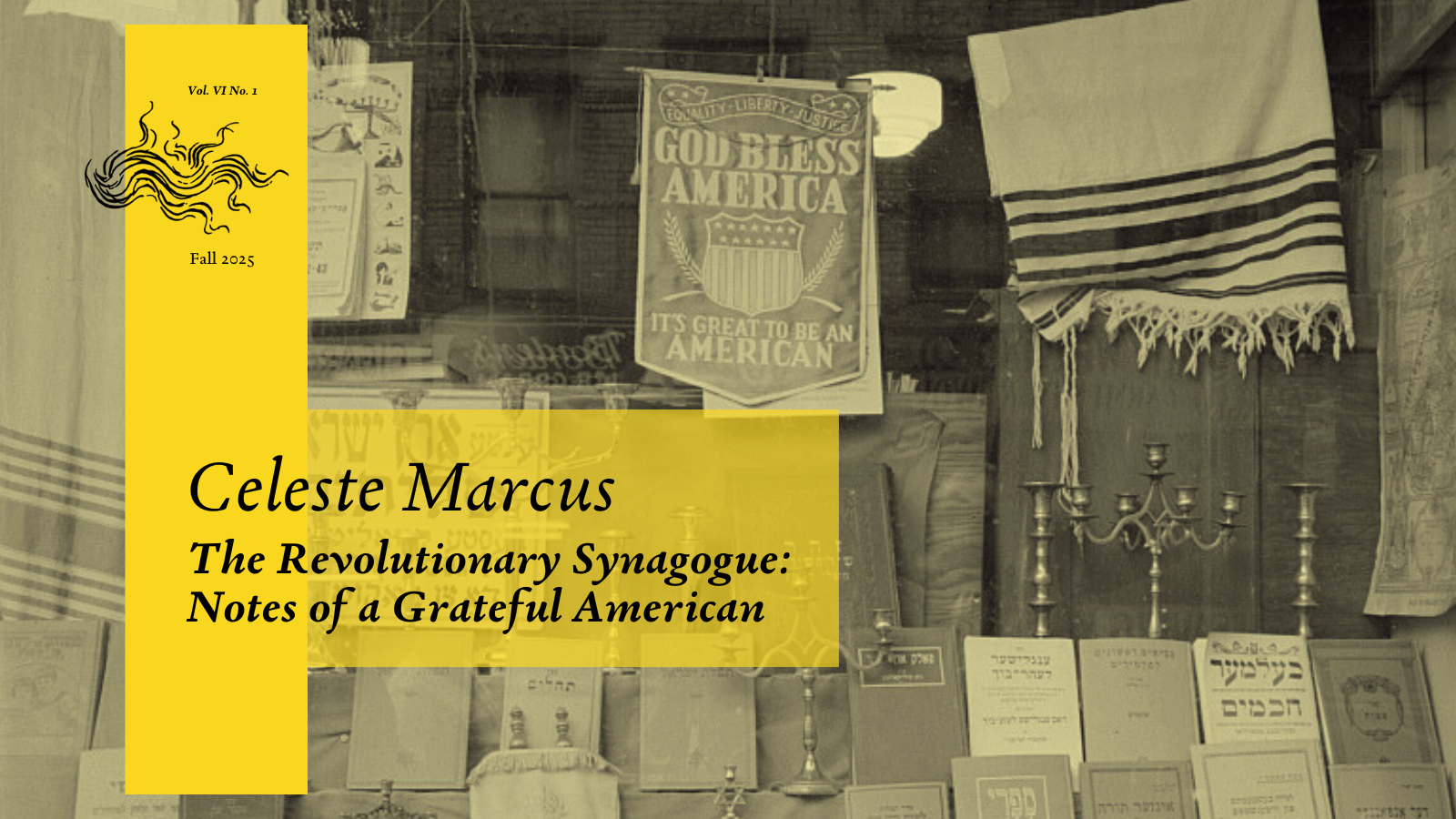 Pedro Alvares Cabral was the first human being in recorded history to have been on four continents. He set foot on each of them — Europe, Africa, America, and Asia — in a single year, 1500, which was the same year that he led the first extensive European exploration of the northeast coast of South America. He “discovered” what we know today as Brazil in April of that year, and wrote home to King Manuel I notifying him of Portugal’s brand new territory, theirs by virtue of the authority vested in him by the King and his interpretation of the divine will. Cabral sailed on from Brazil, but he left behind the seeds of what would become the first robust Jewish community on the American continent. Among Cabral’s crew was a man who went by the name João Faras. Faras was an astronomer, astrologer, physician, translator and — most importantly for our purposes — he was a member of the community of Portuguese Jews who had been forcibly converted to Christianity by the King of Portugal just a few years after the Spanish expulsion.
Cabral’s men had reached what would become Brazil on April 21, but Faras remained on a boat offshore for six days — he had developed an irritation which made it impossible for him to walk. On the twenty-eighth of that month, finally upright and capable of studying the stars to determine location, Faras and two assistants set up a wooden astrolabe on the beach and attempted to establish the altitude of the midday sun. After some days of study, he drafted a letter to King Manuel I, which included a sketch of the stars which make up the southern hemisphere. He explained with apologies to the king that, due to his lame leg, he could not identify the precise height of the stars, but he did identify a new constellation, which we now know as the Southern Cross.
The king to whom that letter was addressed was the very same monarch who, on December 5, 1496, demanded that all his Jewish subjects leave the country. The following year this edict was rescinded and Jews were prohibited from fleeing the country and instead forced to convert to Catholicism. These decrees were issued just four years after the Jews of Spain had been forced from their homeland due to King Ferdinand’s and Queen Isabella’s genuinely world-altering antisemitism — in fact, Manuel issued the decrees in order to satisfy the Spanish monarchs, to whose daughter Manuel was attempting to marry off his son. There were few options for relocation for Spanish Jews in 1492 — England and France had already instituted country-wide bans (in the aftermath of expulsions) against Jews in 1290 and 1306 respectively. Many countries that did not ban Jews wholesale prohibited Jews from owning land and required Christian oaths for vassals under the feudal system. The easiest place for them to go was Portugal, and many of the Jews who were tormented by Manuel’s oppression were originally from the Spanish Jewish community that had just been violently dispersed. Scholars judge from João Faras’ weak Portuguese and preference for Spanish that he was likely among these Jewish Spaniards. In the intervening years, Faras had become a “converso,” or hidden Jew — living publicly as a Christian but privately as a Jew — and so he and his descendants must have remained for as long as the Portuguese maintained control of Brazil.
Jewish responses to the inquisition differed. Some, like Faras, chose to stay in Spain or Portugal, convert to Catholicism, and brave the anti-Semitism which stalked them even after baptism. Rumors swirled that the “new Christians” practiced Judaism in secret, adulterating Catholic purity with atavistic practices. Many chose to leave the Iberian peninsula altogether, and some part of that group travelled north to the newly independent Dutch provinces, which permitted Jewish immigration and Jewish practice. In this period Jewish fate was overwhelmingly determined by the governing power’s caprice, which often swung between prejudice and avarice: prejudice because anti-Semitism is a weed that flourishes under every sun and avarice because the Jews repeatedly proved themselves lucrative residents, and in the host countries, money-lust rivaled xenophobia in ubiquity and its power. There was not a single state which granted Jews rights because it understood that Jews were owed rights. The best Jews could hope for were privileges granted by opportunistic and self-regarding leaders. Privileges could only be acquired and maintained for as long as the governing authority could be persuaded that the deal was a good one. (Authoritarian dealmakers can be like that.)
The Dutch accepted the Jews because the Jews promised wealth and they made good on that promise. The Muslim rulers of Spain had permitted Jews to participate in trade and business, and for the Jews it was a more or less benevolent period, but when the Christians came and the Jews were eventually forced to flee they carried their business acumen on the road with them and, more importantly, they brought connections to the many Jewish businessmen who had been dispersed by the Inquisition and were now scrounging for residence in port cities around the world. The Jews in exile constituted a kind of international business network owing to their relations with each other. By 1600 most of the discriminatory laws that were enforced in other European countries were either not on the books in Amsterdam or ignored there. When, in the early seventeenth century, the Dutch West India Company dispatched ships to conquer territory across the ocean, some of these prospering Jews went with them. They met the community that João Faras’ had helped found when they got to South America.

The descendants of João Faras and his community lived as crypto- Jews for generations. In the years after they first arrived in the new world, the conversos flourished financially, so much so that Adam Smith observed in The Wealth of Nations that
The Portuguese Jews, persecuted by the inquisition, stript of their fortunes, and banished to Brazil, introduced, by their example, some sort of order and industry among the transported felons and strumpets by whom that colony was originally peopled, and taught them the culture of the sugar-cane. Upon all these different occasions, it was not the wisdom and policy, but the disorder and injustice of the European governments, which peopled and cultivated America.
Note that Smith referred to them as “Portuguese Jews” — it seems those Jews who converted learned what so many have had occasion to discover: antisemites don’t want Jews to be Jews, but they don’t want them to be anything else either. Wealth did not gain the Jews toleration, and these Jews knew nothing like the religious freedom that their brothers and sisters enjoyed in Amsterdam — the conversos in Brazil would continue to live in “hiding” for one hundred and thirty years. But apparently hiding was not enough. Between 1593 and 1595 an Inquisitional Commission was established in Olinda, in the port of Recife in Brazil, where conversos were tried and arrested. When the court was dismantled, Jew-monitoring was taken over by the local bishop.
All this changed in 1630, when the Dutch West India Company wrested control of Brazil from the Spanish. They had come to
South America with a specific interest in the cultivation of sugar cane, a trade dominated by the conversos, as Adam Smith noted. The Dutch brought with them members of the powerful Jewish community in Amsterdam, and also the freedom and toleration which was the law of the land back home.
Thus began the first openly practicing Jewish community in the Americas. This is where we started. It was, for a time, the freest Jewish community in the world. Less than ten years after the Dutch arrived, Brazilian Jewry built the first American synagogue, Kahal Kadosh Zur Yisrael, in Recife, which was responsible for maintaining a school and a cemetery for the community. For twenty years it seemed that true freedom was possible as a way of life. But it was too good to last — in 1649 the Portuguese instigated a war to win control of northern Brazil, which they managed to do within six years. After victory they instructed the conquered that the Jews, like the Dutch, had three months to pack their things and go.
Most of the Jews returned to Amsterdam, some went to Curaçao, Surinam, and Barbados, and twenty-three boarded a ship called the Saint Catherine bound for New Amsterdam, a Dutch colony in North America known today as New York City. Their welcome was not warm. Peter Stuyvesant, the director general of New Netherland, began a campaign against the Jews which would last for the rest of his time in office. Stuyvesant met the twenty-three Jews at the dock and tried to prevent their disembarking. He wrote home to his superiors in Amsterdam hectoring that the Jews were “deceitful,” “very repugnant,” and “hateful enemies and blasphemers of the name of Christ,” who ought to be made to depart lest they “infect and trouble this new colony.” He also warned that granting the Jews liberty would force the Dutch Reform community to do the same for “Lutherans and Papists.” (Intolerance is paradoxically inclusive.) Perhaps Stuyvesant had in mind the revolutionary liberal colony recently founded in Rhode Island by the radical Roger Williams, who had written a charter for the city which promised that no one would be “in any wise molested, punished, disquieted, or called in question for a difference in opinion in matters of religion.” This goodwill in Rhode Island did indeed extend to Lutherans and Catholics and it would eventually include Jews. Some of the Jews living under Dutch protection in Barbados, Surinam, and Curaçao got word of the freedoms offered in a faraway place called Providence and ventured there as early as 1658.
The Dutch West India Company (which included Jews among its founders and its directors) was not especially interested in protecting its Jewish subjects, but neither was it swayed by Stuyvesant’s warnings of a pollutant Jewish mass. His superiors had more pressing concerns involving their pocketbooks: a group of Spanish-Portuguese Jewish merchants in Amsterdam had sent the company a letter outlining several reasons why the Jews should be granted entry in New Amsterdam, and prime among them was that “many of the Jewish nation are principal shareholders” of the company itself. The leadership was convinced, and instructed Stuyvesant likewise. Yet the conditions they demanded were a far cry from the freedom these Jews had grown accustomed to in Recife: they were permitted to travel, trade, live, and remain in New Netherland only so long as “the poor among them shall not become a burden to the company or to the community, but be supported by their own nation.” And they were prohibited from practicing their religion in public. These Jews had plenty of experience with precisely this form of religious practice: clandestine and implicitly shameful.
The first documents that spurred on the Enlightenment which rattled Western culture and altered the course of modern history were written in the early seventeenth century, roughly concurrent with settlement in the New World. The proto-liberalism that they espoused was in part the breakthrough accomplishment of the legacy of Amsterdam, particularly the revolutionary thinking of one of Amsterdam’s Jewish sons, Baruch Spinoza. These were the ideas that eventually culminated, almost two centuries later, in this thunderous sentence: “We hold these truths to be self-evident, that all men are created equal, that they are endowed by their Creator with certain unalienable Rights, that among these are Life, Liberty and the pursuit of Happiness.” A rather spectacular historical irony was about to play out: whereas the Enlightenment was kindled an ocean away, it came to fruition nowhere with greater force than the country that would blossom out of Colonial America, the country whose promise was sealed in the Declaration of Independence.
A miracle in Jewish history, in sum, was about to take place. The name of the miracle was the United States of America. The attainment of American independence from Great Britain marked the creation of the only polity in human history that Jews, along with all other human beings on the planet, were considered the just recipients of rights which were owed them purely by virtue of their humanity. These rights were not a charter or a privilege, they were axiomatic.
But there was a problem. By the time of the first Jewish settlement in Colonial America, the ideas that would coagulate into the rich soil from which the possibility of political liberalism would eventually spring were only just beginning to form and were certainly in their infancy in the New World. Anti-Semitism was an early import with which Jeffersonian ideals would have to contend. Peter Stuyvestant was early in his legislation of antisemitic laws — Jews in New Amsterdam were prohibited from purchasing land, serving in the guard (they were forced to pay a tax in lieu of guard duty), voting, holding public office, engaging in retail operations, and trading with the Native Americans — but New Amsterdam was hardly an outlier in terms of codifying antisemitism in the New World. The Catholic community of Maryland instituted a ban on Jewish settlement years before any Jews ever moved there. After Roger Williams’ death, Rhode Island became an inhospitable home to its Jewish residents and the Jewish community that had flourished there shriveled. Even in Pennsylvania, which had been founded by the Quaker William Penn as a “holy experiment” of religious tolerance, Jews had no citizenship rights before the revolution — Penn’s founding charter required all voters and public office holders to profess faith in Jesus Christ. And to some of the Enlightenment thinkers who laid the groundwork for the earth-shaking intellectual revolution consecrated in the American Declaration of Independence, Jews were not obviously worthy of any rights or privileges at all. Thomas Paine — the Voltaire of America in this respect, too — violently opposed both Christianity and Judaism, but believed that Christianity could be unlearned whereas Judaism was biological, and that Jews had to be cured of their Judaism or they would endanger enlightened society.
In this social pre-Enlightenment and pre-American context, the few Jews of North America who arrived before America’s founding followed the pattern of settlement that Jews had repeated in most of their new host countries — they settled primarily in major port cities and worked within the established international, and then national, network of Jewish merchants. Newport, Philadelphia, Charleston, and Savannah became centers of Jewish life, and insofar as Jews enjoyed the hospitality of their Christian hosts; “tolerated guest” was the highest status to which Jews could aspire. And here again they relied on their financial success for their security.
The New World did not extend rights to its Jews until long after Jewish settlement first began. This, despite the fact that the idea of “rights” as such, the idea that a person could be owed anything, as a matter of right, by the state and its governing officials, was percolating in the American intellectual welter. The stirrings of egalitarian idealism were beginning to be felt. Those ideas did not come to the fore until the American Revolution. And the American Revolution was also a revolution in Jewish history.
By the time the Revolutionary War began, one hundred years after a Jewish community settled in New Amsterdam, the Jewish population in North America had swelled to about a quarter of a million people. That Jewish community, which lived through the years of war, was the first Jewry to see a country founded with the promise of a place in it for all people, and so for them, too. (I hasten to add that the new republic was, as a matter of principle and practice, kinder to them than to its black population.) Descendants of that early New Amsterdam community, Shearith Israel, were still living in New York when British fleets approached New York Bay in 1776. Half of them, led by the cantor Gershom Mendes Seixas, fled first to Connecticut and then to Philadelphia three years after the British vacated that city in 1777. Seixas managed to snatch one of the congregation’s two Torah scrolls, lovingly referred to as “the revolutionary Torah,” and took it with him to his father-in-law’s home in Stratford, Connecticut. A few years later he and his flock moved to Philadelphia at the invitation of a congregation called Mikveh Israel, which would become America’s first permanent Jewish congregation.
When the patriot Jewish refugees of New York, led by Seixas, arrived in Philadelphia, the Jewish population of the city had about tripled in size. Israelite patriots from Richmond, Charleston, Savannah, Lancaster, and Easton had already come to the city fleeing the British. These Jews had come, while other residents stayed behind, because they believed in the Revolutionary project, in the philosophical premise of freedom and democratization. As two Philadelphian Jews put it in 1782, American Jews had “fled here from different parts for refuge” and arrived there to reconstitute the fledgling Mikveh Israel congregation on March 24 of that year as a “revolutionary synagogue,” which is how that congregation is described by the contemporary congregation of Mikveh Israel. The move to the City of Brotherly Love was symptomatic of deeply held commitments to the possibility of a country founded on the ideals of the Enlightenment, a possibility that was at that point in the war far from certain to come to fruition.
Jewish American patriots understood from the first that the Enlightenment had implications for how modern Jews ought to relate to their own religion. The first recorded meeting of Mikveh Israel mimicked Jefferson in declaring independence for American Jewry. These Jews claimed that the Philadelphian Jewish community that they were replacing had enjoyed “no right or legal power,” since it was founded only according to the custom of ordinary and familiar congregations and not as a conscious group of free rights-bearing individuals. But now, the document declared, the group must “bind ourselves one to the other that we will assist to form a constitution and rules for the good government of the congregation” in order to “promote our holy religion and establish a proper congregation in this city.” This declaration formally united two traditions for the first time: Judaism and liberalism. The alchemy of that precious admixture altered the course of human history. (It became the civil religion of American Jewry for a long time, and like all civil religions it came to be taken for granted and in need of refreshment. In our time it may be gravely in crisis.)
The affecting thing about the Jewish kindling to the new American dispensation is that Jews were championing their claim to rights about which they did not yet feel completely secure. In the matter of democracy they were rather like Nahshon, the Israelite at the Red Sea whose faith was so great that he dove into its waters before Moses parted them. Before the war was over, the freedom that Jefferson described was very young and (as we would say) aspirational. The Jewish patriots were taking a great risk in throwing their lot in with the revolution: it was not at all clear in 1782 that freedom from Britain would come, or that if it did it would bring with it rights for all citizens regardless of religion. In fact, the same year that the Jews of Mikveh Israel drew up their constitution, they also bought a plot of land to build their first synagogue on a street called Sterling Alley, which happened also to house a church belonging to a German Reform Congregation. The church complained: they did not want their community polluted by Jewish proximity. The Jews had a choice: they could adjudicate the case in court, or they could placate the bigots by buying a new plot of land a safe distance away with money they hardly had to spare. They chose not to bet on the American courts and found another location. In April 1782 it was not at all clear that a Philadelphian court would honor a Jewish community’s right to erect a synagogue wherever it pleased.
The principles were sterling, but it was a struggle. Religious rights were not quite an existential certainty for American Jews, but they were prepared to fight for the American promise. The next year the patriot Jewish congregation in Philadelphia, with Seixas at its helm, petitioned the state of Pennsylvania to formally alter the religious oath required by all elected officials so that Jews would not be prohibited from running for public office; the Pennsylvania Council of Censors considered and then tabled the request, but news about the petition was printed in three newspapers at the time favorably reporting the Jewish cause — it was a salient social issue, and the Jews were on the liberalizing side of it. When the war ended, many states heeded Seixas’ plea and rescinded their test oaths of their own accord. As the Jews who had been holed up in Pennsylvania returned home after the war, the states that accepted them back all dropped their test oaths: Georgia, South Carolina, Pennsylvania, Delaware, and New York lost their test oaths by 1792. Virginia, which had not been a Jewish center before the war, got its first synagogue shortly after victory was declared; its test oath had been abolished in 1786 in the extraordinary Virginia Stature of Religious Freedom, drafted by Thomas Jefferson and husbanded into law by the like-minded James Madison. All this was not, to put it mildly, the familiar Jewish experience of the exile.
In the last decade and a half of the eighteenth century, the laws of state constitutions, and the freedoms owed to all citizens of the newly won country, were in far greater flux than we may realize. True, the Constitution of the United States, and the amendments to it, forbade the federal government to make laws establishing religion or limiting the freedom of religious expression, and it prohibited religious tests for federal offices — but much discretion was still left up to the states. Some states enforce blue laws — laws which prohibit work on Sundays, the Christian Sabbath — to this day, and blue laws were used in the early decades of the country to coerce working class Jews to abandon Jewish practice. Blasphemy laws, always the spear point of illiberalism, were in place in many states into the nineteenth century as well. The federal Constitution of 1787 allowed all states to decide for themselves who could and could not vote — the ideas which would make up the country’s legal skeleton had not yet calcified into shape. In New Jersey, for example, the state legislature amended the state constitution in 1790 to formalize a right that had already been in practical operation. It added the phrase: “he or she” in a clause regarding enfranchisement: “. . . no person shall be entitled to vote in any other township or precinct, than that in which he or she doth actually reside at the time of the election.” It thus made explicit a property-owning woman’s right to vote, which that state had considered implicitly secured through an ambiguity in its original constitution. And seven years later, the state removed a different phrase regarding property ownership after which the number of women voters increased dramatically, as did the number of voters amongst free people of color. And so it remained in the state until 1807.
The Jews were among the scrappy minorities eager to secure for themselves the rights which were not yet clearly stipulated and honored by all. The Jews of New York immediately took advantage of that state’s decision, in 1784, to automatically recognize all religious societies that applied for incorporation. The New York congregation Shearith Israel was incorporated that very year, thus securing the same legal benefits and status as churches in the state. The same legal benefits: almost a secular salvation.
The quarter of a million Jews who benefited from the birth of political liberalism in those early years was a fraction of world Jewry. At that time the largest plurality of the Jewish population — roughly one million people — was concentrated in Eastern Europe and Russia. After the partition of Poland in the final decade of the eighteenth century, at about the time that America’s Jews were reaping the first fruits of American liberalism, Jews in Russia were restricted to a large region known as the Pale of Settlement, established in 1791, essentially an enormous ghettoized community in which Jewish life was governed by strict Russian laws. This geographical sequestration remained in force for over a hundred years (it was dissolved shortly after the abdication of Nicholas II during the Russian Revolution). In Russia there had been no Enlightenment, even if Voltaire and the “enlightened despot” Catherine the Great voluminously corresponded.
But in the late eighteenth century and early nineteenth century, the new liberal dispensation began to make itself known to Europe’s Jews. The phenomenon known as “emancipation” was born, with all its mighty imperfections, first in Austria with a proclamation by the emperor in 1782. In France, the French Revolution and then the rule of Napoleon allowed Jews to become full citizens of the state and annulled the laws requiring that the Jews live in a ghetto and enacted other liberalizing measures, which were extended to the countries that Napoleon conquered. (There were also outbursts of anti-Semitism among the revolutionaries, and Napoleon also enacted some reactionary measures against the Jews. Progress is never unalloyed, especially for Jews.) As is well known, the phenomenon known as “emancipation” also led to the phenomenon known as “assimilation,” with its many psychological agonies and social anxieties. Liberalization came to be rightly seen as a threat to tradition; the founder of Habad Hasidism, in Russia in 1812, wrote that “should Napoleon be victorious, wealth among the Jews will be abundant and the glory of the children of Israel will be exalted, but the hearts of Israel will be separated and distanced from their father in heaven. But if our master [Czar] Alexander will triumph, though poverty will be abundant and the glory of Israel will be humbled, the heart of Israel will be bound and joined with its father in heaven.” This same plot — the joy of liberalization and the fear of liberalization — would later play out in the years of the great immigration to America, when millions of Jews who never experienced it before came to the shores of a liberal order.
And there were other liberalizing developments for the Jews — for example, the creation and distribution across borders of a Jewish press. This innovation in Jewish life created the possibility for there to exist such a thing as a global Jewish community. Jewish newspapers detailing the goings-on of local Jewish life was soon enhanced by a more ambitious Jewish journalism designed to disseminate news of Jewish communities in far-flung parts of the world. The first known Jewish newspaper produced by and for Jewish readers was the Gazeta de Amsterdam, which was printed in Spanish for the converso Dutch community in the Dutch capital. Between 1835 and 1840 eighteen Jewish newspapers were founded in five different countries. Over the following five years, their number increased by fifty-three in thirteen different countries. The circulation of news and opinions strengthened the new liberal muscles.
Scholars argue that a single event catalyzed this steep rise: the Damascus Affair. In 1840, thirteen members of the Jewish Syrian community in Damascus were accused of kidnapping and murdering a Catholic priest and his servant and draining their blood to bake matza — the blood libel that had haunted Jews throughout the medieval period, but the global Jewish community was shocked to discover that the old antisemitic trope still had currency in the modern period, and that in a city as cosmopolitan and significant as Damascus, political and religious leaders could permit — indeed, sanction — such a thing. The French Consul in Damascus, Ulysse de Ratti-Menton, supported the libel, and ordered an investigation in the Jewish quarter. Ratti-Menton swayed the governor of the city, who also happened to be the son-in-law of Muhammad Ali, the viceroy of Ottoman Egypt who governed Ottoman Syria at that time.
The accused were imprisoned and violently tortured until they confessed to the crime. Some were forced to convert to Islam on penalty of death. Others were sentenced to death. Some number of the seven prisoners who were forced to confess died during the interrogations. At the same time state authorities kidnapped sixty-three Jewish children and held them hostage until the entire Jewish community collectively confessed and also brought proof of the murder forward. Bones were unearthed somewhere in the Jewish quarter on the basis of which Ratti-Menton and Sharif Pasha declared that this was “proof” of the ritual slaughter, and more Jews were arrested on charges of abetting the murderers. Christians and Muslims in the city united to unleash violence on their Jewish neighbors. A synagogue in a suburb of the city was pillaged and desecrated.
One of the arrested was a man named Yitzchak Picciotto. His brother, Eliyahu, happened to be the Austrian consul in Aleppo. It was thanks to him that world Jewry was made aware of the catastrophe. Dissolve to American Jewry. Then numbering about fifteen thousand, the Jews of the United States protested the murders in six different cities. For the first time in American Jewish history, Jews demonstrated on behalf of their own interests and exercised influence in foreign policy — they pressured President Van Buren to protest, and the United States consul in Egypt did so at the President’s bidding. As Hasia Diner, the historian of American Judaism, put it,
For the Jews, the Damascus affair launched modern Jewish politics on an international scale, and for American Jews it represented their first effort at creating a distinctive political agenda. Just as the United States had used this affair to proclaim its presence on the global scale, so too did American Jews, in their newspapers and at mass meetings, announce to their coreligionists in France and England that they too ought to be thought of as players in global Jewish diplomacy.
At the same time, the most powerful Jews in the world — among them Moses Montefiore in England, the Rothschild family, and the lawyer Isaac-Jacob Adolph Cremieux who went on to serve as the Minister of Justice in France — questioned the integrity of the investigation. The pressure worked, and the Syrian authorities were forced to lift the death sentence for those who had not succumbed to torture.
The Jewish press came into being in part because the Damascus Affair made clear how uneven the quality of life for Jews was depending on where and under whose authority they lived. Suddenly it was possible for Jews in Cincinnati to know that a Jewish child had been secretly baptized, kidnapped, and forced to be raised as a Catholic in Rome — as happened in 1858 in the infamous Mortara Affair. And when pogroms started rolling through the Pale of Settlement at the end of the nineteenth century, Jews were aware that in a place across the ocean called America it was possible to assert one’s right to live wherever one pleased, to vote, to buy land, and to bring a violent antisemite to court with the confidence that the court was tasked to rule in a wronged Jew’s favor. And so it made sense that between 1880 and the start of World War I approximately two million Eastern European Jews came to America. By 1914, when Congress squeezed Lady Liberty’s arms shut after the start of World War I, the American Jewish population had swelled to 2,349,754 — more than all of the Jewish population in Austria-Hungary — according to the American Jewish Yearbook.
The Declaration of Independence changed Jewish history and it changed Jewish identity. Suddenly Jews possessed a sense of possibility that was not delusional and not limited to messianic redemption. Democracy promised nothing less than to sever the old equation between exile and suffering; and whereas antisemitism has never been expunged from American life, and has recently become more prominent in American life, it generally did not express itself violently. (That is why the Tree of Life massacre and the subsequent violent assaults on Jews in America were so terrifying.)
America is not the only modern revolution in Jewish history, not the only experiment in rejecting the unjust terms of Jewish existence in the violent diaspora. The same dissatisfaction with the oppressive reality that led to the emigration of millions of Jews, that awakened a new sense of historical agency in the exiled Jews, issued also in the other great experiment: the restoration of Jewish sovereignty in the land of Israel, the creation of a Jewish state. You might say that America and Israel, democracy and self-determination, are the two competitors for the Jewish future. Yet it is important to be clear that there are many differences between these two dispensations, and the ways in which these respective states are different are intensely significant for their respective citizenries. The United States is blind to chosenness, or Chosenness. No people who live inside it are esteemed or despised as essentially other in the eyes of the state. Neutrality about difference, and a skepticism about historically and biologically inherited privilege, is a corollary of the American system. America was a nation founded on the principle that all people are equal: there are no exceptions in this all-encompassing proposition.
But Israel — and in this sense Jews are no different from every other ethnically defined nation — was conceived as a Jewish state, whatever the definitions and the difficulties of such a conception. As in all other nation-states, such a definition is a secularized version of Chosenness. When the Jews lost their state the first and then the second time, they were forced to reckon with the plight of every minority in an alien state, in an exile, up until the founding of America: the people who belong, the majority, are held to be historically and sometimes even ontologically better than the people who do not. The state of Israel sought to modify the ugliness of this deep distinction by introducing democracy into the bargain, and making an explicit promise of complete equality to all; but still it lives within the old European framework of a majority and a minority, which, when the minority reaches a size that frightens the majority, has always led to violence. Even as Israel promised equality, it promised favoritism. Is a liberal ethnically-based state a contradiction in terms? Whatever the situation in theory, in practice the government that presides in Jerusalem today certainly thinks so. Netanyahu and his fevered cronies have drowned the possibility of real democracy in blood. Israel promised equal rights to all citizens. In this, it has failed.
So here I am, even in these days, to praise America, and what it has done for the Jews, and why. And to implore my fellow Jewish Americans to remember what we owe American liberalism, what it cost us in life and in pain to get here, and what it will cost us if the dream of American liberalism is allowed to wither. Before the United States, no country had ever accepted liberalism as the groundwork upon which to build a polis and to justify itself. And certainly no liberal society ever made the next essential breakthrough that America did, which was to add pluralism — the recognition of the blessings of difference and of the axiomatic rights of groups as well as individuals — to its public philosophy as a corollary of liberalism.
The magnitude of the struggle that we face in America now is owed precisely to the high moral bar that a liberal order sets for itself. The practice of political liberalism is always incomplete, always asymptotic, because there will always be citizens and non-citizens. The promise of universal equality will always be denied full fruition, and so, in some sense, liberal states are hypocritical by definition. (The moral revolution that is America long ago committed a genocide on its own ground.) Yet there are worse things than stubbornly aspiring to justice, especially when one prefers it to come from below rather than from above. Not doing so is far worse. Better to fail trying to institutionalize equality than to build a political framework on the premise that like should favor like. Tribalism is a constant seduction, but that does not make it a good. And tribalism in a heterogeneous society may quickly become an evil.
The commitment of American Jews to America was well founded. We need to remember this now, as everything is shaking, and as so many of our brothers and sisters link arms with the cruel reactionaries destroying the American Revolution and offer them “antisemite” as a useful spin-word for fascism. The Declaration of Independence is indeed based on, and necessitated by, self-evident truths. It would be a terrible delinquency to shut our eyes to its promise.

 A little lectionary: